
具体描述
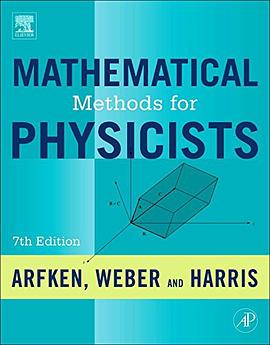
Now inits 7th edition, Mathematical Methods for Physicists continues to provide all the mathematical methods that aspiring scientists and engineers are likely to encounter as students and beginning researchers. This bestselling text provides mathematical relations and their proofs essential to the study of physics and related fields. While retaining thekey features of the 6th edition, the new edition provides a more careful balance of explanation, theory, and examples. Taking a problem-solving-skills approach to incorporating theorems with applications, the book's improved focus will help students succeed throughout their academic careers and well into their professions. Some notable enhancements include more refined and focused content in important topics, improved organization, updated notations, extensive explanations and intuitive exercise sets, a wider range of problem solutions, improvement in the placement, and a wider range of difficulty of exercises. Revised and updated version of the leading text in mathematical physics Focuses on problem-solving skills and active learning, offering numerous chapter problems Clearly identified definitions, theorems, and proofs promote clarity and understanding New to this edition: Improved modular chapters New up-to-date examples More intuitive explanations
作者简介
目录信息
1 Mathematical Preliminaries
1.1 Infinite Series
1.2 Series of Functions
1.3 Binomial Theorem
1.4 Mathematical Induction
1.5 Operations on Series Expansions of Functions
1.6 Some Important Series
1.7 Vectors
1.8 Complex Numbers and Functions
1.9 Derivatives and Extrema
1.10 Evaluation of Integrals
1.11 Dirac Delta Function
Additional Readings
2Determinants and Matrices
2.1 Determinants
2.2 Matrices
Additional Readings
3 Vector Analysis
3.1 Review of Basic Properties
3.2 Vectors in 3-D Space
3.3 Coordinate Transformations
3.4 Rotations in R3
3.5 Differential Vector Operators
3.6 Differential Vector Operators: Further Properties
3.7 Vector Integration
3.8 Integral Theorems
3.9 Potential Theory
3.10 Curvilinear Coordinates
Additional Readings
4 Tensors and Differential Forms
4.1 Tensor Analysis
4.2 Pseudotensors, Dual Tensors
4.3 Tensors in General Coordinates
4.4 Jacobians
4.5 Differential Forms
4.6 Differentiating Forms
4.7 Integrating Forms
Additional Readings
5 Vector Spaces
5.1 Vectors in Function Spaces
5.2 Gram-Schmidt Orthogonalization
5.3 Operators
5.4 Self-Adjoint Operators
5.5 Unitary Operators
5.6 Transformations of Operators
5.7 Invariants
5.8 Summary-Vector Space Notation
Additional Readings
6 Eigenvalue Problems
6.1 Eigenvalue Equations
6.2 Matrix Eigenvalue Problems
6.3 Hermitian Eigenvalue Problems
6.4 Hermitian Matrix Diagonalization
6.5 Normal Matrices
Additional Readings
7 Ordinary Differential Equations
7.1 Introduction
7.2 First-Order Equations
7.3 ODEs with Constant Coefficients
7.4 Second-Order Linear OD. Es
7.5 Series Solutions--Frobenius' Method
7.6 Other Solutions
7.7 Inhomogeneous Linear ODEs
7.8 Nonlinear Differential Equations
Additional Readings
8 Sturm-Liouville Theory
8.1 Introduction
8.2 Hermitian Operators
8.3 ODE Eigenvalue Problems
8.4 Variation Method
8.5 Summary, Eigenvalue Problems
Additional Readings
9 Partial Differential Equations
9.1 Introduction
9.2 First-Order Equations
9.3 Second-Order Equations
9.4 Separation of Variables
9.5 Laplace and Poisson Equations
9.6 Wave Equation
9.7 Heat-Flow, or Diffusion PDE
9.8 Summary
Additional Readings
10 Green's Functions
10.1 One-Dimensional Problems
10.2 Problems in Two and Three Dimensions
Additional Readings
11 Complex Variable Theory
11.1 Complex Variables and Functions
11.2 Cauchy-Riemann Conditions
11.3 Cauchy's Integral Theorem
11.4 Cauchy ' s Integral Formula
11.5 Laurent Expansion
11.6 Singularities
11.7 Calculus of Residues
11.8 Evaluation of Definite Integrals
11.9 Evaluation of Sums
11.10 Miscellaneous Topics
Additional Readings
12 Further Topics in Analysis
12.1 Orthogonal Polynomials
12.2 Bernoulli Numbers
12.3 Euler-Maclaurin Integration Formula
12.4 Dirichlet Series
12.5 Infinite Products
12.6 Asymptotic Series
12.7 Method of Steepest Descents
12.8 Dispersion Relations
Additional Readings
13 Gamma Function
13.1 Definitions, Properties
13.2 Digamma and Polygamma Functions
13,3 The Beta Function
13.4 Stirling's Series
13.5 Riemann Zeta Function
13.6 Other Related Functions
Additional Readings
14 Bessel Functions
14.1 Bessel Functions of the First Kind, Jv (x)
14.2 Orthogonality
14.3 Neumann Functions, Bessel Functions of the Second Kind
14.4 HankeI Functions
14.5 Modified Bessel Functions, Ir(x) and Ky(x)
14.6 Asymptotic Expansions
14.7 Spherical Bessel Functions
Additional Readings
15 Legendre Functions
15.1 Legendre Polynomials
15.2 Orthogonality
15.3 Physical Interpretation of Generating Function
15.4 Associated Legendre Equation
15.5 Spherical Harmonics
15.6 Legendre Functions of the Second Kind
Additional Readings
16 Angular Momentum
16.1 Angular Momentum Operators
16.2 Angular Momentum Coupling
16.3 Spherical Tensors
16.4 Vector Spherical Harmonics
Additional Readings
17 Group Theory
17.1 Introduction to Group Theory
17.2 Representation of Groups
17.3 Symmetry and Physics
17.4 Discrete Groups
17.5 Direct Products
17.6 Symmetric Group
17.7 Continuous Groups
17.8 Lorentz Group
17.9 Lorentz Covariance of Maxwell's Equations
17.10 Space Groups
Additional Readings
18 More Special Functions
18.1 Hermite Functions
18.2 Applications of Hermite Functions
18.3 Laguerre Functions
18.4 Chebyshev Polynomials
18.5 Hypergeometric Functions
18.6 Confluent Hypergeometric Functions
18,7 Dilogarithm
18.8 Elliptic Integrals
Additional Readings
19 Fourier Series
19.1 General Properties
19.2 Applications of Fourier Series
19.3 Gibbs Phenomenon
Additional Readings
20 Integral Transforms
20.1 Introduction
20.2 Fourier Transform
20.3 Properties of Fourier Transforms
20.4 Fourier Convolution Theorem
20.5 Signal-Processing Applications
20.6 Discrete Fourier Transform
20.7 Laplace Transforms
20.8 Properties of Laplace Transforms
20.9 Laplace Convolution Theorem
20.10 Inverse Laplace Transform
Additional Readings
21 Integral Equations
21.1 Introduction
21.2 Some Special Methods
21.3 Neumann Series
21.4 Hilbert-Schmidt Theory
Additional Readings
22 Calculus of Variations
22.1 Euler Equation
22.2 More General Variations
22.3 Constrained Minima/Maxima
22.4 Variation with Constraints
Additional Readings
23 Probability and Statistics
23.1 Probability: Definitions, Simple Properties
23.2 Random Variables
23.3 Binomial Distribution
23.4 Poisson Distribution
23.5 Gauss' Normal Distribution
23.6 Transformations of Random Variables
23.7 Statistics
Additional Readings
Index
· · · · · · (收起)
读后感
Arfken的这本数理方法应列为物理系本科生必备工具书,研究僧也可以拿来做字典用。强烈安利。内容丰富,前后连贯,解释简明清晰,数学思维明显,正好可以和国内偏重计算的课本优势互补,而且世图出的外文书真心实惠。对起步者非常友好--学过微积分和线性代数外加一点特殊函数的...
Arfken的这本数理方法应列为物理系本科生必备工具书,研究僧也可以拿来做字典用。强烈安利。内容丰富,前后连贯,解释简明清晰,数学思维明显,正好可以和国内偏重计算的课本优势互补,而且世图出的外文书真心实惠。对起步者非常友好--学过微积分和线性代数外加一点特殊函数的...
Arfken的这本数理方法应列为物理系本科生必备工具书,研究僧也可以拿来做字典用。强烈安利。内容丰富,前后连贯,解释简明清晰,数学思维明显,正好可以和国内偏重计算的课本优势互补,而且世图出的外文书真心实惠。对起步者非常友好--学过微积分和线性代数外加一点特殊函数的...
Arfken的这本数理方法应列为物理系本科生必备工具书,研究僧也可以拿来做字典用。强烈安利。内容丰富,前后连贯,解释简明清晰,数学思维明显,正好可以和国内偏重计算的课本优势互补,而且世图出的外文书真心实惠。对起步者非常友好--学过微积分和线性代数外加一点特殊函数的...
Arfken的这本数理方法应列为物理系本科生必备工具书,研究僧也可以拿来做字典用。强烈安利。内容丰富,前后连贯,解释简明清晰,数学思维明显,正好可以和国内偏重计算的课本优势互补,而且世图出的外文书真心实惠。对起步者非常友好--学过微积分和线性代数外加一点特殊函数的...
用户评价
这本泛黄的精装书,厚重得像块砖头,封面上那些密密麻麻的希腊字母和复杂的公式,初见时就让人心头一紧,仿佛预示着一场艰苦卓绝的智力拉锯战。我花了整整一个周末才啃完前三章的绪论部分,发现它绝非那种“一看就懂”的科普读物,更像是一本为“硬核”物理学生定制的武功秘籍。作者似乎对初学者的困惑抱有一种近乎残酷的自信,直接将读者抛入了高深的数学海洋,没有太多拐弯抹角的铺垫。比如,在处理傅里叶级数展开时,对收敛性的讨论几乎是蜻蜓点水,直接跳到了复杂的应用案例,这对于我这种数学基础稍弱,更偏爱直观理解的人来说,简直是灾难。我不得不频繁地翻阅隔壁那本《高等数学精讲》,才能勉强跟上它的节奏。书中的例题设计得非常巧妙,但同时也极为刁钻,往往需要融合好几个章节的知识点才能解开。我记得有道关于亥姆霍兹方程的边界值问题的习题,光是边界条件的设置就让我冥思苦想了半天,最后发现漏掉了一个非常微妙的物理假设,真是让人哭笑不得。总而言之,这是一本需要时间、耐心和强大数学背景才能真正驾驭的工具书,它挑战性十足,但阅读体验更像是攀登一座陡峭的山峰,每进一步都伴随着肌肉的酸痛感。
我拿到这本教材时,是抱着“终于找到一本能把我数学功底拉上去的救星”的心态的。这本书的结构安排着实令人耳目一新,它没有采用传统的“数学概念先行,物理应用殿后”的模式,而是采取了一种非常“物理导向”的叙事方式。它似乎认为,对于物理学家而言,数学工具的价值在于解决具体问题,而不是纯粹的理论推导。这种编排的好处是,你总能立刻看到一个新数学技巧是如何服务于某个具体的物理模型,比如拉普拉斯算子在直角坐标系、柱坐标系和球坐标系下的完备展开,是紧密围绕着静电学和量子力学中的经典势场问题来讲解的。然而,这种“为应用服务”的特性也带来了一个小小的副作用:对于那些想深入探究数学本身严谨性的读者来说,这本书的“证明”部分往往显得过于精简甚至有些粗糙。它更像是一个经验丰富的导师在黑板上快速勾勒出解决问题的路径,而不是一份详尽的学术论文。当我试图从这本书中寻找更深层次的数学原理时,我经常会发现作者已经替我“跳”过了那几步,留下一句“通过标准方法可证”的批注。这让我感觉自己像个熟练的维修工,知道如何使用工具,却未必完全理解工具的内部构造。对于那些想做理论研究的后辈来说,可能还需要搭配一本更侧重于数学严谨性的原著作为补充。
我个人对这本书最欣赏的一点,在于它对物理图像和数学形式的无缝切换能力。它不满足于仅仅罗列公式,而是始终在努力建立起两者间的桥梁。例如,在讲解狄拉克符号(Bra-Ket Notation)时,作者并没有像某些教科书那样,把它视为一个独立的数学概念来引入,而是直接将其置于量子态的线性代数表达中,通过对算符作用的讨论,自然而然地引出了它在计算中的强大威力。这种“情境化”的学习方式,极大地增强了我的学习动力。我感觉我不是在学习数学,而是在学习如何用数学来“看穿”物理世界的本质。书中对于群论在角动量理论中的应用,尤其体现了这种深刻的洞察力,它清晰地展示了对称性如何约束了物理系统的可能行为,这种宏观的理解比单纯的矩阵对角化要深刻得多。虽然计算过程依然复杂,但每当解出一个漂亮的结果,那种“啊,原来是这样!”的顿悟感,完全值回了所有的枯燥时光。这本书成功地将冰冷的数学工具赋予了生动的物理灵魂,让复杂的计算不再是目的,而是通往更深层物理洞察的手段。
这本书的排版和印刷质量简直是一场视觉上的灾难,简直就是对“实用主义至上”的完美诠释。纸张的质感粗糙得像是回收材料,油墨的浓淡似乎是随机分布的,导致有些公式的上下标几乎要与正文融为一体,尤其是在那些复杂积分符号和张量指标交错出现的地方,辨识度极低。我不得不经常戴上老花镜,凑得很近,才能准确无误地抄写下一个微分符号。更要命的是,似乎校对工作也十分草率,我至今已经发现了至少五处明显的印刷错误——要么是一个负号写成了正号,要么是一个希腊字母被印成了拉丁字母。虽然这些错误在上下文逻辑中大多可以被纠正,但在第一次遇到时,足以让人在深夜的灯光下怀疑自己是不是数学水平退化了。这种对细节的漠视,对于一本宣称是“方法论”的书籍来说,是极其不负责任的。读者花费了大量的时间和精力去理解抽象的概念,结果却要花费额外的、令人恼火的时间去与这些低级的印刷缺陷作斗争。希望未来的再版能够彻底更换印刷厂,至少把墨水调匀一点。
坦白地说,这本书的难度曲线非常陡峭,而且非常不平衡。前三分之一的内容,关于微分方程和级数解的部分,可以说是讲解得相当详尽和扎实,每一步推导都清晰可循,即便是像变分法这样的高级主题,作者也用费曼图式的直观解释开辟了一条相对平坦的道路,让人信心倍增。然而,一旦进入到后半部分——特别是涉及广义相对论预备知识和更复杂的场论方法时,书本的风格仿佛瞬间切换成了另一位作者的作品。推导变得极其跳跃,许多关键的坐标变换和张量分析被一笔带过,留给读者的只有结果和一堆需要读者自己去填充的空白。我阅读到关于黎曼曲率张量的部分时,感觉自己像是被直接从“欧几里得平面”扔进了“非欧几里得空间”,没有任何缓冲。这使得这本书的整体实用性打了个折扣——它非常适合那些在课堂上已经接受了大量基础训练,只想找一本“参考手册”来快速复习特定高级方法的学生,但对于自学,尤其是在后期内容上,它显得有些高冷和疏远。总而言之,它是一把双刃剑,前半段是良师益友,后半段则更像是一个需要你拥有高超技巧才能驾驭的超级工具。
本科大三就該學完的水平,甚至不到。這能寫出1200頁的書來實在不可思議。
本来就是部大全,本科三年级就能全会?呵呵,普通的本科三年级可不行,至于讨论优秀的没有意义,人家毕业论文可以对赛博格胃疼理论写综述了,杰出的如Donaldson大二都干了啥?这是第七版了,这么多年来增补得很不错 比hassani的要好。
本来就是部大全,本科三年级就能全会?呵呵,普通的本科三年级可不行,至于讨论优秀的没有意义,人家毕业论文可以对赛博格胃疼理论写综述了,杰出的如Donaldson大二都干了啥?这是第七版了,这么多年来增补得很不错 比hassani的要好。
还不错吧 讲得不是很细 但也算挺全了
还不错吧 讲得不是很细 但也算挺全了