
具体描述
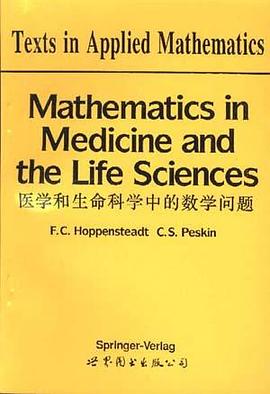
Mathematical Biology is the study of medicine and the life sciences that uses mathematical models to help predict and interpret what we observe. This book describes several major contributions that have been made to population biology and to physiology by such theoretical work. We have tried to keep the presentation brief to keep the price of the book as reasonable as possible, and to ensure that the topics are presented at a level that is accessible to a wide audience. Each topic could serve as a launching point for more advanced study, and suitable references are suggested to help with this. If the underlying mathematics is understood for these basic examples. then mathematical aspects of more advanced life science preblems will be within reach.
本书为英文版。
作者简介
目录信息
Series Preface
Preface
Introduction
1 The Mathematics of Populations: Demographics
1.1. Geometric Population Growth
1.1.1. Growth of Bacterial Cultures
1.1.2. Least-Squares Estimation of the Growth Rate
1.1.3. Growth of Human Populations
1.1.4. Infinitesimal Sampling Intervals and Doubling Times
1.2. Geometric Growth in a Population Stratified by Age
1.2.1. Fibonacci's Rabbit Population
1.2.2. Euler's Renewal Equations
1.2.3. Age Structure in Human Popnlations
1.3. The Limits of Growth
1.3.1. Verhulst's Model
1.3.2. Predator Satiation
1.3.3. Chaos
1.3.4. Infimtesimal Sampling Intervals in
a Limiting Environment
1.4. Age Structure of Populations near
the Limits of Growth
1.5. Harvesting
1.6. Summary
1.7. Annotated References
Exercises
2 Inheritance
2.1. Mendel's Laws
2.2. Bacterial Genetics: Plasmids
2.3. Genetics in Small Populations of Human.
2.4. The Hardy-Weinberg Equilibrium
2.5. Summary
2.6. Annotated References
Exercises
3 A Theory of Epidemics
3.1. Spread of Infection within a Family
3.2. The Threshold of an Epidemic
3.3. Calculation of the Severity of an Epidemic
3.4. Summary
3.5. Annotated References
Exercises
4 Biogeography
4.1. TheGameofLife.
4.2. Random Walks
4.3. The Diffusion Apprcndmation
4.4. The Growth of Bacteria on Plates
4.5. Another View of Random Walks
4.6. Summary
4.7. Annotated References
Exercises
5 The Heart and Circulation
5.1. Plan of the Circulation
5.2. Volume, Flow, and Pressure
5.3. Resistance and Compliance Vessels
5.4. The Heart as a Pair of Pumps
5.5. Mathematical Model of the
Uncontrolled Circulation
5.6. Balancing the Two Sides of the Heart and
the Two Circulations
5.7. Cardiac Output and Arterial Blood Pressure:
The Need for Extemal Circulatory Control Mechanisms
5.8. Neural Control: The Baroreceptor Loop
5.9. Autoregulation
5.10. Changes in the Circulation Occurring at Birth
5.11. Dynamics of the Arterial Pulse
5.12. Annotated References,
Exercises
6 Gas Exchange in the Lungs
6.1. The Ideal Gas Law and the Solubility of Gases
6.2. The Equations of Gas Transport in One Alveolus.
6.3. Gas Transport in the Lung
6.4. Optimal Gas TRansport
6.5. Mean Alveolar and Arterial Partial Pressures
6.6. Transport of O2
6.7. Annotated References
Exercises
7 Control of Cell Volume ana
the Electrical Properties of Cell Membranes
7.1. Osmotic Pressure and the Work of Concentration
7.2. A Simple Model of Cell Volume Control
7.3. The Movement of lons across Cell Membranes
7.4. Control of Cell Volume: The Interaction of
Electrical and Osmotic Effects
7.5. Transient Changes in Membrane Potential:
A Signaling Mechanism in Nerve and Muscle
7.6. Annotated References
Exercises
8 The Renal Countercurrent Mechanism
8.1. The Nephron
8.2. Differential Equations of Na+ and H2o Transport
along the Renal Tubules
8.3. The Loop of Henle
8.4. The Juxtaglomerular Apparatus and
the Renin-Angiotensin System
8.5. The Distal Tubule and Collecting Duct:
Concentrating and Diluting Modes
8.6. Remarks on the Significance of
the Juxtaglomerular Apparatus
8.7. Annotated References
Exercises
9 Muscle Mechanics
9.1. The Force-Velocity Curve
9.2. Cross-Bridge Dynamics
9.3. Annotated References
Exercises
10 Biological Clocks and Mechanisms
of Neural Control
10.1. A Theory of Clocks
10.1.1.The Clock on the Wall
10.1.2. Pbase Resetting: A Rubber Handed CIock
10.1.3. Modulated Clocks
10.2. Nerve Cell Membranes
10.2.1. Cell Membrane Potential
10.2.2. Guttman's Experiments
10.3. VCON: A Voltage Controlled Oscillator Neuron
10.3.1. Voltage Controlled Oscillators
10.3.2. Phase Comparators and a Model Synapse.
10.3.3. VCON: A Model Spike Generator
10.3.4. Phase Locking Properties of a VCON
10.4. Neural Control Networks
10.4.1. Network Nqtation
10.4.2. von Euler's Respiration Control Mechanism.
10.5. Summary
10.6. Annotated References
Exercises
Answers for Selected Exercises
Index
· · · · · · (收起)
读后感
用户评价
我希望这本书能够真正体现出“问题导向”的特点,而不是一本纯粹的数学教科书的附录。这意味着,它应该围绕生物学中那些尚未解决或存在争议的核心问题来组织内容。比如,当我们面对“老化”这样一个复杂的生物学现象时,数学模型能提供哪些不同的解释框架?是衰变模型,还是系统失稳模型?书中是否会对比不同数学模型在解释同一现象时的优缺点?另外,对于新兴的、对数学依赖性极强的领域,比如利用深度学习处理医学影像(如MRI、病理切片)的卷积神经网络(CNN)的内在工作原理,这本书能否提供数学层面的剖析,而不是仅仅停留在应用层面?我更想知道,这些深度学习模型的非线性激活函数背后的数学意义,以及梯度下降优化过程如何保证模型收敛到有生物学意义的解空间。一本优秀的跨学科著作,应当能激发读者进行新的数学建模尝试,而不是仅仅复述已有的成果。它应该是一块磨刀石,让读者锋利的数学思维能够更好地切割复杂的生命难题。
阅读体验上,我更偏好那种结构清晰、逻辑严密的论述方式。对于这种涉及多个学科背景的书籍,章节间的过渡和概念的引入顺序至关重要。我希望看到它能从最基础的微积分和线性代数概念入手,然后逐步过渡到更专业的领域,比如偏微分方程在组织工程和生物力学中的应用。想象一下,描述骨骼在不同应力下的形变,或者流体动力学在血液循环中的作用,这些都需要对场方程有深刻的理解。这本书如果能在每个关键的数学概念后,立即跟进一个具体的生物学实例来巩固理解,将大大提高学习效率。例如,讲解矩阵分解时,能否直接关联到主成分分析(PCA)在降维处理大量蛋白质组数据时的表现?更进一步,如果它能包含一些现代计算数学的视角,比如如何利用有限元方法(FEM)对人体器官进行模拟和预测,那就更符合当前工程生物学的趋势了。这本书的价值,很大程度上取决于它能否将这些“高大上”的数学工具,转化为可操作的、能解决实际生物学难题的方法论。
当我翻开这本书时,内心充满了对跨学科知识交汇的渴望,尤其是对生物统计学在现代医学研究中角色的深入探讨。我希望能看到关于生存分析(如Kaplan-Meier估计和Cox比例风险模型)的详尽讲解,不仅仅是公式的堆砌,而是对这些模型在临床试验数据解释中的实际应用和潜在偏倚的批判性分析。比如,在评估一种新疗法是否延长了患者的预期寿命时,如何正确地处理失访率和安慰剂效应,这些都是需要扎实数学基础支撑的实践问题。此外,对于生物信息学领域,我对如何利用概率图模型,如贝叶斯网络,来推断基因调控网络或代谢通路间的复杂依赖关系很感兴趣。这本书如果能提供一个从基础概率论到高级因果推断的完整路径图,帮助读者辨识实验设计中的随机误差和系统误差,那它就不仅仅是一本参考书,更像是一个思维训练的工具。我期望的不是浅尝辄止的介绍,而是那种能让我合上书本后,面对真实数据时,能够自主选择并恰当应用数学工具的深度。
这本《医学和生命科学中的数学问题》的书,坦白说,我期待它能深入剖析那些将抽象的数学模型与复杂的生物现象紧密联系起来的案例。我原以为会看到大量关于微分方程在疾病传播动力学中的应用,比如SIR模型的精细推导和参数估计,毕竟在面对传染病爆发时,这种数学工具是不可或缺的。我也很想了解,在高维度的基因表达数据分析中,机器学习和统计推断是如何构建预测模型的,特别是对于癌症分型和药物靶点发现的最新进展。如果书中能提供足够详实的案例研究,展示如何从实际的临床数据中提取有意义的数学见解,那就太棒了。例如,探讨如何用拓扑数据分析来理解蛋白质折叠的复杂结构,或者如何利用随机过程模型来模拟细胞内信号传导的随机性,这些都是我非常感兴趣的领域。对我来说,一本好的教材不仅要展示公式,更要展示公式背后的生物学逻辑和实际的解决问题的过程。如果它能提供足够的背景知识,让非数学专业的生命科学家也能理解那些高级的数学工具的适用范围和局限性,那就更具价值了。期待它能成为连接实验室和理论分析的坚实桥梁。
从一个更侧重于基础科学研究的角度来看,我对这本书在阐述随机过程和信息论在分子生物学中的应用给予厚望。例如,细胞如何通过随机的分子碰撞和反应来执行复杂的决策过程,这完全可以用马尔可夫链或布朗运动来建模。如果书中能详尽地探讨化学反应速率方程与随机涨落的关系,特别是对于那些只有少数分子参与的反应,那将非常有启发性。此外,香农信息论在分析DNA序列的冗余度、基因信息的存储和传递效率方面有着巨大的潜力。我期待看到如何用熵和互信息来量化生物系统中信息的含量和传输效率。这本书如果能以一种严谨而不失趣味性的方式,引导读者思考生物系统如何巧妙地利用概率和信息来克服分子层面的不确定性,那么它无疑是一部杰作。它需要展示出数学语言如何能够精确地捕捉到生命活动中那种内在的、微妙的平衡与动态。