
具体描述
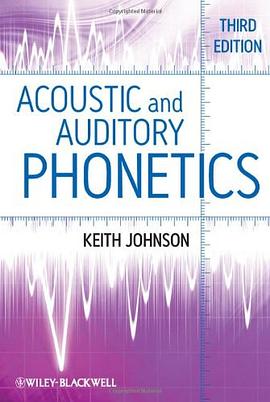
Fully revised and expanded, the third edition of Acoustic and Auditory Phonetics maintains a balance of accessibility and scholarly rigor to provide students with a complete introduction to the physics of speech. Newly updated to reflect the latest advances in the field Features a balanced and student-friendly approach to speech, with engaging side-bars on related topics Includes suggested readings and exercises designed to review and expand upon the material in each chapter, complete with selected answers Presents a new chapter on speech perception that addresses theoretical issues and well as practical concerns
作者简介
目录信息
Introduction.
Part I Fundamentals.
1 Basic Acoustics and Acoustic Filters.
1.1 The Sensation of Sound.
1.2 The Propagation of Sound.
1.3 Types of Sounds.
1.3.1 Simple periodic waves.
1.3.2 Complex periodic waves.
1.3.3 Aperiodic waves.
1.4 Acoustic Filters.
Recommended Reading.
Exercises.
2 The Acoustic Theory of Speech Production: Deriving Schwa.
2.1 Voicing.
2.2 Voicing Quanta.
2.3 Vocal Tract Filtering.
2.4 Pendulums, Standing Waves, and Vowel Formants.
2.5 Discovering Nodes and Antinodes in an Acoustic Tube.
Recommended Reading.
Exercises.
3 Digital Signal Processing.
3.1 Continuous versus Discrete Signals.
3.2 Analog-to-Digital Conversion.
3.2.1 Sampling.
3.2.2 Quantization.
3.3 Signal Analysis Methods.
3.3.1 RMS amplitude.
3.3.2 Fast Fourier transform (FFT).
3.3.3 Auto-correlation pitch tracking.
3.3.4 Digital filters.
3.3.5 Linear predictive coding (LPC).
3.3.6 Spectra and spectrograms.
Recommended Reading.
Exercises.
4 Basic Audition.
4.1 Anatomy of the Peripheral Auditory System.
4.2 The Auditory Sensation of Loudness.
4.3 Frequency Response of the Auditory System.
4.4 Saturation and Masking.
4.5 Auditory Representations.
Rcommended Reading.
Exercises.
5 Speech Perception.
5.1 Auditory Ability Shapes Speech Perception.
5.2 Phonetic Knowledge Shapes Speech Perception.
5.2.1 Categorical perception.
5.2.2 Phonetic coherence.
5.3 Linguistic Knowledge Shapes Speech Perception.
5.4 Perceptual Similarity.
5.4.1 Maps from distances.
5.4.2 The perceptual map of fricatives.
Recommended Reading.
Exercises.
Part II Speech Analysis.
6 Vowels.
6.1 Tube Models of Vowel Production.
6.2 Perturbation Theory.
6.3 “Preferred” Vowels – Quantal Theory and Adaptive Dispersion.
6.4 Vowel Formants and the Acoustic Vowel Space.
6.5 Auditory and Acoustic Representations of Vowels.
6.6 Cross-linguistic Vowel Perception.
Recommended Reading.
Exercises.
7 Fricatives.
7.1 Turbulence.
7.2 Place of Articulation in Fricatives.
7.3 Quantal Theory and Fricatives.
7.4 Fricative Auditory Spectra.
7.5 Dimensions of Fricative Perception.
Recommended Reading.
Exercises.
8 Stops and Affricates.
8.1 Source Functions For Stops and Affricates.
8.1.1 Phonation types.
8.1.2 Sound sources in stops and affricates.
8.2 Vocal Tract Filter Functions in Stops.
8.3 Affricates.
8.4 Auditory Properties of Stops.
8.5 Stop Perception in Different Vowel Contexts.
Recommended Reading.
Exercises.
9 Nasals and Laterals.
9.1 Bandwidth.
9.2 Nasal Stops.
9.3 Laterals.
9.4 Nasalization.
9.5 Nasal Consonant Perception.
Recommended Reading.
Exercises.
References.
Answers to Selected Short-answer Questions.
Index.
· · · · · · (收起)
读后感
用户评价
挺烂的,尤其是信号处理那部分,排版太差老是要翻来翻去的,图/实际应用太少。建议直接读lyons和shaughnessy的,这种想要什么都涉及的小书是非常难写的,觉得作者没什么天分写书,看了他好几本了,读起来都很涩
想来想去,还是给4分,为什么?因为可能没有工程系的人愿意给学语言的我们写一本这样通俗易懂的书。谈到了很多科学方法,也开眼界,一般的语音学文献反正不会达到这个深度的。auditory只是每章结尾一页带过,有点不厚道。书写的太薄啦! Johnson大神,体量再增加150页,谈谈那些方法怎么样简单地实现,我相信这本书就会是这时代的航灯了。
比起之前读第二版的时候,这一版读得更细。总觉得这本书太atechnical,基本上所有术语都没有给出科学定义,以至于练习中sufficient jargon部分几乎全部要自己去查资料才能找到准确定义。不过这本书最值得推荐的是每一章后面recommended reading不仅仅列出文献,还很贴心地写了annotation,使得每一篇文献的地位更加清楚,也方便读者快速找到对自己价值最大的经典文献。selected answer嘛,select得比较玄学就是了……
太浅了
Speech perception部分偏少。










![Spanish II, 3rd Ed. (Compr.) [CD] pdf epub mobi 电子书 下载](https://doubookpic.tinynews.org/e93395cf4301e52b07ec1a2f62c53bf9674a479dc583616726c845eaeccc6b91/s2882582.jpg)