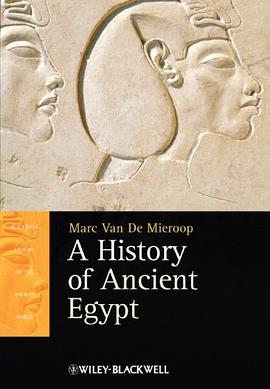

具体描述
Outlining the major political and cultural events, A History of Ancient Egypt is an authoritative and accessible introduction to this fascinating ancient culture.
An accessible chronological narrative that draws on a range of historical sources
Offers an up-to-date survey of ancient Egypt’s history from its origins to its domination by the Roman Empire
Considers social and economic life and the rich culture of ancient Egypt
Places Egypt’s history within its regional context, detailing interactions with Asia and Africa
Engages students with various perspectives on a range of critical issues with the Key Debate section included in each chapter
Makes the latest discoveries and scholarship accessible to a wide audience
作者简介
Marc Van De Mieroop is Professor of History at Columbia University. He is the author and editor of numerous publications on the Ancient Near East and ancient Egypt, including A History of the Ancient Near East, ca. 3000 - 323 B.C., 2nd edition (Wiley-Blackwell, 2007), The Eastern Mediterranean in the Age of Ramesses II (Wiley-Blackwell, 2007) and King Hammurabi of Babylon (Wiley-Blackwell, 2005).
目录信息
List of Color Plates xvi
List of Maps xvii
List of Boxed Texts xviii
List of Summaries of Dynastic History xx
Preface xxi
1 Introductory Concerns 1
1.1 What Is Ancient Egypt? 1
Chronological boundaries 1
Geographical boundaries 3
What is ancient Egyptian history? 4
Who are the ancient Egyptians? 5
1.2 Egypt’s Geography 7
The Nile River 7
The desert 8
Climate 10
Frontiers and links 10
1.3 The Makeup of Egyptian Historical Sources 10
Papyri and ostraca 11
Monumental inscriptions 13
Historical criticism 13
1.4 The Egyptians and Their Past 14
King lists 14
Egyptian concepts of kingship 18
1.5 The Chronology of Egyptian History 19
Modern subdivisions of Egyptian history 19
Absolute chronology 20
1.6 Prehistoric Developments 21
The beginning of agriculture 21
Naqada I and II periods 23
2 The Formation of the Egyptian State (ca. 3400–2686) 27
2.1 Sources 30
2.2 Royal Cemeteries and Cities 31
The Late Naqada culture 31
Dynasty 0 32
2.3 The First Kings 33
Images of war 33
The unification of Egypt 35
2.4 Ideological Foundations of the New State 36
Kings 36
Cemeteries 37
Festivals 37
Royal annals and year names 38
Gods and cults 39
Bureaucracy 40
2.5 The Invention of Writing 42
Precursors at Abydos 43
Hieroglyphic script 43
2.6 Foreign Relations 47
The Uruk culture of Babylonia 47
Late-fourth-millennium Nubia 48
Late-fourth-millennium Palestine 49
3 The Great Pyramid Builders (ca. 2686–2345) 52
3.1 Sources 53
3.2 The Evolution of the Mortuary Complex 55
Djoser’s step pyramid at Saqqara 56
Sneferu’s three pyramids 57
The Great Pyramids at Giza 58
Solar temples of the 5th dynasty 61
3.3 Administrating the Old Kingdom State 62
Neferirkara’s archive at Abusir 62
Officialdom 64
3.4 Ideological Debates? 66
Problems of royal succession 67
The gods Horus and Ra 69
3.5 Foreign Relations 71
Contacts with Nubia 71
Contacts with Asia 71
3.6 Later Traditions about the Old Kingdom 73
Djoser and Imhotep 73
Sneferu 74
The Great Pyramid builders 74
4 The End of the Old Kingdom and the First Intermediate Period (ca. 2345–2055) 78
4.1 Sources 79
4.2 The Rise of the Regions and Political Fragmentation 80
Nomes and nomarchs 80
Mortuary texts 81
Officials’ biographies 84
Pepy II 84
Why did the Old Kingdom dissolve? 86
4.3 Foreign Relations 88
Nubian independence 88
Beyond the Nile Valley 91
Mercenaries 91
4.4 Competition between Herakleopolis and Thebes 93
Herakleopolis 93
Thebes 93
4.5 Appraising the First Intermediate Period 94
Middle Kingdom literary refl ections 94
Historical critique 95
5 The Middle Kingdom (ca. 2055–1650) 97
5.1 Sources and Chronology 98
5.2 Kings and Regional Elites 100
Reunification and the 11th dynasty 100
The start of the 12th dynasty and the foundation of Itj-tawi 101
Provincial powers in the early Middle Kingdom 103
Royal interference in the provinces 104
Administrative centralization 106
Royal power in the 13th dynasty 107
5.3 Kings as Warriors 108
The annexation of Nubia 112
5.4 Egypt in the Wider World 114
The early Kingdom of Kush 114
The eastern desert and Sinai 115
Syria and Palestine 117
The world beyond 117
Rhetoric and practice in foreign relations 118
5.5 The Cult of Osiris 120
5.6 Middle Kingdom Literature and Its Impact on
Egyptian Culture 121
6 The Second Intermediate Period and the Hyksos (ca. 1700–1550) 126
6.1 Sources and Chronology 127
6.2 Avaris: The Multiple Transformations of a Delta City 128
A history of Avaris 128
Cultural hybridity 129
Other immigrants 131
6.3 The Hyksos 131
The name Hyksos 131
Hyksos origins 132
Egyptian cultural influences 132
Political history 134
The 14th and 16th dynasties 135
Hyksos rule in Palestine? 135
6.4 Nubia and the Kingdom of Kush 136
The independence of Lower Nubia 136
The Kingdom of Kush 136
Kerma 137
The extent of the Kingdom of Kush 140
6.5 Thebes in the Middle 141
Royal tombs 141
Seqenenra Taa 142
Kamose’s war 143
6.6 The Hyksos in Later Perspective 144
Queen Hatshepsut 144
The gods Ra and Seth 145
Manetho and Josephus 147
7 The Birth of Empire: The Early 18th Dynasty (ca. 1550–1390) 151
7.1 Egypt in a New World Order 154
7.2 Sources and Chronology 155
7.3 Egypt at War 157
War and society in the New Kingdom 157
The “war of liberation” 159
The annexation of Nubia 161
Wars in western Asia 164
7.4 Egypt and the Outside World 167
7.5 Domestic Issues 169
Royal succession 169
Hatshepsut 171
Royal mortuary customs 175
New Kingdom bureaucracy 177
Building activity in the early 18th dynasty 180
8 The Amarna Revolution and the Late 18th Dynasty (ca. 1390–1295) 184
8.1 An International Age 186
The Club of the Great Powers 187
The administration of Syria and Palestine 189
The rise of the Hittites 191
A failed marriage alliance 191
8.2 Amenhotep III: The Sun King 192
Amenhotep III’s divinity and his building projects 193
The king’s family 196
The king’s court 197
8.3 From Amenhotep III to Amenhotep IV/Akhenaten 199
8.4 Akhenaten 200
Theban years (years 1 to 5) 200
Akhetaten (years 5 to 12) 202
Turmoil (years 12 to 17) 206
Akhenaten’s successors 206
8.5 Akhenaten’s Memory 209
9 The Ramessid Empire (ca. 1295–1203) 213
9.1 Domestic Policy: Restoration and Renewal 215
Sety I 215
Rameses II 216
9.2 International Relations: Reforming the Empire 219
Wars in Syria 219
Egyptian–Hittite peace 222
A new imperial structure 223
Foreigners in Egypt 225
9.3 Rameses’s Court 227
Officials 227
The royal family 230
9.4 A Community of Tomb Builders 233
10 The End of Empire (ca. 1213–1070) 240
10.1 Problems at Court 242
Sety II and Amenmessu 242
Saptah and Tausret 243
Sethnakht 244
10.2 Breakdown of Order 245
Tomb robberies 245
Workers’ strikes 247
10.3 The Decline of Royal Power 247
10.4 Pressures from Abroad 250
Libyans and Sea Peoples 250
The end of the international system 255
10.5 End of the New Kingdom 256
11 The Third Intermediate Period (ca. 1069–715) 260
11.1 Sources and Chronology 261
11.2 Twin Cities: Thebes and Tanis (the 21st dynasty, 1069–945) 264
Thebes 265
Tanis 267
The concordat 269
11.3 Libyan Rule (22nd to 24th dynasties, 945–715) 272
Centralization and diffusion of power 272
The God’s Wife of Amun 274
11.4 The End of the Third Intermediate Period 276
Nubian resurgence 276
Saite expansion 278
12 Egypt in the Age of Empires (ca. 715–332) 283
12.1 Sources and Chronology 284
12.2 The Eastern Mediterranean in the First Millennium 286
12.3 Egypt, Kush, and Assyria (ca. 715–656) 290
Military incidents 290
12.4 Egypt, Greeks, and Babylonians (656–525) 295
Greek–Egyptian relations 295
Military activity 299
12.5 Recollections of the Past under the Kings of Kush and Sais 300
12.6 Egypt and Persia (525–332) 304
Domination and resistance 305
Mixing cultures 310
13 Greek and Roman Egypt (332 BC–AD 395) 316
13.1 Sources and Chronology 317
13.2 Alexandria and Philae 319
Alexandria 319
Philae 322
13.3 Kings, Queens, and Emperors 325
The Ptolemies 325
Queen Cleopatra VII 327
Roman Egypt 328
13.4 Greeks, Romans, and Egyptians 329
Administration 329
Culture and religion 332
13.5 Economic Developments: Agriculture, Finance, and Trade 336
13.6 The African Hinterland 338
13.7 The Christianization of Egypt 341
Epilogue 344
Guide to Further Reading 346
Glossary 358
King List 362
Bibliography 368
Index 387
· · · · · · (收起)
读后感
用户评价
我必须说,这本书对于任何对古埃及历史感兴趣的人来说,都是一份不可多得的宝藏。作者的功底非常扎实,引用了大量的考古发现和历史文献,使得书中的论述既有学术深度,又不失趣味性。我特别欣赏他对古埃及政治斗争和王朝更迭的细致梳理,从早期王朝的统一,到新王国时期的鼎盛,再到后期王朝的衰落,每一个时期的特点和重要事件都得到了清晰的呈现。书中关于阿肯那顿宗教改革的章节尤其引人入胜,那种挑战传统、追求创新的勇气,以及最终的失败,都充满了戏剧性。此外,作者对古埃及与周边文明的互动也有着独到的见解,比如他们与努比亚、赫梯、亚述等文明之间的交流与冲突,都深刻地影响了古埃及的历史进程。读这本书,我仿佛穿越了时空,置身于那个古老而又充满活力的国度。
坦白说,刚开始我以为这会是一本比较枯燥的历史学术著作,但这本书彻底颠覆了我的看法。作者的写作风格非常流畅,充满了人文关怀,他不仅仅是陈述事实,更是试图去理解和解读古埃及人的思想和情感。我被书中关于古埃及人对死亡的看法和丧葬习俗的描写深深吸引。那些精心制作的木乃伊、宏伟的陵墓,以及对来世的虔诚信仰,都展现了他们对生命的珍视和对永恒的渴望。书中关于古埃及艺术的章节也让我大开眼界,那些壁画、雕塑和珠宝,无不展现出他们高超的艺术造诣和独特的审美情趣。它们不仅仅是艺术品,更是古埃及人精神世界的映射。阅读这本书,让我对古埃及文明有了更深层次的理解,不仅仅是历史事件,更是他们的灵魂和精神。
这本书就像是一扇通往古埃及辉煌文明的时光之门,让我沉醉其中,仿佛亲身经历着尼罗河畔的千年变迁。作者以细腻的笔触,勾勒出一幅幅生动的历史画卷:从金字塔的宏伟壮丽,到神庙的神秘庄严,再到法老的权势滔天,每一个细节都充满了历史的厚重感。阅读这本书的过程,就像是在与那些伟大的古埃及人对话,感受他们的智慧、信仰和生活方式。我尤其着迷于作者对古埃及宗教和神话的深入剖析,那些关于奥西里斯、伊西斯、荷鲁斯的故事,充满了哲思和象征意义,让我对人类早期对宇宙和生命的理解有了全新的认识。书中对古埃及文字,即象形文字的讲解也让我大开眼界,那些神秘的符号背后承载着丰富的历史信息,仿佛在低语着古老的故事。这本书不仅仅是一本历史书籍,更是一次心灵的洗礼,让我重新审视人类文明的起源和发展,感受历史的伟大与魅力。
这本书简直就是古埃及文明的百科全书!我之前对古埃及的了解非常有限,但读完这本书,我感觉自己仿佛成为了半个埃及学家。作者的知识储备非常渊博,几乎涵盖了古埃及文明的方方面面。我特别喜欢他对古埃及经济和贸易的描述,了解他们是如何利用尼罗河的丰饶土地,发展农业,以及如何与地中海沿岸的各个文明进行贸易往来。书中关于古埃及的社会分层和法律制度的介绍也让我大开眼界,让我看到了一个既有等级森严,又相对公平的社会体系。此外,作者对古埃及医学和卫生习惯的探讨也相当有趣,让人惊叹于古埃及人在这些领域取得的成就。总而言之,这本书信息量巨大,内容丰富,但又不会让人感到 overwhelming,阅读体验非常好。
这本关于古埃及的书,简直是一场知识的盛宴!作者的叙事风格非常吸引人,不是那种枯燥的说教,而是像一位博学的长者,娓娓道来那些遥远而又迷人的故事。我喜欢他对于古埃及社会结构的解读,从法老至高无上的地位,到祭司阶层的神秘力量,再到普通民众的日常生活,都描绘得淋漓尽致。特别是关于古埃及的法律和行政体系的介绍,让我看到了一个高度发达的古代文明是如何运转的,那种精密的组织和管理,即便在今天看来也令人赞叹。书中对古埃及科技的描述也让我印象深刻,例如他们精湛的建筑技术,是如何在没有现代机械的辅助下建造出如此宏伟的工程的,至今仍是一个谜团。还有他们对天文学和数学的掌握,也为后世留下了宝贵的遗产。这本书不仅满足了我对古埃及的好奇心,更让我对人类文明的发展充满了敬畏之情。
感覺還是牛津的那本比較好
有一处小小的技术性错误:p263,She(克里奥佩脱拉7) bore the Roman general(安东尼) twin boys and a daughter……这里的说法容易令人误解,事实上,赛琳娜和赫利俄斯才是twin。原文这种提法容易让人联想赫利俄斯和费拉德尔甫斯是twin
可怕
Mieroop一贯的好
Mieroop一贯的好