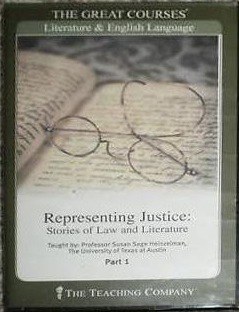

具体描述
Great literature can be the means of understanding as well as creating our world—by teaching and reinforcing society's laws, articulating its values, and enforcing the social contracts that unite us as a culture. What if literature itself generated our ideas and feelings about justice, marriage and family, property, authority, race, or gender? What if it enflamed our determination to pursue justice—or, conversely, undermined our ability to detect injustice?
What if law in all its variations—from religious commandments to oral tradition to codified statute—embraced its own narrative assumptions to the point of absorbing purely literary conventions as a means of more forcefully arguing its points in the legal arena?
And what if this dynamic relationship between written and unwritten laws and literature is constantly evolving? How do law and literature influence or reflect one other? And what lessons might we draw from their symbiotic relationship?
Representing Justice: Stories of Law and Literature is a provocative exploration of just such questions—an examination of the rhetorical and philosophical connections that link these two disciplines.
Mine the Riches of a New Scholarly Field
Professor Susan Sage Heinzelman, who has been honored many times for her teaching skills, is also president of the Association for the Study of Law, Culture, and the Humanities, and she brings to these lectures many years of thought and research into the roles of law and literature in society and culture and their relationship to one another.
She is especially concerned to break down the stereotypical definitions of these two disciplines: that literature is fictive and subjective, that is, persuasive on a primarily emotional level understood as the realm of the feminine, and that law is factual and objective, and thus primarily persuasive in the intellectual realm traditionally ascribed to the masculine.
Professor Heinzelman refers to the representation of culture, whether legal or literary, through language, image, symbol systems, and action. It is the intertwining of the stereotypical definitions that she untangles in these lectures, showing how each has contributed to creating our cultural beliefs and expectations "in similar ways—by offering us ways of imagining ourselves—both at our best and at our worst."
Professor Heinzelman's examination encompasses more than 3,000 years. It begins with the Old Testament—in which literature was law—and takes us through ancient Greece, the Middle Ages, England's experience of the Renaissance and the Enlightenment, and the 19th and 20th centuries. Focusing on works of literature that hold law, implicit or explicit, as a central theme—as well as on the overall relationship between law and literature in society—she shows how that relationship gradually transformed from the astoundingly intricate cross-connections between law and literature still present during the time of Shakespeare, to a point in the mid-18th century when the two disciplines separated more clearly into the distinct realms we recognize today.
Fresh Insights into Great Works and Their Eras
As Professor Heinzelman guides you through these great works, she shows how each reflects its times, and she offers fresh insights that can illuminate even those with which you may already be familiar. For example:
* In The Scarlet Letter , you'll see how a woman sentenced to a lifetime of community shame sets aside societal dictates to create a new standard of virtue for women.
* In the 1917 short story, A Jury of Her Peers, you'll see how a reporter covering a sensational turn-of-the-century murder trial would one day reconfigure the events of the case into a play and a short story that would dramatize the implications of all-male juries sitting in judgment on female defendants.
* And in Lolita, you'll see how a single literary work can challenge not only a society's written jurisprudence, but its unwritten moral codes, as well.
As presented by Professor Heinzelman, these and the other works explored in this course each present their own challenges, forcing you to re-evaluate the ways you read fiction, watch films and plays, or take in legal arguments. Indeed, you may never do any of these things the same way again.
About Your Professor
Susan Sage Heinzelman, Ph.D., is associate professor of English and Women's and Gender Studies at The University of Texas at Austin, where she has taught in both the English Department and the School of Law since receiving her doctorate from the University of Western Ontario in 1977. She specializes in 18th -century British literature; literary theory; and women, gender, and literature. The winner of many university teaching awards—most recently the President's Associates Teaching Award in 2003—Professor Heinzelman is also coeditor (with Zipporah Batshaw Wiseman) of Representing Women: Law, Literature, and Feminism (1994) and is the author of many articles on the representation of women in law and literature.
作者简介
Susan Sage Heinzelman
The University of Texas at Austin
Ph.D., University of Western Ontario
Susan Sage Heinzelman, Associate Professor of English and Women’s and Gender Studies, has been teaching at The University of Texas at Austin since 1977 in the English Department and the School of Law. She holds a Ph.D. from the University of Western Ontario.
Professor Heinzelman has won many university teaching awards, most recently the President’s Associates Teaching Award (2003). She is president of the Association for the Study of Law, Culture, and the Humanities.
She is co-editor (with Zipporah Batshaw Wiseman) of Representing Women: Law, Literature, and Feminism (1994) and author of many articles on the representation of women in law and literature, including “Black Letters and Black Rams: Fictionalizing Law and Legalizing Literature in Enlightenment England” in Law/Text/Culture (2002).
目录信息
读后感
用户评价
我必须承认,这本书初读时给我带来了一定的认知冲击。它似乎对那些被我们奉为圭臬的法律原则提出了温和但坚定的质疑。作者运用了一种非常独特的“反向论证”技巧,即通过讲述一系列看似微不足道,却最终指向系统性失衡的个人故事,来解构“公正”这一概念的公共叙事。那些故事里的配角,往往是推动情节发展或揭示深层主题的关键,他们的命运被置于显微镜下,使得读者不得不审视法律在执行层面产生的“噪音”和“偏差”。我印象特别深的是其中关于“程序正义”和“实体正义”之间永恒拉锯战的探讨,作者没有站在任何一方,而是巧妙地展示了两者如何相互消耗,最终可能导致共同的失败。这种不偏不倚的观察视角,需要极高的文学素养和深刻的社会洞察力才能达成,读完后,我对日常新闻中那些法律判决的理解维度,无疑被拓宽了许多层次。
阅读体验犹如经历一场精心编排的戏剧,节奏的把控令人拍案叫绝。开篇的几章,作者以一种近乎冷峻的笔触,描摹了法律制度从诞生之初就携带的某种内在矛盾——即如何用一套统一的规则去约束千差万别的个体经验。接着,叙事陡然加速,通过几个高强度的案例分析,将这些理论上的张力瞬间具象化为鲜活的冲突场景。最让我震撼的是,作者处理那些灰色地带的手法,没有给出任何轻易的答案,而是将球抛给了读者。这使得阅读过程充满了一种主动的参与感,我感觉自己不是在被动接受信息,而是在和作者共同探寻真理的碎片。书中的语言风格极为多变,时而古典,时而又夹杂着当代口语的锐利,这种混搭非但没有造成阅读障碍,反而增强了文本的生命力,仿佛作者在用最适合表达当下困境的“语态”来构建他的论点。总而言之,这是一部结构上极其饱满、阅读起来充满智力挑战的作品。
此书在情感张力上的拿捏堪称一绝,它成功地在保持学术讨论的严谨性与激发读者深层共情之间找到了一个近乎完美的平衡点。作者的叙事视角非常灵活,时而拉远成为一个冷静的社会观察者,时而又骤然拉近,以一种几乎第一人称的代入感去体验案件当事人的绝望与希望。特别是在处理那些涉及身份认同和边缘群体权利的部分时,那种细腻的笔触让人心头一紧,它清晰地揭示了法律体系在面对多元化现实时所表现出的滞后性和僵硬性。我读到一处关于“遗忘的法律”的论述,深感震撼,它提醒我们,每一次法律的修订或停滞,都意味着某些群体的存在感被剥夺或边缘化。这本书并非仅仅在讲述“发生了什么”,而是在探讨“为什么我们会选择以这种方式去判断和记录发生过的事实”,这是一种对人类集体意识的反思,深刻且发人深省,绝对是值得反复品读的佳作。
这本书的文体构造非常具有实验性,它似乎在挑战传统非虚构作品的边界。作者的笔调冷静克制,但其潜台词却汹涌澎湃。与其说这是一本探讨法律哲学的书,不如说它是一部关于“权力边界”的文学编年史。其中对历史案例的引用,不是为了简单地复述事实,而是将其作为一种象征符号,映射到当代语境中。更令人称奇的是,作者对“沉默”的处理——那些没有被记录在案的、未被法庭采纳的证词和情感,反而成为了推动全书主题深入的关键元素。我感觉自己被邀请进入了一个高度私密的空间,去目睹那些在宏大叙事下被磨平棱角的个体声音是如何努力发出的。文字的力量被发挥到了极致,每一个形容词的选择似乎都经过了千锤百炼,以确保其能精准地传达出那种难以言喻的、关于是非对错之间的微妙张力。
这部作品的叙事结构极其精巧,作者似乎在构建一个迷宫,引导读者在字里行间穿梭,每一次转折都伴随着对既有观念的微妙挑战。它不像传统意义上的法律文本那样严谨或教条,反倒更像是一部充满哲思的散文集,只不过其核心关乎“正义”这个宏大而又难以捉摸的概念。我尤其欣赏作者处理多重叙事线索的手法,那些看似不相关的个体命运,最终在某种形而上的力量牵引下,汇聚成一幅关于社会契约与道德困境的宏大图景。例如,其中关于某位地方检察官内心挣扎的描写,细腻入微,将法律条文冰冷的逻辑与人性的温热柔软进行了极富张力的对比,让人不禁反思,在追求“绝对正确”的过程中,我们究竟牺牲了多少“相对善意”。这种对复杂性的坦然呈现,使得本书超越了单纯的法律普及读物,上升到了文学与伦理学的探讨层面。它迫使读者慢下来,去咀嚼那些看似简单的判决背后蕴含的千年伦理难题,每一次阅读都像是在与古老的智慧进行一场跨越时空的对话。
2011.9.27 最近闲得发空,才开始填以前挖的这么多坑... 可能因为讲得太浅,听得异常的快。刚开始几课还挺有意思的,后来越来越臆想多于实质,文学鉴赏多于法制挖掘,毫无深度。还弄这么大一个标题... 很失望。
2011.9.27 最近闲得发空,才开始填以前挖的这么多坑... 可能因为讲得太浅,听得异常的快。刚开始几课还挺有意思的,后来越来越臆想多于实质,文学鉴赏多于法制挖掘,毫无深度。还弄这么大一个标题... 很失望。
2011.9.27 最近闲得发空,才开始填以前挖的这么多坑... 可能因为讲得太浅,听得异常的快。刚开始几课还挺有意思的,后来越来越臆想多于实质,文学鉴赏多于法制挖掘,毫无深度。还弄这么大一个标题... 很失望。
2011.9.27 最近闲得发空,才开始填以前挖的这么多坑... 可能因为讲得太浅,听得异常的快。刚开始几课还挺有意思的,后来越来越臆想多于实质,文学鉴赏多于法制挖掘,毫无深度。还弄这么大一个标题... 很失望。
2011.9.27 最近闲得发空,才开始填以前挖的这么多坑... 可能因为讲得太浅,听得异常的快。刚开始几课还挺有意思的,后来越来越臆想多于实质,文学鉴赏多于法制挖掘,毫无深度。还弄这么大一个标题... 很失望。