
具体描述
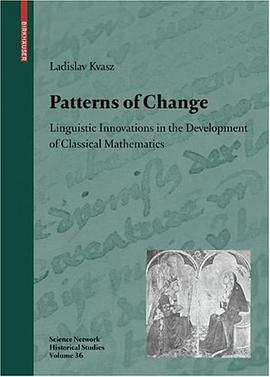
The book offers a reconstruction of linguistic innovations in the history of mathematics. It argues that there are at least three ways in which the language of mathematics can be changed. As illustration of changes of the first kind, called re-codings, is the development along the line: synthetic geometry, analytic geometry, fractal geometry, and set theory. In this development the mathematicians changed the very way of constructing geometric figures. As illustration of changes of the second kind, called relativization, is the development of synthetic geometry along the line: Euclida (TM)s geometry, projective geometry, non-Euclidean geometry, Erlanger program up to Hilberta (TM)s Grundlagen der Geometrie. Changes of the third kind, called re-formulations are for instance the changes that can be seen on the different editions of Euclida (TM)s Elements. Perhaps the best known among them is Playfaira (TM)s change of the formulation of the fifth postulate.
作者简介
目录信息
Acknowledgements......Page 7
Preface......Page 9
Introduction......Page 20
1. Re-coding as the First Pattern of Change in Mathematics......Page 30
1.1 Historical Description of Re-codings......Page 33
1.1.1 Elementary Arithmetic......Page 36
1.1.2 Synthetic Geometry......Page 42
1.1.3 Algebra......Page 48
1.1.4 Analytic Geometry......Page 56
1.1.5 The Differential and Integral Calculus......Page 66
1.1.6 Iterative Geometry......Page 75
1.1.7 Predicate Calculus......Page 86
1.1.8 Set Theory......Page 95
1.2 Philosophical Reflections on Re-Codings......Page 104
1.2.1 Relation between Logical and Historical Reconstructions of Mathematical Theories......Page 108
1.2.2 Perception of Shape and Motion......Page 113
1.2.3 Epistemic Tension and the Dynamics of the Development of Mathematics......Page 117
1.2.4 Technology and the Coordination of Activities......Page 118
1.2.5 The Pre-History of Mathematical Theories......Page 121
2. Relativizations as the Second Pattern of Change in Mathematics......Page 125
2.1 Historical Description of Relativizations in Synthetic Geometry......Page 129
2.1.1 The Perspectivist Form of Language of Synthetic Geometry......Page 132
2.1.2 The Projective Form of Language of Synthetic Geometry......Page 136
2.1.3 The Interpretative Form of Language of Synthetic Geometry......Page 142
2.1.4 The Integrative Form of Language of Synthetic Geometry......Page 151
2.1.5 The Constitutive Form of Language of Synthetic Geometry......Page 161
2.1.6 The Conceptual Form of Language of Synthetic Geometry......Page 172
2.1.7 An Overview of Relativizations in the Development of Synthetic Geometry......Page 177
2.2 Historical Description of Relativizations in Algebra......Page 178
2.2.1 The Perspectivist Form of the Language of Algebra......Page 183
2.2.2 The Projective Form of the Language of Algebra......Page 185
2.2.3 The Coordinative Form of the Language of Algebra......Page 191
2.2.4 The Compositive Form of the Language of Algebra......Page 195
2.2.5 The Interpretative Form of the Language of Algebra......Page 198
2.2.6 The Integrative Form of the Language of Algebra......Page 202
2.2.7 The Constitutive Form of the Language of Algebra......Page 210
2.2.8 The Conceptual Form of the Language of Algebra......Page 215
2.2.9 An Overview of Relativizations in the Development of Algebra......Page 216
2.3 Philosophical Reflections on Relativizations......Page 219
2.3.1 Comparison of the Development of Algebra with the Development of Geometry......Page 220
2.3.2 Form of Language and the Development of Mathematical Theories......Page 223
2.3.3 The Notion of the Form of Language and Philosophy of Mathematics......Page 228
2.3.4 The Changes of the Form of Language and the Development of Subjectivity......Page 233
2.3.5 The Problem of Understanding Mathematical Concepts......Page 238
2.3.6 A Gap of Two Centuries in the Curricula......Page 240
3. Re-Formulations as a Third Pattern of Change in Mathematics......Page 242
3.1 Re-Formulations and Concept-Formation......Page 245
3.2 Re-Formulations and Problem-Solving......Page 249
3.3 Re-Formulations and Theory-Building......Page 252
4. Mathematics and Change......Page 256
4.1.1 What Kind of Changes Should we Consider Revolutionary?......Page 257
4.1.2 The Distinction between Revolutions and Epistemological Ruptures......Page 258
4.1.3 Possible Refinements of the Kuhnian Picture......Page 260
4.2 Mathematical Research Programmes (Lakatos)......Page 262
4.2.1 The Lack of Connection between the Two Major Parts of Proofs and Refutations......Page 263
4.2.2 Reduction of the Development of Mathematics to Re-Formulations......Page 264
4.3.1 The Problem of the Omitted Stages......Page 266
4.3.2 The Relation of Ontogenesis and Phylogenesis......Page 267
Bibliography......Page 269
· · · · · · (收起)