
具体描述
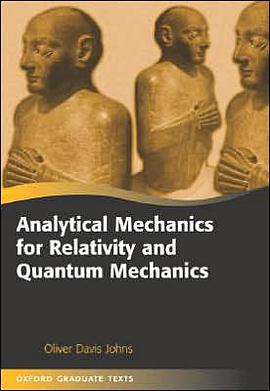
This book provides an innovative and mathematically sound treatment of the foundations of analytical mechanics and the relation of classical mechanics to relativity and quantum theory. It is intended for use at the introductory graduate level. A distinguishing feature of the book is its integration of special relativity into teaching of classical mechanics. After a thorough review of the traditional theory, Part II of the book introduces extended Lagrangian and Hamiltonian methods that treat time as a transformable coordinate rather than the fixed parameter of Newtonian physics. Advanced topics such as covariant Langrangians and Hamiltonians, canonical transformations, and Hamilton-Jacobi methods are simplified by the use of this extended theory. And the definition of canonical transformation no longer excludes the Lorenz transformation of special relativity. This is also a book for those who study analytical mechanics to prepare for a critical exploration of quantum mechanics. Comparisons to quantum mechanics appear throughout the text. The extended Hamiltonian theory with time as a coordinate is compared to Dirac's formalism of primary phase space constraints.The chapter on relativisitic mechanics shows how to use covariant Hamiltonian theory to write the Klein-Gordon and Dirac equations. The chapter on Hamilton-Jacobi theory includes a discussion of the closely related Bohm hidden variable model of quantum mechanics. Classical mechanics itself is presented with an emphasis on methods, such as linear vector operators and dyadics, that will familiarize the student with similar techniques in quantum theory. Several of the current fundamental problems in theoretical physics - the development of quantum information technology, and the problem of quantizing the gravitational field, to name two - require a rethinking of the quantum-classical connection. Graduate students preparing for research careers will find a graduate mechanics course based on this book to be an essential bridge between their undergraduate training and advanced study in analytical mechanics, relativity, and quantum mechanics.
作者简介
目录信息
Dedication v
Preface vii
Acknowledgments ix
PART I INTRODUCTION: THE TRADITIONAL THEORY
1 Basic Dynamics of Point Particles and Collections 3
1.1 Newton’s Space and Time 3
1.2 Single Point Particle 5
1.3 Collective Variables 6
1.4 The Law of Momentum for Collections 7
1.5 The Law of Angular Momentum for Collections 8
1.6 “Derivations” of the Axioms 9
1.7 The Work–Energy Theorem for Collections 10
1.8 Potential and Total Energy for Collections 11
1.9 The Center of Mass 11
1.10 Center of Mass and Momentum 13
1.11 Center of Mass and Angular Momentum 14
1.12 Center of Mass and Torque 15
1.13 Change of Angular Momentum 15
1.14 Center of Mass and the Work–Energy Theorems 16
1.15 Center of Mass as a Point Particle 17
1.16 Special Results for Rigid Bodies 17
1.17 Exercises 18
2 Introduction to Lagrangian Mechanics 24
2.1 Configuration Space 24
2.2 Newton’s Second Law in Lagrangian Form 26
2.3 A Simple Example 27
2.4 Arbitrary Generalized Coordinates 27
2.5 Generalized Velocities in the q-System 29
2.6 Generalized Forces in the q-System 29
2.7 The Lagrangian Expressed in the q-System 30
2.8 Two Important Identities 31
2.9 Invariance of the Lagrange Equations 32
2.10 Relation Between Any Two Systems 33
2.11 More of the Simple Example 34
2.12 Generalized Momenta in the q-System 35
2.13 Ignorable Coordinates 35
2.14 Some Remarks About Units 36
2.15 The Generalized Energy Function 36
2.16 The Generalized Energy and the Total Energy 37
2.17 Velocity Dependent Potentials 38
2.18 Exercises 41
3 Lagrangian Theory of Constraints 46
3.1 Constraints Defined 46
3.2 Virtual Displacement 47
3.3 Virtual Work 48
3.4 Form of the Forces of Constraint 50
3.5 General Lagrange Equations with Constraints 52
3.6 An Alternate Notation for Holonomic Constraints 53
3.7 Example of the General Method 54
3.8 Reduction of Degrees of Freedom 54
3.9 Example of a Reduction 57
3.10 Example of a Simpler Reduction Method 58
3.11 Recovery of the Forces of Constraint 59
3.12 Example of a Recovery 60
3.13 Generalized Energy Theorem with Constraints 61
3.14 Tractable Non-Holonomic Constraints 63
3.15 Exercises 64
4 Introduction to Hamiltonian Mechanics 71
4.1 Phase Space 71
4.2 Hamilton Equations 74
4.3 An Example of the Hamilton Equations 76
4.4 Non-Potential and Constraint Forces 77
4.5 Reduced Hamiltonian 78
4.6 Poisson Brackets 80
4.7 The Schroedinger Equation 82
4.8 The Ehrenfest Theorem 83
4.9 Exercises 84
5 The Calculus of Variations 88
5.1 Paths in an N-Dimensional Space 89
5.2 Variations of Coordinates 90
5.3 Variations of Functions 91
5.4 Variation of a Line Integral 92
5.5 Finding Extremum Paths 94
5.6 Example of an Extremum Path Calculation 95
5.7 Invariance and Homogeneity 98
5.8 The Brachistochrone Problem 100
5.9 Calculus of Variations with Constraints 102
5.10 An Example with Constraints 105
5.11 Reduction of Degrees of Freedom 106
5.12 Example of a Reduction 107
5.13 Example of a Better Reduction 108
5.14 The Coordinate Parametric Method 108
5.15 Comparison of the Methods 111
5.16 Exercises 113
6 Hamilton’s Principle 117
6.1 Hamilton’s Principle in Lagrangian Form 117
6.2 Hamilton’s Principle with Constraints 118
6.3 Comments on Hamilton’s Principle 119
6.4 Phase-Space Hamilton’s Principle 120
6.5 Exercises 122
7 Linear Operators and Dyadics 123
7.1 Definition of Operators 123
7.2 Operators and Matrices 125
7.3 Addition and Multiplication 127
7.4 Determinant, Trace, and Inverse 127
7.5 Special Operators 129
7.6 Dyadics 130
7.7 Resolution of Unity 133
7.8 Operators, Components, Matrices, and Dyadics 133
7.9 Complex Vectors and Operators 134
7.10 Real and Complex Inner Products 136
7.11 Eigenvectors and Eigenvalues 136
7.12 Eigenvectors of Real Symmetric Operator 137
7.13 Eigenvectors of Real Anti-Symmetric Operator 137
7.14 Normal Operators 139
7.15 Determinant and Trace of Normal Operator 141
7.16 Eigen-Dyadic Expansion of Normal Operator 142
7.17 Functions of Normal Operators 143
7.18 The Exponential Function 145
7.19 The Dirac Notation 146
7.20 Exercises 147
8 Kinematics of Rotation 152
8.1 Characterization of Rigid Bodies 152
8.2 The Center of Mass of a Rigid Body 153
8.3 General Definition of Rotation Operator 155
8.4 Rotation Matrices 157
8.5 Some Properties of Rotation Operators 158
8.6 Proper and Improper Rotation Operators 158
8.7 The Rotation Group 160
8.8 Kinematics of a Rigid Body 161
8.9 Rotation Operators and Rigid Bodies 163
8.10 Differentiation of a Rotation Operator 164
8.11 Meaning of the Angular Velocity Vector 166
8.12 Velocities of the Masses of a Rigid Body 168
8.13 Savio’s Theorem 169
8.14 Infinitesimal Rotation 170
8.15 Addition of Angular Velocities 171
8.16 Fundamental Generators of Rotations 172
8.17 Rotation with a Fixed Axis 174
8.18 Expansion of Fixed-Axis Rotation 176
8.19 Eigenvectors of the Fixed-Axis Rotation Operator 178
8.20 The Euler Theorem 179
8.21 Rotation of Operators 181
8.22 Rotation of the Fundamental Generators 181
8.23 Rotation of a Fixed-Axis Rotation 182
8.24 Parameterization of Rotation Operators 183
8.25 Differentiation of Parameterized Operator 184
8.26 Euler Angles 185
8.27 Fixed-Axis Rotation from Euler Angles 188
8.28 Time Derivative of a Product 189
8.29 Angular Velocity from Euler Angles 190
8.30 Active and Passive Rotations 191
8.31 Passive Transformation of Vector Components 192
8.32 Passive Transformation of Matrix Elements 193
8.33 The Body Derivative 194
8.34 Passive Rotations and Rigid Bodies 195
8.35 Passive Use of Euler Angles 196
8.36 Exercises 198
9 Rotational Dynamics 202
9.1 Basic Facts of Rigid-Body Motion 202
9.2 The Inertia Operator and the Spin 203
9.3 The Inertia Dyadic 204
9.4 Kinetic Energy of a Rigid Body 205
9.5 Meaning of the Inertia Operator 205
9.6 Principal Axes 206
9.7 Guessing the Principal Axes 208
9.8 Time Evolution of the Spin 210
9.9 Torque-Free Motion of a Symmetric Body 211
9.10 Euler Angles of the Torque-Free Motion 215
9.11 Body with One Point Fixed 217
9.12 Preserving the Principal Axes 220
9.13 Time Evolution with One Point Fixed 221
9.14 Body with One Point Fixed, Alternate Derivation 221
9.15 Work–Energy Theorems 222
9.16 Rotation with a Fixed Axis 223
9.17 The Symmetric Top with One Point Fixed 224
9.18 The Initially Clamped Symmetric Top 229
9.19 Approximate Treatment of the Symmetric Top 230
9.20 Inertial Forces 231
9.21 Laboratory on the Surface of the Earth 234
9.22 Coriolis Force Calculations 236
9.23 The Magnetic – Coriolis Analogy 237
9.24 Exercises 239
10 Small Vibrations About Equilibrium 246
10.1 Equilibrium Defined 246
10.2 Finding Equilibrium Points 247
10.3 Small Coordinates 248
10.4 Normal Modes 249
10.5 Generalized Eigenvalue Problem 250
10.6 Stability 252
10.7 Initial Conditions 252
10.8 The Energy of Small Vibrations 253
10.9 Single Mode Excitations 254
10.10 A Simple Example 255
10.11 Zero-Frequency Modes 260
10.12 Exercises 261
PART II MECHANICS WITH TIME AS A COORDINATE
11 Lagrangian Mechanics with Time as a Coordinate 267
11.1 Time as a Coordinate 268
11.2 A Change of Notation 268
11.3 Extended Lagrangian 269
11.4 Extended Momenta 270
11.5 Extended Lagrange Equations 272
11.6 A Simple Example 273
11.7 Invariance Under Change of Parameter 275
11.8 Change of Generalized Coordinates 276
11.9 Redundancy of the Extended Lagrange Equations 277
11.10 Forces of Constraint 278
11.11 Reduced Lagrangians with Time as a Coordinate 281
11.12 Exercises 282
12 Hamiltonian Mechanics with Time as a Coordinate 285
12.1 Extended Phase Space 285
12.2 Dependency Relation 285
12.3 Only One Dependency Relation 286
12.4 From Traditional to Extended Hamiltonian Mechanics 288
12.5 Equivalence to Traditional Hamilton Equations 290
12.6 Example of Extended Hamilton Equations 291
12.7 Equivalent Extended Hamiltonians 292
12.8 Alternate Hamiltonians 293
12.9 Alternate Traditional Hamiltonians 295
12.10 Not a Legendre Transformation 295
12.11 Dirac’s Theory of Phase-Space Constraints 296
12.12 Poisson Brackets with Time as a Coordinate 298
12.13 Poisson Brackets and Quantum Commutators 300
12.14 Exercises 302
13 Hamilton’s Principle and Noether’s Theorem 305
13.1 Extended Hamilton’s Principle 305
13.2 Noether’s Theorem 307
13.3 Examples of Noether’s Theorem 308
13.4 Hamilton’s Principle in an Extended Phase Space 310
13.5 Exercises 312
14 Relativity and Spacetime 313
14.1 Galilean Relativity 313
14.2 Conflict with the Aether 315
14.3 Einsteinian Relativity 316
14.4 What Is a Coordinate System? 318
14.5 A Survey of Spacetime 319
14.6 The Lorentz Transformation 331
14.7 The Principle of Relativity 337
14.8 Lorentzian Relativity 339
14.9 Mechanism and Relativity 340
14.10 Exercises 341
15 Fourvectors and Operators 343
15.1 Fourvectors 343
15.2 Inner Product 346
15.3 Choice of Metric 347
15.4 Relativistic Interval 347
15.5 Spacetime Diagram 349
15.6 General Fourvectors 350
15.7 Construction of New Fourvectors 351
15.8 Covariant and Contravariant Components 352
15.9 General Lorentz Transformations 355
15.10 Transformation of Components 356
15.11 Examples of Lorentz Transformations 358
15.12 Gradient Fourvector 360
15.13 Manifest Covariance 361
15.14 Formal Covariance 362
15.15 The Lorentz Group 362
15.16 Proper Lorentz Transformations and the Little Group 364
15.17 Parameterization 364
15.18 Fourvector Operators 366
15.19 Fourvector Dyadics 367
15.20 Wedge Products 368
15.21 Scalar, Fourvector, and Operator Fields 369
15.22 Manifestly Covariant Form of Maxwell’s Equations 370
15.23 Exercises 373
16 Relativistic Mechanics 376
16.1 Modification of Newton’s Laws 376
16.2 The Momentum Fourvector 378
16.3 Fourvector Form of Newton’s Second Law 378
16.4 Conservation of Fourvector Momentum 380
16.5 Particles of Zero Mass 380
16.6 Traditional Lagrangian 381
16.7 Traditional Hamiltonian 383
16.8 Invariant Lagrangian 383
16.9 Manifestly Covariant Lagrange Equations 384
16.10 Momentum Fourvectors and Canonical Momenta 385
16.11 Extended Hamiltonian 386
16.12 Invariant Hamiltonian 387
16.13 Manifestly Covariant Hamilton Equations 388
16.14 The Klein–Gordon Equation 389
16.15 The Dirac Equation 390
16.16 The Manifestly Covariant N-Body Problem 392
16.17 Covariant Serret–Frenet Theory 399
16.18 Fermi–Walker Transport 401
16.19 Example of Fermi–Walker Transport 403
16.20 Exercises 405
17 Canonical Transformations 411
17.1 Definition of Canonical Transformations 411
17.2 Example of a Canonical Transformation 412
17.3 Symplectic Coordinates 412
17.4 Symplectic Matrix 416
17.5 Standard Equations in Symplectic Form 417
17.6 Poisson Bracket Condition 418
17.7 Inversion of Canonical Transformations 419
17.8 Direct Condition 420
17.9 Lagrange Bracket Condition 422
17.10 The Canonical Group 423
17.11 Form Invariance of Poisson Brackets 424
17.12 Form Invariance of the Hamilton Equations 426
17.13 Traditional Canonical Transformations 428
17.14 Exercises 430
18 Generating Functions 434
18.1 Proto-Generating Functions 434
18.2 Generating Functions of the F1 Type 436
18.3 Generating Functions of the F2 Type 438
18.4 Examples of Generating Functions 439
18.5 Other Simple Generating Functions 441
18.6 Mixed Generating Functions 442
18.7 Example of a Mixed Generating Function 444
18.8 Finding Simple Generating Functions 445
18.9 Finding Mixed Generating Functions 446
18.10 Finding Mixed Generating Functions—An Example 448
18.11 Traditional Generating Functions 449
18.12 Standard Form of Extended Hamiltonian Recovered 451
18.13 Differential Canonical Transformations 452
18.14 Active Canonical Transformations 453
18.15 Phase-Space Analog of Noether Theorem 454
18.16 Liouville Theorem 455
18.17 Exercises 456
19 Hamilton–Jacobi Theory 461
19.1 Definition of the Action 461
19.2 Momenta from the S1 Action Function 462
19.3 The S2 Action Function 464
19.4 Example of S1 and S2 Action Functions 465
19.5 The Hamilton–Jacobi Equation 466
19.6 Hamilton’s Characteristic Equations 467
19.7 Complete Integrals 469
19.8 Separation of Variables 472
19.9 Canonical Transformations 473
19.10 General Integrals 475
19.11 Mono-Energetic Integrals 480
19.12 The Optical Analogy 482
19.13 The Relativistic Hamilton–Jacobi Equation 483
19.14 Schroedinger and Hamilton–Jacobi Equations 483
19.15 The Quantum Cauchy Problem 485
19.16 The Bohm Hidden Variable Model 486
19.17 Feynman Path-Integral Technique 487
19.18 Quantum and Classical Mechanics 488
19.19 Exercises 489
PART III MATHEMATICAL APPENDICES
A Vector Fundamentals 495
A.1 Properties of Vectors 495
A.2 Dot Product 495
A.3 Cross Product 496
A.4 Linearity 496
A.5 Cartesian Basis 497
A.6 The Position Vector 498
A.7 Fields 499
A.8 Polar Coordinates 499
A.9 The Algebra of Sums 502
A.10 Miscellaneous Vector Formulae 502
A.11 Gradient Vector Operator 504
A.12 The Serret–Frenet Formulae 505
B Matrices and Determinants 508
B.1 Definition of Matrices 508
B.2 Transposed Matrix 508
B.3 Column Matrices and Column Vectors 509
B.4 Square, Symmetric, and Hermitian Matrices 509
B.5 Algebra of Matrices: Addition 510
B.6 Algebra of Matrices: Multiplication 511
B.7 Diagonal and Unit Matrices 512
B.8 Trace of a Square Matrix 513
B.9 Differentiation of Matrices 513
B.10 Determinants of Square Matrices 513
B.11 Properties of Determinants 514
B.12 Cofactors 515
B.13 Expansion of a Determinant by Cofactors 515
B.14 Inverses of Nonsingular Matrices 516
B.15 Partitioned Matrices 517
B.16 Cramer’s Rule 518
B.17 Minors and Rank 519
B.18 Linear Independence 520
B.19 Homogeneous Linear Equations 520
B.20 Inner Products of Column Vectors 521
B.21 Complex Inner Products 523
B.22 Orthogonal and Unitary Matrices 523
B.23 Eigenvalues and Eigenvectors of Matrices 524
B.24 Eigenvectors of Real Symmetric Matrix 525
B.25 Eigenvectors of Complex Hermitian Matrix 528
B.26 Normal Matrices 528
B.27 Properties of Normal Matrices 530
B.28 Functions of Normal Matrices 533
C Eigenvalue Problem with General Metric 534
C.1 Positive-Definite Matrices 534
C.2 Generalization of the Real Inner Product 535
C.3 The Generalized Eigenvalue Problem 536
C.4 Finding Eigenvectors in the Generalized Problem 537
C.5 Uses of the Generalized Eigenvectors 538
D The Calculus of Many Variables 540
D.1 Basic Properties of Functions 540
D.2 Regions of Definition of Functions 540
D.3 Continuity of Functions 541
D.4 Compound Functions 541
D.5 The Same Function in Different Coordinates 541
D.6 Partial Derivatives 542
D.7 Continuously Differentiable Functions 543
D.8 Order of Differentiation 543
D.9 Chain Rule 543
D.10 Mean Values 544
D.11 Orders of Smallness 544
D.12 Differentials 545
D.13 Differential of a Function of Several Variables 545
D.14 Differentials and the Chain Rule 546
D.15 Differentials of Second and Higher Orders 546
D.16 Taylor Series 547
D.17 Higher-Order Differential as a Difference 548
D.18 Differential Expressions 548
D.19 Line Integral of a Differential Expression 550
D.20 Perfect Differentials 550
D.21 Perfect Differential and Path Independence 552
D.22 Jacobians 553
D.23 Global Inverse Function Theorem 556
D.24 Local Inverse Function Theorem 559
D.25 Derivatives of the Inverse Functions 560
D.26 Implicit Function Theorem 561
D.27 Derivatives of Implicit Functions 561
D.28 Functional Independence 562
D.29 Dependency Relations 563
D.30 Legendre Transformations 563
D.31 Homogeneous Functions 565
D.32 Derivatives of Homogeneous Functions 565
D.33 Stationary Points 566
D.34 Lagrange Multipliers 566
D.35 Geometry of the Lagrange Multiplier Theorem 569
D.36 Coupled Differential Equations 570
D.37 Surfaces and Envelopes 572
E Geometry of Phase Space 575
E.1 Abstract Vector Space 575
E.2 Subspaces 577
E.3 Linear Operators 578
E.4 Vectors in Phase Space 580
E.5 Canonical Transformations in Phase Space 581
E.6 Orthogonal Subspaces 582
E.7 A Special Canonical Transformation 582
E.8 Special Self-Orthogonal Subspaces 583
E.9 Arnold’s Theorem 585
E.10 Existence of a Mixed Generating Function 586
References 588
Index 591
· · · · · · (收起)
读后感
用户评价
这本书的排版和印刷质量无疑是顶级的,这一点必须首先提及。纸张的质感,字体的大小和间距,都体现了出版商对物理学术书籍应有标准的尊重。清晰的图表和规范的数学符号系统,极大地减轻了长时间阅读带来的视觉疲劳。从内容结构上看,作者显然是抱着“穷尽”某种理论体系的意图来编撰的。它对经典力学框架的梳理,达到了对后续理论过渡的完美铺垫效果。然而,我个人在阅读过程中,最希望看到的是更多关于历史背景或者不同学派观点对比的讨论,这能帮助读者更好地理解为什么某些理论路径被选择,而另一些则被放弃。这本书更像是直接呈现了“最优”的结果,而省略了探索过程中的曲折与争论。这种“纯粹性”固然在数学上是美丽的,但在构建完整的学术认知图谱时,可能会让人感觉缺少了一些“人情味”和历史的纵深感。它要求你直接接受体系,而不是和你探讨体系的形成。
这本书的封面设计着实引人注目,那种深邃的蓝色调配上银白色的字体,立刻就给人一种严谨而前沿的感觉。我当初拿起它,主要是冲着作者在理论物理界的名声去的,期待能从中窥见对经典力学更深层次的理解,尤其是在那些涉及到相对论和量子力学交汇的领域。然而,当我真正翻开内页时,发现它更像是一本精心打磨的工具书,而不是那种能引导初学者逐步上手的入门指南。公式推导极其详尽,每一个步骤都如同数学证明般不容置疑,这对于已经具备一定基础的研究人员来说无疑是极大的便利,可以迅速回溯和验证关键步骤。但对于那些渴望看到物理图像和概念演化的读者,这本书可能会显得有些冷峻。它更偏向于数学框架的构建,对于物理直觉的培养似乎着墨不多。我花了大量时间在理解那些抽象的拉格朗日量和哈密顿量在特定背景下的具体表述上,每次都能从中找到新的理解层次,这证明了其内容的深度和密度。不过,如果你的目标是快速掌握某个特定应用领域,这本书的广度可能会让你感到有些吃力,因为它试图在一个统一的框架下覆盖太多内容。
这本书的叙事方式,与其说是讲解,不如说更像是在构建一个宏伟的数学宫殿。它对理论基础的阐述极其扎实,几乎没有留下任何可以被质疑的逻辑漏洞。我尤其欣赏作者在处理变分原理时的那种近乎偏执的严谨性,每一个符号、每一个指标的上下标似乎都经过了反复的推敲。对于习惯了通过类比和生动例子来学习物理概念的读者,这本书一开始可能会带来一些挫败感,因为它几乎是直接将读者“扔”进了抽象的数学结构之中,要求读者自行去挖掘其中的物理意义。但一旦你适应了这种节奏,你会发现其精妙之处。它迫使你跳出日常经验的束缚,用纯粹的数学语言去审视宇宙的运行规律。其中关于正则变换和泊松括号的章节,简直是力学理论美学的体现,那种对称性和守恒律之间的内在联系被揭示得淋漓尽致,让人不得不感叹数学语言的强大表达力。这本书,与其说教人知识,不如说是在训练一种特定的、高度抽象的思维模式。
这本书所采用的语言风格极其精确和内敛,几乎没有冗余的词汇。每一句话都承担着传递精确信息的任务,这使得信息获取效率极高,但同时也牺牲了一定的可读性和亲和力。我发现自己不得不频繁地停下来,查阅一些背景知识,以确保对某些隐含假设的完全理解。比如,在引入某些推广的坐标变换时,作者并没有花时间解释这些选择如何影响了我们对物理实在的日常直觉,而是直接进入了运算层面。这无疑加速了那些熟练掌握现代微分几何和拓扑学工具的读者的进度。对于我这样偏向于物理直觉的思考者来说,这种“直入核心”的方式虽然高效,却也意味着需要付出更多的努力去重新构建内在的物理图像。总而言之,这本书是一座需要专业工具才能攀登的高峰,其回报是深刻而坚实的理论洞察力,但攀登的难度也同样令人敬畏。
我阅读这本书的过程更像是一场艰苦的攀登。它不是那种可以轻松翻阅,然后在咖啡馆里讨论几句就能领会其精髓的读物。它要求的是专注和时间。书中的例题设计得非常巧妙,它们并非那种简单的计算练习,而是对核心理论的深度应用和拓展。我记得有几个关于场论在弯曲时空中的初步应用的例子,处理起来需要极高的耐心和对张量分析的熟练掌握。每次解决完一个复杂的推导,那种“豁然开朗”的感觉是无与伦比的,但达到这个阶段前的探索过程无疑是漫长而寂寞的。这本书的深度决定了它更适合作为一本参考书或进阶教材,而非初学者的首选。它的价值在于其内容的密度和连贯性,它将不同的物理领域用统一的数学语言连接起来,展现出一种令人震撼的内在统一性。然而,对于那些希望在轻松的氛围中学习的读者,这本书带来的压迫感可能会让他们望而却步,它更像是一块需要被雕琢的璞玉,而不是一件现成的艺术品。