
具体描述
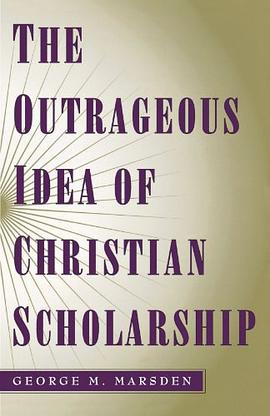
At the end of his 1994 book, The Soul of the American University, George Marsden advanced a modest proposal for an enhanced role for religious faith in today's scholarship. This "unscientific postscript" helped spark a heated debate that spilled out of the pages of academic journals and TheChronicle of Higher Education into mainstream media such as The New York Times, and marked Marsden as one of the leading participants in the debates concerning religion and public life. Marsden now gives his proposal a fuller treatment in The Outrageous Idea of Christian Scholarship, a thoughtful and thought-provoking book on the relationship of religious faith and intellectual scholarship.
More than a response to Marsden's critics, The Outrageous Idea of Christian Scholarship takes the next step towards demonstrating what the ancient relationship of faith and learning might mean for the academy today. Marsden argues forcefully that mainstream American higher education needs to be more open to explicit expressions of faith and to accept what faith means in an intellectual context. While other defining elements of a scholar's identity, such as race or gender, are routinely taken into consideration and welcomed as providing new perspectives, Marsden points out, the perspective of the believing Christian is dismissed as irrelevant or, worse, antithetical to the scholarly enterprise.
Marsden begins by examining why Christian perspectives are not welcome in the academy. He rebuts the various arguments commonly given for excluding religious viewpoints, such as the argument that faith is insufficiently empirical for scholarly pursuits (although the idea of complete scientific objectivity is consider naive in most fields today), the fear that traditional Christianity will reassert its historical role as oppressor of divergent views, and the received dogma of the separation of church and state, which stretches far beyond the actual law in the popular imagination. Marsden insists that scholars have both a religious and an intellectual obligation not to leave their deeply held religious beliefs at the gate of the academy. Such beliefs, he contends, can make a significant difference in scholarship, in campus life, and in countless other ways. Perhaps most importantly, Christian scholars have both the responsibility and the intellectual ammunition to argue against some of the prevailing ideologies held uncritically by many in the academy, such as naturalistic reductionism or unthinking moral relativism.
Contemporary university culture is hollow at its core, Marsden writes. Not only does it lack a spiritual center, but it is without any real alternative. He argues that a religiously diverse culture will be an intellectually richer one, and it is time that scholars and institutions who take the intellectual dimensions of their faith seriously become active participants in the highest level of academic discourse. Whether the reader agrees or disagrees with this conclusion, Marsden's thoughtful, well-argued book is necessary reading for all sides of the debate on religion's role in education and culture.
作者简介
目录信息
读后感
用户评价
阅读这本书的过程,对我而言,更像是一场与作者进行的跨越时空的深度辩论。每读完一个章节,我都会忍不住在脑海中构建起反驳的论点,试图找出他逻辑上的薄弱之处。然而,令人沮丧又兴奋的是,作者似乎早就预料到了所有的反对意见,并在后续的章节中用更强有力的证据链进行了反击和深化。这种“预判式”的反驳技巧,使得全书的论证密度极高,几乎没有可以喘息的空间。书中引用的跨学科资料之广博,令人咋舌,从早期基督教的教父文集到后现代解构主义的思潮,作者信手拈来,游刃有余地在不同的知识领域间架设桥梁。这让我深刻意识到,真正的“博学”并非知识的堆砌,而是对知识之间内在联系的洞察力。这本书迫使我走出自己熟悉的专业舒适区,去接触那些原本认为与我无关的领域,从而拓宽了思考的边界。它不仅仅是在讨论“学术”本身,更是在探讨“整合性思维”的价值。
这本书的最终影响,并非是提供了一个清晰的答案,而是成功地播下了一颗“怀疑的种子”。读完最后一页时,我的心情复杂,既有被彻底说服的释然,更有对现有体系的深刻不安。它没有给我一个可以轻松引用的口号,反而让我开始审视自己日常工作和学习中所遵循的那些“不言自明”的前提假设。这种由内而外的颠覆感,是衡量一本真正有价值的书的标准之一。它让人对“权威”产生健康的敬畏和质疑,鼓励读者去重建自己的知识结构,而不是被动接受既有的框架。我敢肯定,这本书在未来几年内,仍会不断地被我回想起,尤其是在我面临需要做出重大学术判断的十字路口时。它的价值在于其持久的启发性,而非一时的阅读快感。它是一剂强效的清醒剂,让我对追求“真理”的复杂性和艰巨性有了更深刻的体认。
这本书的叙事风格非常独特,它糅合了学术论文的严谨性和个人回忆录的坦诚,形成了一种奇特的张力。作者在阐述宏大理论时,偶尔会穿插一些关于自己学术生涯中遇到的尴尬境地或顿悟瞬间的小插曲,这些片段极大地软化了理论的硬度,让角色的形象更加立体和可信。我尤其欣赏他处理争议性议题时的那种“既要又要”的平衡感——他既不回避那些尖锐的矛盾,又不至于滑向纯粹的煽动性言论。与其说这是一本纯粹的学术专著,不如说它是一份带着强烈个人烙印的宣言书。这种叙事策略,使得原本可能枯燥的议题变得引人入胜,仿佛作者正坐在我对面,用一种略带倦怠却又充满激情的语气,向我娓娓道来他对于知识本质的理解。对于那些长期在象牙塔中感到窒息的读者来说,这种真诚的、近乎告解式的写作,无疑具有强大的治愈和激励作用,它让人重新相信,学术探索也可以充满人性光辉。
我是在一个漫长的雨天,窝在沙发里,伴随着窗外的淅沥声,才真正沉下心来品读这本书的。一开始,我对其中一些术语的密集使用感到有些吃力,感觉作者似乎默认读者已经具备了非常深厚的哲学和神学背景,这在一定程度上提高了阅读门槛。不过,一旦我调整好节奏,开始跟随作者的逻辑链条深入下去,便立刻被他那严密的论证结构所折服。他并非空泛地批判,而是用大量的历史案例和文本分析来支撑自己的论点,那种抽丝剥茧般的细致,简直令人叹为观止。特别是有几处地方,作者对某些经典文本的重新解读角度,如同在迷雾中点燃了一盏灯,让我对原本熟悉的概念产生了全新的认识。这种思维的碰撞带来的震撼,是快餐式的阅读体验无法比拟的。我甚至几次停下来,合上书本,默默思考作者提出的那个悖论,那种强迫思考的体验,正是阅读的至高乐趣所在。这本书无疑需要读者投入极大的专注力,但回报也是丰厚的——它提供了一套观察世界的全新滤镜。
这本书的封面设计着实吸引人,那种略带古典的字体搭配上略显张扬的标题,让人忍不住想一探究竟。我是在一家独立书店里偶然发现它的,当时架子上摆放着各种学术书籍,但唯独这一本散发出一种与众不同的气息。 拿到手里掂了掂,感觉分量十足,这通常意味着内容的深度和广度。 尽管书名听起来有些耸人听闻,但我更倾向于相信它会提供一种全新的视角来审视学术研究中的一些固有观念。 翻开扉页,首先映入眼帘的是作者对当代高等教育环境的犀利观察,那种直言不讳的批评态度,让我立刻产生了共鸣。 它似乎在挑战我们习以为常的知识构建方式,试图撕开一层温文尔雅的面纱,直视学术界内部那些微妙的权力动态和意识形态的暗流涌动。 这种开宗明义的姿态,让人对后续的内容充满了期待,想知道作者究竟打算如何“离经叛道”地去论证他的观点。 纸张的质感也值得称赞,那种略带粗粝却又触感舒适的纸张,很适合长时间阅读和反复翻阅。 整体而言,这本书在视觉和触觉上都给人留下了深刻的第一印象,预示着一场思想上的不妥协的对话即将展开。 它的存在本身,就像是对主流学术话语的一种无声的挑衅,让人无法轻易忽略。