
具体描述
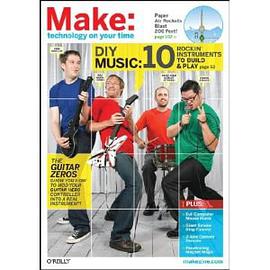
Explore the euphonic delights of homemade music in MAKE, Volume 15, the Musical Instrument issue. From handheld synthesizers, to laser harps, to autonomous robot composers, MAKE 15 will fill your world with sweet sounds made by you, even if you've never learned to play an instrument.
作者简介
Mark Frauenfelder is a writer and illustrator living in Los Angeles, and the editor of MAKE. He is the cofounder of the popular Boing Boing weblog and was an editor at Wired from 1993-1998.
目录信息
Sharing the Adventure by Dale Dougherty in Welcome
Make's publisher Dale Dougherty talks about the beauty of sharing between makers. Page 12
Gander Sauce for Hollywood by Cory Doctorow in Make Free
Cory Doctorow advocates the entertainment industry take a little bit of their own sauce. Page 14
Reader Input in Reader Input
Makers tell their tales of mad boating experiments and childhood hijinks. Page 16
Shock and Awesome by Eric Smillie in Made on Earth
Czech artist Kristof Kintera likes to make the patrons of his art a little nervous. Page 19
Form and Functions by Bruce Stewart in Made on Earth
David Jones makes his own scientific calculator watch. Page 20
Interstellar Visions by Goli Mohammadi in Made on Earth
South of Tucson, Ariz., a science enthusiast has been collecting moonlight. Page 21
Stylish Change by Eric Smillie in Made on Earth
Stacey Lee Webber makes tools from solder and pennies. Page 22
Planeboat Memories by Megan Mansell Williams in Made on Earth
An old aircraft found new life as a yacht. Page 23
Strike Anywhere by Keith Hammond in Made on Earth
Billy Gordon has made a gigantic, strike-anywhere match. Page 24
Political Hot Seat by Ed Troxell in Made on Earth
Sean Regan has taken street spam and made it into comfortable furniture. Page 25
Generated in Italy by Bruce Sterling in Hands On
Computers are putting decor and ornament back into fabrication. Page 26
Maker's Corner by Dan Woods in Maker's Corner
Bring DIY inspiration to a kid you don't know. Page 28
Outbreak by Lee D. Zlotoff in MakeShift
The creator of MacGyver challenges you to use your skills to manage an outbreak on a passenger plane. Page 30
Bend It Like Bach by Karen Hansen in Maker
Tim Kaiser's fabulously weird world of music. Page 32
Solar-Powered Studio by Charles Platt in Maker
Bruce Baldwin's DIY desert dream. Page 37
My Daughter's DNA by Hugh Young Rienhoff, Jr. in Maker
One father's search for the scientific answers that no one seemed to have. Page 40
Secret of Evermor by Buzz Moran in Maker
Flight of fancy on a monumental scale. Page 44
VoIPing the iPod Touch by Erica Sadun in Maker
How makers gave you the feature that Apple held back. Page 46
Go-Karts Race to College by Nate Bell in Maker
Winner gets a $10,000 college scholarship. Loser goes home. Page 48
Breezing Through Oshkosh by William Gurstelle in Maker
A maker’s look at the Experimental Aircraft Association’s AirVenture show. Page 50
Juke Box Zero by Jay Laney
The Guitar Zeros turn plastic and programming into real hard rock. Page 54
21st-Century Keytars by Owen Grace
Make your own music with Guitar Hero controllers. Page 56
Drumbot Activate! by Michael Una
This MIDI kit just wants to bang on the drum all day. Page 60
Laser Harp by Stephen Hobley
Play strings of light, using laser pointers, rangefinders, photocells, and Arduino. Page 64
The MoofTronic Mini Synth by Brian McNamara
New sounds from a truly tiny instrument. Page 70
USB Gamepad Music Controller by Brian Schmierer
Make a responsive, stage-ready effects controller from a common gamepad. Page 74
Hooked on Phononics by Charles Platt
Filter sound frequencies with an array of metal tubes. Page 78
Stomp Box Basics: Tremolo and Fuzz by Charles Platt
Simple guitar effects circuits you can build. Page 82
Music at Maker Faire
Just a few of the wild and wonderful music acts at our Bay Area event. Page 86
Electronic Drum Kit by Tom Zimmerman
Velocity-sensitive impact sensors in PVC pipes interface to a micro drum machine. Page 88
Exquisite Crops by Charles Platt in Upload
Collaborative art for the artistically challenged. Page 93
Make Your PC (Seem) Intelligent by Charles Platt in Upload
Can your computer pass the Turing test? Page 96
Make Yourself Invisible by Publius in Upload
Anyone can now acquire a bulletproof, anonymous online identity. Page 98
Compressed Air Rocket by Rick Schertle
Blow your friends away as you send this 25-cent rocket hundreds of feet in the air. You can build this easy launcher and rocket with common hardware store items in an afternoon. Page 102
Vortex Cannons by Edwin Wise
These three cannons can throw chunks of air in the form of smoke rings across a room. Page 114
The Amazing Seebeck Generator by Andrew Lewis
With no moving parts, this simple energy-recycling generator scavenges waste heat from a candle and turns it into usable electricity. Page 122
The iConveyor by John Edgar Park in Build Notes
Use microchipped wooden tiles to launch your favorite websites and applications. Page 130
Two-Cent Wobbler by George W. Hart in 123
Mathematically rich thrills from a cheap toy. Page 136
The Arms of Assistance by Colin Cunningham in DIY: Workshop
Come to grips with this handy vise on a flexible gooseneck. Page 137
Hole Pattern Transfer by Mose O’Griffin in DIY: Workshop
Prevent hole misalignment in mating parts. Page 139
Pickup the Phone by Thomas Arey in DIY: Workshop
T.J. Arey has been a freelance writer to the radio/ electronics hobby world for more than 25 years and is the author of Radio Monitoring: The How-To Guide. Page 141
Model Wind Tunnel by Doug Desrochers in DIY: Home
Getting (or going over) the edge on Pinewood Derby day. Page 143
Front Door Remote by Ryan O'Horo in DIY: Home
Wireless keychain fob controls apartment intercom’s door buzzer. Page 147
Evil Mouse Prank by John Edgar Park in DIY: Pranks
Control your co-worker’s cursor! Page 149
2-Mile Camera Remote by Tom Rodgers in DIY: Imaging
Walkie-talkie actuator lets everyone pose without rushing for a timer. Page 151
DSLR Time-Lapse Trigger by Chris Thompson in DIY: Imaging
Shutter-control “intervalometer” uses a 555 timer chip. Page 156
Time-Lapse Panning by Jay Burlage in DIY: Imaging
Make ultraslow motion-control camera mounts, on a budget. Page 159
Caught In The Act by Ken Lange, Jim Moir in DIY: Imaging
Auto-trigger photos of critters who roam your neighborhood. Page 162
Maker's Calendar by William Gurstelle in Maker's Calendar
Our favorite events from around the world. Page 165
The Penetrating Magnets Illusion by Donald E. Simanek in Toys, Tricks, and Teasers
Magnets are fascinating things, and they behave in unexpected ways. I will show you a little-known property of magnets, which actually allows them to pass through one another. Page 166
Handy Tricks from Guatemala by Tim Anderson in Heirloom Technology
Maize tips compiled over 3,000 years of cultivation. Page 168
Economic Disequilibrium by George Dyson in Retrospect
Can you have your house and spend it too? Page 170
Toolbox by Daniel Carter, Kris Magri, Justin Morris, Meara O'Reilly, Arwen O'Reilly Griffith, Luigi Oldani, John Edgar Park, Don Reisinger, Terrie Schweitzer, Carol Scott, Alex Sugg, Phillip Torrone in Toolbox
Binoculars for beginners, über-accurate torque, a tea-serving robot, and 100 monsters. Page 172
MAKE’s favorite puzzles. by Michael H. Pryor in Aha!
MAKE’s favorite puzzles. Page 180
Mouse Trap by Tom Parker in Make Money
Sometimes it costs more to buy it than to make it from the money itself. Page 182
One-Man March'n Band by Saul Griffith in Howtoons
Make your own marching band. Page 184
My Own Laser Tag System by Jim Robertson in Homebrew
Jim Robertson decided to make his own laser tag implementation. Page 192
EXTRAS
Additional content for this volume available only online.
MakeShift 15: Analysis, Commentary, and Winners
by Lee D. Zlotoff; December 17, 2008
MakeShift 15: Dr. Robert Baker's Most Plausible Winning Entry
Dr. Robert Baker's entry was awarded the MakeShift Master Plausible award for his solution to MakeShift 15.
by Lee D. Zlotoff; December 17, 2008
MakeShift 15: Nate Gatfield's Most Creative Winning Entry
· · · · · · (收起)
读后感
用户评价
这本书的阅读体验非常独特,它更像是一次充满惊喜的“寻宝之旅”,而不是一次线性的知识灌输。每次翻阅,都可能在不经意间发现一些被巧妙隐藏起来的“宝藏知识点”。我注意到,作者在描述那些需要精确校准的步骤时,总是会给出至少两种截然不同的方法:一种是依赖精确仪器的“标准”做法,另一种则是利用物理原理和经验判断的“快速估算”方法。这种双轨并行的讲解方式,极大地丰富了读者的应对策略。尤其是在涉及测量和调试的部分,作者给出的故障排除指南详尽得令人发指,几乎涵盖了所有可能的错误情景,并提供了清晰的逻辑树来指导读者定位问题所在。我曾遇到过一个棘手的电源噪声问题,按照常规的排除法怎么也解决不了,最后翻到这本书里关于地线布局的几页小插图,才恍然大悟——原来是某个看似无关的反馈回路引入了耦合。这种“柳暗花明又一村”的感觉,正是这本著作的魅力所在。它教会的不仅是技术,更是一种严谨而又不失灵活性的科学思维方式。
读完这本书,我感觉自己的“动手阈值”被极大地降低了。过去,一些看起来很“硬核”的项目,总会因为感觉技术壁垒太高而望而却步。但这本书的作者有一种近乎魔术般的能力,能把复杂的事情拆解成一系列清晰、可执行的小步骤。他的文字充满了对读者的鼓励和信任,总是在暗示:“你看,这并不难,你只需要理解这个核心原理,剩下的就是耐心和实践。”我尤其喜欢它对旧技术的热情重燃。书中有一段内容是关于如何用磁带记录数字数据,这在今天看来几乎是古董级的功能,但作者却把它讲得无比生动,甚至详细比较了不同年代磁介质的优缺点和寿命问题。这让我意识到,许多看似过时的技术,其背后的工程学思想依然闪耀着光芒。这本书的价值,很大程度上在于它构建了一个开放的知识生态,鼓励读者不仅要学会书本上的内容,更要利用这些基础去创造属于自己的、独一无二的“时间里的科技装置”。它是一份邀请函,邀请我们进入一个不断实验、不断创造的奇妙世界。
这本书给我最大的感受是,它完全打破了我对“专业”和“业余”的刻板印象。作者似乎拥有极其广博的知识面,能够自如地在微控制器编程、木工制作、金属加工甚至是一些非常小众的模拟电子领域之间切换。这种跨学科的融合能力,让书中的每一个项目都显得格外立体和耐人寻味。例如,有一个关于制作一个定制化环境监测站的章节,他不仅详尽地介绍了传感器的数据采集和单片机编程,还花费了大量篇幅去讨论如何设计一个既美观又耐候的外壳,包括如何选择合适的密封材料、如何处理热胀冷缩的问题。这种对细节的执着,简直令人叹服。我个人尤其欣赏它对“工具哲学”的探讨,作者认为工具是思想的延伸,并花了大量的篇幅来介绍如何自己动手优化和改造那些市售的工具,使其更符合特定项目的需求。这种“为我所用,而我亦可以为之改造”的态度,是这本书最核心的精神所在。它告诉我们,技术不应该被商业化的产品定义,真正的创造力来自于对现有条件的不断打磨和超越。
这本书简直是一本“黑客圣经”的姊妹篇,但它更侧重于动手实践的纯粹乐趣,而非仅仅是理论的探讨。我得说,它的叙事风格非常具有感染力,不是那种干巴巴的技术手册腔调,而是充满了激情和对探索未知领域的渴望。最让我印象深刻的是其中关于无线电和信号处理的那几个章节,作者似乎对频谱中的每一个波段都怀有近乎虔砚的敬畏。他没有满足于仅仅告诉你如何调谐一个接收器,而是深入剖析了电磁波在不同介质中的传播特性,甚至还涉及了一些非常底层的物理学知识,但所有的讲解都巧妙地融入到了实际的项目构建中。比如,为了演示多径效应,他设计了一个非常巧妙的实验,用到的材料在我们日常生活中随处可见,看完之后,我立刻跑去翻箱倒柜找零件试试看。而且,这本书的深度是分层的,初学者可以只跟着步骤完成一个基础项目,而有经验的爱好者则可以从作者留下的“彩蛋”——那些尚未完成的优化思路或者更深层次的理论探讨中找到新的挑战。它鼓励读者不断地提问、不断地去拆解和重构,而不是被动地接受既定的方案。读完之后,我感觉自己对“信号”这个概念的理解上升到了一个新的维度,不再是屏幕上跳动的波形,而是真实世界中无形的能量流动。
天呐,我最近翻阅了手上这本厚厚的书,光是封面设计就充满了某种复古的科技感,让人忍不住想一探究竟。这本书的内容跨度实在太大了,完全不是那种按部就班的教科书,更像是某个天才工程师的私人笔记本被公之于众。我尤其喜欢它在讲述那些看似复杂的电子项目时,总能找到一个非常接地气的切入点。比如说,它详细介绍了一个用旧式继电器制作一个小型自动化系统的过程,那种机械的“咔哒”声和背后的逻辑交织在一起,让人仿佛能触摸到那个时代的脉搏。作者在文字的组织上非常自由奔放,有时候会突然插入一段关于某个特定元器件历史渊源的深度挖掘,让人在学习技术的同时,也进行了一次小型的人文地理之旅。我记得有一章讲到了早期PCB设计的一些“野路子”,那些用手绘和手工蚀刻的方法,对比现在主流的CAD软件,简直是两个世界,但其中蕴含的解决问题的智慧和对材料特性的深刻理解,是任何现代工具都无法替代的。整本书的排版也很有趣,时不时会出现一些手写的注释和草图,增加了阅读的亲密感,仿佛作者正坐在你旁边,轻声给你讲解每一个电路的玄机。这本书的价值在于,它不仅仅是教你怎么做,更重要的是让你理解“为什么”要这样做,以及在资源有限的条件下,人类的创造力能迸发出多大的能量。