
具体描述
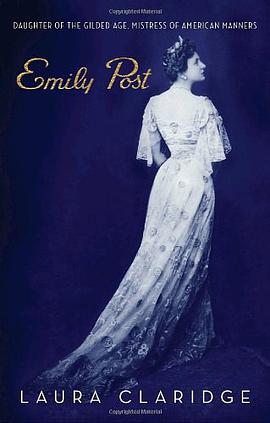
“What would Emily Post do?” Even today, Americans cite the author of the perennial bestseller Etiquette as a touchstone for proper behavior. But who was the woman behind the myth, the authority on good manners who has outlasted all comers? Award-winning author Laura Claridge presents the first authoritative biography of the unforgettable woman who changed the mindset of millions of Americans, an engaging book that sweeps from the Gilded Age to the 1960s.
Born shortly after the Civil War, Emily Post was a daughter of high society, the only child of an ambitious Baltimore architect, Bruce Price, and his wellborn wife. Within a few years of his daughter’s birth, Price moved his family to New York City, where they mingled with the Roosevelts and the Astors as well as with the new crowd in town–J. P. Morgan and the Vanderbilt clan. Blossoming into one of Manhattan’s most sought-after debutantes, Emily went on to marry Edwin Post, planning to re-create in her own home the happiness she’d observed between her parents. Instead, she would find herself in the middle of a scandalous divorce, its humiliating details splashed across the front pages of New York newspapers for months.
Traumatic though it was, the end of her marriage forced Emily Post to become her own person. She would spend the next fifteen years writing novels and attending high-powered literary events alongside the likes of Mark Twain and Edith Wharton, but in middle age she decided she would try something different.
When it debuted in 1922 with a tiny first print run, Etiquette represented a fifty-year-old woman at her wisest–and a country at its wildest. Claridge addresses the secret of Etiquette’s tremendous success and gives us a panoramic view of the culture from which Etiquette took its shape, as its author meticulously updated her book twice a decade to keep it consistent with America’s constantly changing social landscape.
A tireless advocate for middle-class and immigrant Americans, Emily Post became the emblem of a new kind of manners in which etiquette and ethics were forever entwined. Now, nearly fifty years after her death, we still feel her enormous influence on how we think Best Society should behave .
Praise for Emily Post
“Given the ubiquitousness of her repeatedly revised magnum opus, Etiquette , first published in 1922, we think of Emily Post as an institution rather than a human being. But she was a woman of substance and sensitivity. The first to fully portray this pioneer, Claridge is becoming the sort of biographer readers will follow anywhere, and one hopes she’ll continue in the vein that yielded Norman Rockwell (2001) and now this absorbing study of a keenly perceptive ethicist second only to Eleanor Roosevelt in the immensity of her influence. A child of privilege born in the wake of the Civil War, smart and beautiful Emily Price married a rascal. The pain and humiliation of her divorce from Edwin Post fostered her devotion to writing (she was a successful novelist) and seeded the compassion and advocacy for women that shaped her highly moral approach to etiquette. Claridge chronicles Post’s remarkable ability to discern the needs of a Claridge chronicles Post’s remarkable ability to discern the needs of a burgeoning American public transformed by immigration, industrialization, war, and women’s and civil rights, and hungry for guidance in social and familial situations. A best-selling writer and hugely popular radio personality, Post equated etiquette with character and ensured a ‘democratization of manners.’ Claridge greatly deepens our appreciation for Post’s achievements and brings forward the impressive woman behind the do’s and don’ts.” ---Donna Seaman, Booklist (starred review)
“It was the genius of Emily Post to show us that manners are the small coin of morality….Emily Post became perhaps the most important and certainly the most influential moralist of the 20th century. It is Laura Claridge’s genius to explain the surprising and improbable background and equally amazing personality of Emily Post.” — P.J. O’Rourke, author of Modern Manners: An Etiquette Book for Rude People
“What she [Claridge] has given us is not only a canny and insightful read, but when she calls her Emily ‘a domestic anthropologist,’ you know she’s right. Brava!” –Nancy Milford, author of Savage Beauty: The Life of Edna St. Vincent Millay
“Laura Claridge has given us so much more than a mere biography of this august arbiter of good manners; [She] has flung open the doors of an entire society — she has shown us in enchanting, mesmerizing detail how the modern city of New York was built and made.” -- Carolyn See, author of Making a Literary Life
“… a biography as rich and engaging as a portrait by John Singer Sargent.” — Daniel Mark Epstein, author of The Lincolns: Portrait of a Marriage
“Laura Claridge’s masterful Emily Post tells the story of a livelyheroine, raised in a Gilded Age New York of silk-stockings and debutante balls, who wrote one of the enduring bestsellers of the 20th century…. Laura Claridge’s vivid, graceful biography of Emily Post is an essential contribution to American social history.” ——Eric Homberger, author of Mrs. Astor’s New York
作者简介
目录信息
读后感
用户评价
这本**《礼仪的艺术:现代社交指南》**真是令人耳目一新,它几乎可以作为一本关于如何优雅地处理人际关系和日常事务的百科全书。我特别欣赏作者在处理那些细微末节时的那份执着和清晰度,比如餐桌上的刀叉摆放、如何得体地回应不请自来的客人,甚至是数字时代的邮件礼仪。这些看似微不足道的细节,实际上构筑了我们社会互动的基石。阅读过程中,我感觉自己像是在一位经验丰富、品味高雅的导师的指导下,一步步拆解和重塑自己的行为模式。它不是那种枯燥的教条罗列,而是充满了对人性的深刻洞察,让你明白“为什么”要这样做,而不仅仅是“怎么”做。比如,关于介绍环节,书中详细阐述了如何通过恰当的介绍,既能让双方感到舒适,又能为后续的交流奠定积极的基调,这远比我以往阅读的任何速成手册都要深刻。书中对不同场合着装的建议也极为实用,从半正式晚宴到商务午餐,每一种场景都有详尽的色彩搭配和面料选择的指南,让人在关键时刻能自信满满。这本书的价值在于,它将那些我们潜意识里觉得“应该知道”却从未被系统教授的社交智慧,以一种可操作、可学习的方式呈现了出来。它教会我,真正的礼貌不是束缚,而是一种能让周围人都感到愉悦和被尊重的艺术表达。
我花了整整一个周末才读完这本**《家庭事务的艺术管理》**,它完全颠覆了我对“家庭礼仪”的狭隘理解——我曾以为这只关乎谁洗碗。这本书的格局之大,在于它将家庭视为一个微型社会,一个需要精细化管理的“组织”。作者将维护家庭和谐所需的沟通技巧、冲突解决机制,甚至是对待家政服务人员的专业态度,都纳入了讨论范畴。最让我感到震撼的是关于“家庭会议”和“代际沟通”的章节。它提供了一套结构化的方法,来处理那些敏感的、关乎界限和责任分配的问题,避免了情绪化的争吵。书中强调,家庭中的礼仪,核心在于“尊重每一个独立个体的自主权”,即使是最小的孩子,也需要被以对待成年人般的尊重来对待,只是沟通方式需要调整。这种对家庭内部权力动态和情感流动的细腻描摹,让我对自己家中一些长期的、未被言明的紧张关系有了新的认识和处理思路。这本书的基调是温暖而坚定的,它教导我们如何用结构化的方式去承载非结构化的情感,从而建立一个既有秩序又充满爱的生活空间。它无疑是现代家庭生活中不可或缺的“内部治理手册”。
当我翻开这本**《从容应对:公共场合的自我管理学》**时,我原本预期会看到一些老生常谈的“不要打断别人”、“保持微笑”之类的陈词滥调。然而,我错了。这本书的视角非常独特,它聚焦于个体在压力环境下的内部状态管理,而非仅仅是外部动作的规范。它深入探讨了“不自在感”的来源,并提供了一系列心理调适技巧,让我惊奇地发现,许多社交尴尬其实源于我们对自身表现的过度关注。书中对“倾听的科学”那一部分简直是醍醐灌顶,它不仅仅是教你如何保持眼神接触,更引导你去理解积极倾听背后的认知过程——如何延迟判断、如何用非语言信号鼓励对方深入表达。特别是对于那些需要进行公开演讲或商务谈判的场景,作者提供的“准备一套应对突发情况的‘万能暂停’机制”,非常具有实操性。我尝试在一次重要的会议中使用了一种书中提到的呼吸调整法,效果立竿见影,那股想要逃避的冲动瞬间被一种沉稳的力量取代。这本书的行文风格非常冷静克制,带着一种老派的智慧,它没有对现代生活的复杂性做任何让步,而是教你如何在复杂中保持内心的秩序。它更像是一本关于如何成为一个内心强大、不易被环境驱动的“场域掌控者”的指南。
我必须承认,我对**《餐桌上的美学与哲学》**这本书是带着一种审视的态度开始阅读的,因为我对那些过于讲究的餐饮礼仪总有些疏离感。但这本书成功地将餐饮礼仪从一种繁文缛节的负担,转变成了一种对生活品质的深刻追求。它并没有停留在教导你如何区分鱼叉和沙拉叉的层面(虽然这些也讲得很明白),而是深入挖掘了食物背后的文化意义和分享的哲学。作者对不同国家和地区用餐习惯的对比分析尤其精彩,比如对待食物的“浪费观”在不同文明中的差异,这让我对自己在日常用餐中的行为有了更广阔的道德和文化参照系。书中关于侍酒礼仪的部分,也摆脱了那种高高在上的精英主义口吻,转而强调侍酒的核心在于“尊重酿造者的心血和饮用者的感受”。最让我印象深刻的是关于“共同进餐的仪式感”的论述,它提醒我们,在快节奏的生活中,好好坐下来,与所爱之人共享一餐,本身就是一种对“时间”和“关系”的最高敬意。这本书让人学会品味,不仅是品味食物本身,更是品味生活中的每一个细微的、围绕着餐桌展开的互动瞬间。它让吃饭这件事,从生存需求升华为一种高雅的社交仪式。
要用几句话概括**《跨文化交流的无形边界》**这本书的价值,简直是一种挑战,因为它涉及的维度太广,分析得太透彻了。这本书并非一本简单的“禁忌清单”,而是一部关于“理解差异如何影响信息传递”的精妙学术普及作品。作者用大量的案例,生动地展示了在国际商务谈判中,一个微妙的停顿、一个不经意的肢体动作,如何在不同文化背景下被解读为“同意”、“冒犯”或“犹豫不决”。我特别喜欢它关于“高语境文化”和“低语境文化”的区分模型,这个框架帮助我梳理了许多以往沟通失败的模糊体验。这本书的写作风格非常严谨但又不失趣味性,它没有采用那种说教式的批判,而是以一种近乎人类学家的客观冷静,引导读者去构建一个更具适应性的认知地图。例如,书中分析了在不同文化中,“守时”的定义是如何从一个物理时间点,演变成一种对承诺的尊重程度。它让我意识到,所谓的“国际礼仪”,其实是建立在对彼此底层逻辑的深层理解之上的,肤浅的模仿毫无意义。这本书是给任何需要与全球背景的人群打交道的专业人士准备的绝佳工具书,它提供的是洞察力,而非简单的规则手册。