
具体描述
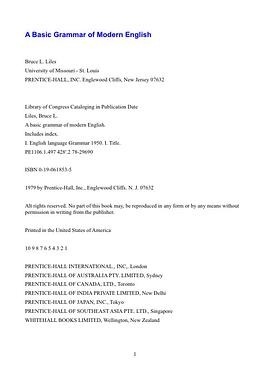
This book is designed for those students whose primary interest is learning
about the structures of written English rather than the methodology of a
particular grammatical model. Consequently, there are no discussions of the
goals of the traditionalists, structuralists, tagmemicists, stratificationalists,
generative-transformationalists, Neo-Firthians, or others who have made
important contributions to the study of language during this century. Each
chapter describes some aspect of English, and the discussions are drawn
eclectically from various grammatical models.
The book includes topics ranging from simple sentence structures to the
more complex. It begins with the Subject-Verb-Object structure and
proceeds to show how it may be expanded with optional adverbials,
auxiliary verbs, and various kinds of modifiers. Finally, such structures as
noun clauses, gerund and infinitive phrases, and compound constructions
are considered. In addition to providing descriptions of these structures, the
book tries to explain why we use them and why one arrangement may be
better than another. Although the length of the book has been deliberately
kept short, the most important structures in English are included, most of
them in some detail.
It is assumed that the users of this book have a dual interest: to learn about
English sentence structure and to acquire enough knowledge to enable them
to apply this material. Some will be interested in studying grammar as an
aid to understanding literature and as a tool for analyzing style. Others will
study it for its applications to their writing or to the teaching of reading and
composition. Still others who are planning to study linguistics as a discipline
in itself need an understanding of the structure of English as background for
more advanced work. Throughout, it is assumed that the readers have a
dual interest, not just a desire to learn grammar for itself.
作者简介
目录信息
Adverbial, 19, 16-28, 30, 52-54, 110-12, 142, 146-47, 151-53
Adverbial complement, 23
Adverbial of accompaniment, 21
Adverbial of agent, 26
Adverbial of concession, 144
Adverbial of condition, 26, 144
Adverbial of degree, 20
Adverbial of direction, 25, 74
Adverbial of frequency, 25
Adverbial of instrument, 26, 52
Adverbial of manner, 17-21, 52, 74, 144
Adverbial of place, 21-23, 52, 144
Adverbial of reason, 26, 52, 144
Adverbial of time, 24-25, 52, 130, 143
Antecedent, 177-81, 182
Appositive, 84-85, 86, 124-25, 148, 149, 187-88
Article, 88, 90
Auxiliary, 38-43, 55-56, 71, 76-77
Case, 185-91
Comma, 53-54, 164-65, 166-67
Common noun, 87
Complement, 12, 86
Complex sentence, 160
Compound, 96
Compound-complex sentence, 160
Compound sentence, 160-61
Compound structure, 158-75
Conjunction, 122, 143, 161-63
Conjunctive adverb, 163-64
Coordinate adjective, 95
Coordinating conjunction, 161-63, 166
Copulative verb, 12
Correlative conjunction, 162
Dangling modifier, 148
Definite article, 88, 102
Deletion, 73, 131, 134
Demonstrative, 88, 90, 102
Dependent clause, 178
Determiner, 96
Direct object, 7-11, 13, 63, 110, 123, 125, 129, 130, 187
Do, 57
Echo question, 55
Elliptical clause, 116
Embedded sentence, 203-4, 208
Expletive, 61, 123, 206
Extraposition, 123, 149- 50, 203-4, 206
Faulty parallelism, 167, 168
Future tense, 35-36
Genitive, 90
Gerund phrase, !28-33, 159, 178, 183-84
Get passive, 75-77
Historical present tense, 34
Indefinite article, 88
Indefinite pronoun, 73, 131, 180
Indirect object, 62-64, 86, 125, 130, 187
Infinitive, 30
Infinitive phrase, 133-34, 146--47, 159, 178, 183-84
Inflected possessive, 92
Intensifier, 20
Intensive pronoun, 181-82
Interrogative pronoun, 105-28
Intransitive verb, 9, 13, 44
Linking verb, 12, 14, 75
Modals, 36-38
Negatives, 77
Nominative case, 185
Nonrestrictive modifier, 112-17
Noun, 10, 132
Noun clause, 122-28, 159, 204
Noun phrase, 10, 83-101, 177
Object, 83
Objective case, 185
Objective complement, 85-86, 110, 126, 130
Object of a preposition, 83, 126, 127, 130, 187
Parallel structure, 167-68
Participial phrase, 107-11, 115-16, 147, 149-50, 159, 178, 183-84
Passive, 69-82
Passive structure, 70, 83, 109-10
Past participle, 41, 44-46, 70, 74, 108-9, 147, 150
Past tense, 30-32, 45-46
Perfect tense, 39-43
Periphrastic possessive, 92-93
Possessive, 89-94, 102, 185-86
Predicate, 5-6
Predicate adjective, 11, 14, 110, 130
Predicate nominative, 12
Predicate noun, 11, 14, 83, 84, 122, 126, 130, 134
Preposition, 19, 22, 24, 60, 106
Prepositional phrase, 19, 112
Present participle, 39, 108-9, 132, 147, 149
Present tense, 32-34, 169
Progressive action, 38-39
Progressive verb, 38
Pronoun, 176-98
Proper noun, 86-87
Reflexive pronoun, 76, 182-85
Relative clause, 103-7, 124-25, 159, 203
Relative pronoun, 104-6, 125
Restrictive modifier, 112-17
Semicolon, 160, 165
Sentence adverbial, 20-21
Simple sentence, 160
Stative verb, 72, 74
Strong verb, 31, 44-46
Subject, 4-5, 83, 122, 125, 129, 130, 131, 133, 187
Subjective complement, 12
Subject-verb agreement, 6, 169-71
Subjunctive mood, 37, 191
Subordinate conjunction, 143
Subordination, 104
Suppletive verb, 32
SVO order, 8-9, 64-65, 69, 121, 201-6
Tense, 30-36
There, 60-62
Third person, 32
Transitive verb, 9, 13, 44
Verb phrase, 29-50
Weak verb, 31, 44
WH question, 58-60, 188
Who, 3, 59-60, 126-27, 189-91
Yes-no question, 54-57, 77, 128
· · · · · · (收起)