具体描述
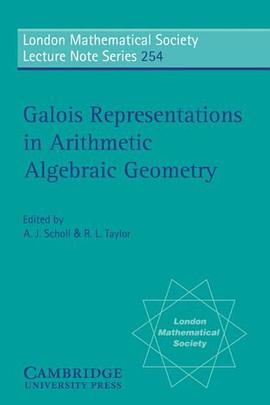
This book contains conference proceedings from the 1996 Durham Symposium on 'Galois representations in arithmetic algebraic geometry'. The title was interpreted loosely and the symposium covered recent developments on the interface between algebraic number theory and arithmetic algebraic geometry. The book reflects this and contains a mixture of articles. Some are expositions of subjects which have received substantial attention, e.g. Erez on geometric trends in Galois module theory; Mazur on rational points on curves and varieties; Moonen on Shimura varieties in mixed characteristics; Rubin and Scholl on the work of Kato on the Birch-Swinnerton-Dyer conjecture; and Schneider on rigid geometry. Others are research papers by authors such as Coleman and Mazur, Goncharov, Gross and Serre.
Galois Representations in Arithmetic Algebraic Geometry: A Deeper Dive into Geometric Structures and Number Theoretic Connections This book delves into the intricate relationship between Galois representations and arithmetic algebraic geometry, exploring how profound symmetries in algebraic varieties over number fields manifest as representations of Galois groups. It offers a comprehensive examination of these fundamental objects, their construction, properties, and their pivotal role in unlocking deep arithmetic invariants of geometric objects. The narrative begins by laying a solid foundation in the theory of Galois representations. It systematically introduces the concept of a Galois representation, focusing on those arising from the action of the absolute Galois group of a number field on various moduli spaces and cohomology groups associated with algebraic varieties. Key examples such as Tate modules of elliptic curves and abelian varieties, as well as étale cohomology of smooth projective varieties, are thoroughly analyzed. The book meticulously details the definition and significance of these representations, emphasizing their connection to the arithmetic of the underlying geometric structures. A significant portion of the exposition is dedicated to the study of the deformation theory of Galois representations. This area, crucial for understanding the landscape of possible Galois representations and their moduli, is treated with considerable rigor. The book explores the infinitesimal and higher-order deformations of a given Galois representation, introducing the essential tools and concepts like the deformation functor and its associated universal object. The interplay between geometric moduli spaces of certain objects (e.g., families of elliptic curves) and the deformation spaces of their associated Galois representations is a recurring theme, highlighting the power of this correspondence. Furthermore, the text provides an in-depth treatment of the properties and classifications of Galois representations. It delves into the notions of irreducibility, semisimplicity, and the concept of "crystalline" or "de Rham" representations in the context of p-adic fields, linking them to the arithmetic of varieties over finite fields and p-adic fields respectively. The book also explores the profound implications of the inverse Galois problem and its reformulations in the context of algebraic geometry, examining how Galois representations can encode information about the structure of Galois groups themselves. The authors skillfully weave together concepts from algebraic geometry, number theory, and representation theory. For instance, the construction of Galois representations from étale cohomology is meticulously explained, demonstrating how the geometric structure of a variety over a number field dictates the representation afforded by its étale fundamental group or higher étale cohomology. The book explores the rich properties of these representations, including their behavior under functoriality, base change, and their connections to modular forms and automorphic representations. The latter is a particularly important area, where the book discusses how Galois representations arising from geometry are conjectured to be automorphic, a cornerstone of the Langlands program. The book also addresses advanced topics, such as the theory of motives and their role in unifying different cohomology theories and Galois representations. It explores how the concept of a Chow ring and its relation to cohomology provides further insight into the structure of Galois actions on geometric objects. The p-adic aspect of Galois representations is given due attention, with discussions on their properties over p-adic fields and their connections to p-adic Hodge theory. Throughout the text, numerous examples and detailed calculations are presented to illustrate the abstract concepts. These concrete instances range from classical examples like the Galois representations attached to elliptic curves and modular forms to more recent developments in the study of Galois representations arising from higher-dimensional varieties and their associated zeta functions. The book aims to equip the reader with the necessary theoretical framework and computational tools to understand and contribute to this vibrant field. This volume is designed for graduate students and researchers in mathematics with a strong background in algebraic geometry and number theory. It serves as an invaluable resource for those seeking a comprehensive understanding of the sophisticated interplay between geometric structures and arithmetic symmetries, paving the way for further exploration into cutting-edge research questions at the intersection of these disciplines.