具体描述
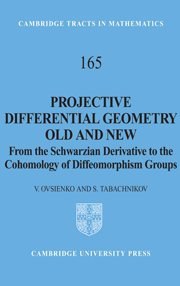
Ideas of projective geometry keep reappearing in seemingly unrelated fields of mathematics. The authors' main goal in this 2005 book is to emphasize connections between classical projective differential geometry and contemporary mathematics and mathematical physics. They also give results and proofs of classic theorems. Exercises play a prominent role: historical and cultural comments set the basic notions in a broader context. The book opens by discussing the Schwarzian derivative and its connection to the Virasoro algebra. One-dimensional projective differential geometry features strongly. Related topics include differential operators, the cohomology of the group of diffeomorphisms of the circle, and the classical four-vertex theorem. The classical theory of projective hypersurfaces is surveyed and related to some very recent results and conjectures. A final chapter considers various versions of multi-dimensional Schwarzian derivative. In sum, here is a rapid route for graduate students and researchers to the frontiers of current research in this evergreen subject.
Projective Differential Geometry: A Bridge Between Geometry and Analysis This book offers a comprehensive exploration of projective differential geometry, a field that gracefully intertwines the intrinsic properties of curves and surfaces with the powerful tools of calculus and differential equations. It delves into how projective transformations, which preserve lines and ratios of distances along lines, reveal fundamental geometric invariants that are otherwise obscured by Euclidean measurements. Part I: Foundations in Projective Space The journey begins with a rigorous introduction to projective space. We will establish the fundamental concepts of homogeneous coordinates, lines, planes, and higher-dimensional projective spaces. The geometric interpretation of projective transformations, including their matrices and canonical forms, will be meticulously laid out. Special attention will be paid to the concept of polarity and its profound implications in relating points and lines, as well as conics and quadrics. This foundational section will equip the reader with the essential language and framework for understanding the subsequent geometric developments. Part II: Projective Properties of Curves The focus then shifts to curves, where we will investigate their behavior under projective transformations. The concept of the projective tangent and osculating plane will be introduced, and we will derive differential invariants that characterize curves projectively. This will involve exploring the fundamental theorems of projective curve theory, such as the classification of projectively equivalent curves. The relationship between curvature in Euclidean geometry and its projective counterparts will be examined, highlighting how projective invariants offer a more intrinsic and general description. We will also delve into the study of special curves with significant projective properties. Part III: Projective Geometry of Surfaces Building upon the theory of curves, we will extend our investigations to surfaces. The projective normal, geodesic, and asymptotic lines will be defined, and their projective significance will be elucidated. The core of this section lies in the development of projective surface theory, which aims to classify surfaces based on their behavior under projective transformations. We will introduce and meticulously analyze the fundamental equations of projective differential geometry for surfaces, including the determination of projective curvature. Key theorems, such as the Dupin cyclide in a projective context, will be explored, revealing the deep connections between differential invariants and projective equivalence. The section will also touch upon special types of surfaces possessing unique projective characteristics. Part IV: Advanced Topics and Modern Connections The latter part of the book ventures into more advanced and contemporary aspects of projective differential geometry. This will include exploring connections with affine differential geometry, highlighting the transition from projective to affine invariants. We will investigate the role of Lie groups and their actions in understanding projective transformations and their invariants. The geometric interpretation of certain differential equations within the projective framework will be examined, showcasing the interplay between geometry and analysis. Furthermore, the book will touch upon modern research directions and potential applications, such as connections to algebraic geometry and areas of theoretical physics where projective structures play a crucial role. Throughout the book, the emphasis will be on a clear and intuitive geometric understanding, supported by rigorous analytical derivations. The interplay between visual intuition and formal mathematical proof will be a guiding principle. While no prior knowledge of projective geometry is strictly assumed, a solid understanding of differential calculus and basic linear algebra will be beneficial. The material is structured to be accessible to graduate students and researchers in mathematics and related fields seeking to deepen their understanding of geometric structures and their transformations. The "Old and New" in the title reflects both the established classical results and the modern reinterpretations and extensions that continue to make this field vibrant and relevant.