
具体描述
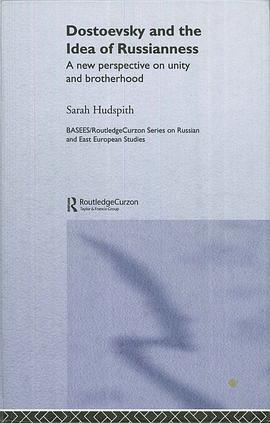
This book examines Dostoevsky’s interest in, and engagement with, ‘Slavophilism’
- a Russian mid-nineteenth century movement of conservative nationalist
thought. It explores Dostoevsky’s views, as expressed in both his non-fiction and
fiction, on the religious, spiritual and moral ideas which he considered to be
innately Russian. It concludes that Dostoevsky is an important successor to the
Slavophiles, in that he developed their ideas in a more coherent fashion,
broadening their moral and spiritual concerns into a more universal message
about the true worth of Russia and her people.
作者简介
Sarah Hudspith is a lecturer at the University of Leeds. Her main area of
specialism is nineteenth-century Russian literature, especially Dostoevsky and
Tolstoy.
目录信息
Note on editions, transliteration and translation
1. The Slavophile context
2. Dostoevsky’s ideological position with regard to the Slavophile movement
Early work 17
Siberia 23
Vremia, Epokha and pochvennichestvo 38
Diary of a Writer and the Pushkin Speech 64
3 The dramatization in Dostoevsky’s fiction of themes found in Slavophile thought
The condition of rootiessness: the Kushite category 90
Living in sobornost': the Iranian category 128
4 The Iranian text: Slavophile principles applied to the practice of writing
Dostoevsky and the Slavophile aesthetic 162
Examples of Slavophile writing in Dostoevsky’s oeuvre 176
5 Concluding remarks
Glossary of Russian terms 202
Notes 204
Bibliography 217
Index 224
· · · · · · (收起)
读后感
用户评价
感觉还可以。
感觉还可以。
感觉还可以。
感觉还可以。
感觉还可以。