
具体描述
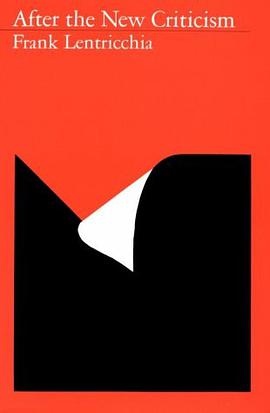
This work is the first history and evaluation of contemporary American critical theory within its European philosophical contexts. In the first part, Frank Lentricchia analyzes the impact on our critical thought of Frye, Stevens, Kermode, Sartre, Poulet, Heidegger, Sussure, Barthes, Levi-Strauss, Derrida, and Foucault, among other, less central figures. In a second part, Lentricchia turns to four exemplary theorists on the American scene--Murray Krieger, E. D. Hirsch, Jr., Paul de Man, and Harold Bloom--and an analysis of their careers within the lineage established in part one.
Lentricchia's critical intention is in evidence in his sustained attack on the more or less hidden formalist premises inherited from the New Critical fathers. Even in the name of historical consciousness, he contends, contemporary theorists have often cut literature off from social and temporal processes. By so doing he believes that they have deprived literature of its relevant values and turned the teaching of both literature and theory into a rarefied activity. All along the way, with the help of such diverse thinkers as Saussure, Barthes, Foucault, Derrida, and Bloom, Lentricchia indicates a strategy by which future critical theorists may resist the mandarin attitudes of their fathers.
作者简介
目录信息
读后感
用户评价
If we share Arnold's loss of faith, we can go either of two ways: we can view poetry as a human triumph made out of our darkness, as the creation of verbal meaning in a blank universe to serve as a visionary substitute for a defunct religion; or we can-in our negation-extend our faithlessness, the blankness of our universe, to our poetry.不言而喻,选择前路。
If we share Arnold's loss of faith, we can go either of two ways: we can view poetry as a human triumph made out of our darkness, as the creation of verbal meaning in a blank universe to serve as a visionary substitute for a defunct religion; or we can-in our negation-extend our faithlessness, the blankness of our universe, to our poetry.不言而喻,选择前路。
If we share Arnold's loss of faith, we can go either of two ways: we can view poetry as a human triumph made out of our darkness, as the creation of verbal meaning in a blank universe to serve as a visionary substitute for a defunct religion; or we can-in our negation-extend our faithlessness, the blankness of our universe, to our poetry.不言而喻,选择前路。
If we share Arnold's loss of faith, we can go either of two ways: we can view poetry as a human triumph made out of our darkness, as the creation of verbal meaning in a blank universe to serve as a visionary substitute for a defunct religion; or we can-in our negation-extend our faithlessness, the blankness of our universe, to our poetry.不言而喻,选择前路。
If we share Arnold's loss of faith, we can go either of two ways: we can view poetry as a human triumph made out of our darkness, as the creation of verbal meaning in a blank universe to serve as a visionary substitute for a defunct religion; or we can-in our negation-extend our faithlessness, the blankness of our universe, to our poetry.不言而喻,选择前路。