
具体描述
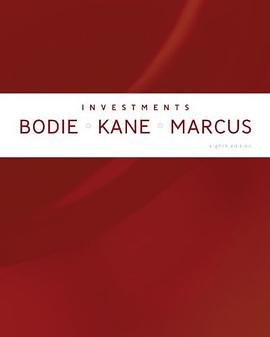
Investments, Eighth Edition, is intended primarily as a
textbook for courses in investment analysis. Our guiding
principle has been to present the material in a framework
that is organized by a central core of consistent fundamental
principles. We make every attempt to strip away unnecessary
mathematical and technical detail, and we have
concentrated on providing the intuition that may guide
students and practitioners as they confront new ideas and
challenges in their professional lives.
作者简介
Zvi Bodie is Professor of Finance and Economics at the Boston University School of Management. He is the director of Boston University’s Chartered Financial Analysts Examination Review Program and has served as consultant to many private and governmental organizations. Professor Bodie is a research associate of the National Bureau of Economic Research, where he was director of the NBER Project on Financial Aspects of the U.S. Pension System, and he is a member of the Pension Research Council of The Wharton School. He is widely published in leading professional journals, and his previous books include Pensions in the U.S. Economy, Issues in Pension Economics, and Financial Aspects of the U.S. Pension System.
Alex Kane is professor of finance and economics at the Graduate School of International Relations and Pacific Studies at the University of California, San Diego. He was visiting professor at the Faculty of Economics, University of Tokyo; Graduate School of Business, Harvard; Kennedy School of Government, Harvard; and research associate, National Bureau of Economic Research. An author of many articles in finance and management journals, Professor Kane’s research is mainly in corporate finance, portfolio management, and capital markets, most recently in the measurement of market volatility and the pricing of options. Professor Kane is the developer of the International Simulation Laboratory (ISL) for training and experimental research in executive decision making.
Alan Marcus is professor of finance in the Wallace E. Carroll School of Management at Boston College. He received his PHD in Economics from MIT in 1981. Professor Marcus recently has been a visiting professor at the Athens Laboratory of Business Administration and at MIT’s Sloan School of Management and has served as a research associate at the National Bureau of Economic Research. He also established the Chartered Financial Analysts Review Program at Boston College. Professor Marcus has published widely in the fields of capital markets and portfolio management, with an emphasis on applications of futures and options pricing models. His consulting work has ranged from new product development to provision of expert testimony in utility rate proceedings. He also spend two years at the Federal Home Loan Mortgage Corporation (Freddie Mac), where he developed models of mortgage pricing and credit risk, and he currently serves on the Advisory Council for the Currency Risk Management Alliance of State Street Bank and Windham Capital Management Boston.
目录信息
读后感
基于外国市场的波动以及市场间的相关性,我们认为最优证券组合投资为70%投资于美国,20%投资于发达国家市场,10%投资于新兴市场 国际投资可以被认为只是一种简单的归纳,这种简单的归纳是我们前面讲的用大量的资产构成投资组合的投资组合选择的方法。 投资者面对相似的问题,诸...
区分四种类型的市场:直接交易市场、经纪人市场、交易商市场和拍卖市场 1. 直接交易市场 直接交易市场是最松散的市场,买方和卖方必须直接相互搜寻。 例如,要售出一台旧冰箱,卖方通过在当地报纸上登载广告征求买方。 该市场的特点是零星参与、低价和商品的非标准化。 专于这...
区分四种类型的市场:直接交易市场、经纪人市场、交易商市场和拍卖市场 1. 直接交易市场 直接交易市场是最松散的市场,买方和卖方必须直接相互搜寻。 例如,要售出一台旧冰箱,卖方通过在当地报纸上登载广告征求买方。 该市场的特点是零星参与、低价和商品的非标准化。 专于这...
投资银行负责新证券向公众的发行。 一旦证券交易委员会对募股说明书做出评价,而且说明书初稿已经被分发给了感兴趣的投资者,投资银行就会组织路演,全美巡回宣传即将进行的发行活动。 这些路演活动有两个目的: 一是为潜在投资者提供发行信息的同时激发其兴趣; 二是为发行公...
用户评价
最后几章还没看
最后几章还没看
最后几章还没看
最后几章还没看
最后几章还没看