具体描述
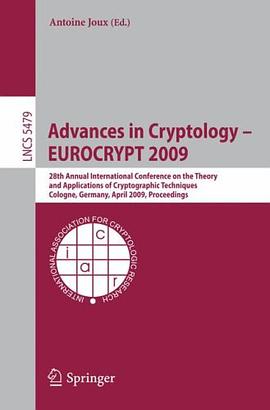
This book constitutes the refereed proceedings of the 28th Annual International Conference on the Theory and Applications of Cryptographic Techniques, EUROCRYPT 2009, held in Cologne, Germany, in April 2009. The 33 revised full papers presented together with 1 invited lecture were carefully reviewed and selected from 148 submissions. The papers address all current foundational, theoretical and research aspects of cryptology, cryptography, and cryptanalysis as well as advanced applications. The papers are organized in topical sections on security, proofs, and models, hash cryptanalysis, group and broadcast encryption, cryptosystems, cryptanalysis, side channels, curves, and randomness.
The Foundations of Modern Cryptography: A Deep Dive into Contemporary Security Protocols This volume offers a comprehensive exploration of the cutting edge in cryptographic theory and practice, moving beyond the specific proceedings of EUROCRYPT 2009 to focus on the enduring principles and emerging challenges that define modern information security. While acknowledging the historical significance of specific conferences, this collection charts the broader landscape of cryptographic research, emphasizing foundational concepts, novel construction techniques, and the rigorous analysis required to secure the digital age. The text is meticulously structured into several thematic sections, designed to guide the reader from fundamental cryptographic primitives to complex, real-world application scenarios. Part I: Primitive Constructions and Provable Security This section lays the groundwork by examining the bedrock upon which all secure systems are built. It delves into the mathematical structures underpinning modern cryptography, moving beyond simple block ciphers to explore advanced concepts such as lattice-based cryptography and pairing-based cryptography. Hardness Assumptions and Reduction Proofs: A significant portion is dedicated to understanding the necessity of reliance on computational hardness assumptions. We dissect the most influential assumptions—including the Discrete Logarithm Problem (DLP), the Decisional Diffie-Hellman (DDH) problem, and factoring—examining their current standing in the face of new algorithmic attacks. The focus here is on the formal methodology of proving security: how researchers construct a system and then rigorously reduce its security to the assumed hardness of a well-studied problem. This ensures that breaking the cryptosystem implies solving a fundamentally hard mathematical puzzle. Symmetric Key Cryptography Evolutions: While the focus shifts towards asymmetric methods, the evolution of symmetric primitives remains crucial. This part analyzes the design principles behind modern block ciphers and hash functions, emphasizing criteria like diffusion, confusion, and resistance to advanced cryptanalytic techniques such as differential and linear cryptanalysis. We explore modes of operation (e.g., authenticated encryption schemes like GCM) that move beyond simple confidentiality to provide integrity and authenticity simultaneously, a necessity in networked communications. Pseudorandomness and Expansions: The concept of true randomness versus provable pseudorandomness is explored in detail. We review the construction and analysis of robust Pseudorandom Generators (PRGs) and Pseudorandom Functions (PRFs), detailing how deterministic algorithms can simulate true randomness effectively enough for cryptographic purposes. This includes a mathematical treatment of stream ciphers derived from these primitives, focusing on their resilience against state recovery attacks. Part II: Public-Key Infrastructure and Key Exchange The transition to public-key cryptography revolutionized secure communication. This section concentrates on the algorithms that enable secure key establishment over insecure channels and the management of digital identities. The Mathematics of Key Exchange: Beyond the foundational Diffie-Hellman exchange, the text explores its vulnerabilities and modern replacements. This includes an in-depth look at Elliptic Curve Cryptography (ECC), detailing the mathematical advantages (smaller key sizes for equivalent security) and implementation challenges. We cover the intricacies of curve selection, point decompression, and the specific security models (e.g., MOV attack resistance) relevant to elliptic curve discrete logarithms. Digital Signatures and Authentication: Authentication mechanisms are scrutinized. The analysis covers the spectrum from traditional signature schemes (like DSA and RSA-PSS) to more advanced, smaller, and faster schemes. A core focus is placed on post-quantum considerations, introducing lattice-based signature schemes (such as those based on the Short Integer Solution problem) as essential future-proofing mechanisms against the theoretical threat of large-scale quantum computation. Certificate Authorities and Trust Models: The practical realization of public-key cryptography hinges on trust infrastructures. This part examines various PKI models, including Hierarchical PKI, web-of-trust models, and emerging concepts like decentralized identity management. It discusses the critical interplay between cryptographic strength and operational security failures within these management systems. Part III: Advanced Cryptographic Primitives and Applications This final section moves into specialized cryptographic tools designed to achieve specific security goals often unattainable with basic encryption alone. Zero-Knowledge Proofs (ZKPs): ZKPs are examined as a cornerstone of privacy-enhancing technology. The text differentiates between interactive and non-interactive proofs, detailing the mathematical structures underpinning schemes like Schnorr proofs and more complex, modern constructions like zk-SNARKs and zk-STARKs. The focus is on how these proofs allow one party to convince another of a statement's truth without revealing any underlying information, with applications in verifiable computation and anonymous credential systems. Homomorphic Encryption (HE): A significant chapter is dedicated to the revolutionary field of Homomorphic Encryption, where computations can be performed directly on encrypted data without decryption. The discussion traces the development from partially homomorphic schemes (like Paillier) through to fully homomorphic encryption (FHE). It delves into the underlying mathematics—often involving noisy lattices and polynomial rings—and outlines the trade-offs between computational overhead, security levels, and the complexity of the supported arithmetic operations. Secure Multi-Party Computation (MPC): MPC enables multiple distrusting parties to jointly compute a function over their private inputs, revealing only the function's output. The text analyzes the fundamental protocols for secure addition and multiplication gates, exploring various paradigms such as secret sharing schemes (e.g., Shamir's scheme) and garbled circuits. The efficiency challenges associated with achieving high rounds of communication versus the robust security guarantees of abortive protocols are critically assessed. Part IV: Implementation Security and Cryptanalysis The transition from mathematical design to physical implementation introduces a new realm of vulnerabilities. This final section addresses the practical aspects of security assurance. Side-Channel Attacks (SCA): This topic is treated with seriousness, detailing how physical leakage—power consumption, electromagnetic radiation, timing variations—can betray secret cryptographic keys. Analysis includes Differential Power Analysis (DPA), Simple Power Analysis (SPA), and countermeasures such as blinding, masking, and constant-time programming practices, emphasizing that even perfectly secure mathematics can be broken by imperfect hardware implementation. Formal Verification and Language-Based Security: The necessity of proving that a protocol implementation correctly matches its mathematical specification is explored through formal methods. This includes the use of specialized cryptographic description languages and formal verification tools to catch subtle logical flaws that might escape standard software testing. The Evolving Threat Landscape: Concluding the volume, this part synthesizes current trends, examining the implications of increasing computational power and the ongoing research into quantum algorithms (like Shor's and Grover's algorithms) that threaten current asymmetric cryptography standards. It reinforces the need for continuous cryptanalysis and proactive migration towards quantum-resistant algorithms. This compilation serves not merely as a record of past achievements, but as an essential reference manual for researchers, engineers, and advanced students committed to building and breaking the next generation of secure digital systems. The emphasis remains firmly fixed on rigorous proofs, architectural soundness, and practical security assessment.