
具体描述
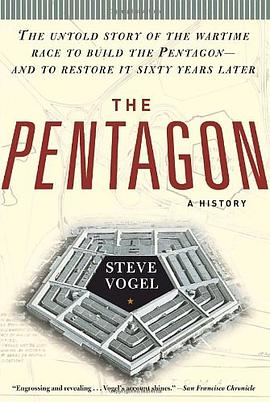
The creation of the Pentagon in seventeen whirlwind months during World War II is one of the great construction feats in American history, involving a tremendous mobilization of manpower, resources, and minds. In astonishingly short order, Brigadier General Brehon B. Somervell conceived and built an institution that ranks with the White House, the Vatican, and a handful of other structures as symbols recognized around the world. Now veteran military reporter Steve Vogel reveals for the first time the remarkable story of the Pentagon’s construction, from it’s dramatic birth to its rebuilding after the September 11 attack.
At the center of the story is the tempestuous but courtly Somervell–“dynamite in a Tiffany box,” as he was once described. In July 1941, the Army construction chief sprang the idea of building a single, huge headquarters that could house the entire War Department, then scattered in seventeen buildings around Washington. Somervell ordered drawings produced in one weekend and, despite a firestorm of opposition, broke ground two months later, vowing that the building would be finished in little more than a year. Thousands of workers descended on the site, a raffish Virginia neighborhood known as Hell’s Bottom, while an army of draftsmen churned out designs barely one step ahead of their execution. Seven months later the first Pentagon employees skirted seas of mud to move into the building and went to work even as construction roared around them. The colossal Army headquarters helped recast Washington from a sleepy southern town into the bustling center of a reluctant empire.
Vivid portraits are drawn of other key figures in the drama, among them Franklin D. Roosevelt, the president who fancied himself an architect; Secretary of War Henry L. Stimson and Army Chief of Staff General George C. Marshall, both desperate for a home for the War Department as the country prepared for battle; Colonel Leslie R. Groves, the ruthless force of nature who oversaw the Pentagon’s construction (as well as the Manhattan Project to create an atomic bomb); and John McShain, the charming and dapper builder who used his relationship with FDR to help land himself the contract for the biggest office building in the world.
The Pentagon’s post-World War II history is told through its critical moments, including the troubled birth of the Department of Defense during the Cold War, the tense days of the Cuban Missile Crisis, and the tumultuous 1967 protest against the Vietnam War. The pivotal attack on September 11 is related with chilling new detail, as is the race to rebuild the damaged Pentagon, a restoration that echoed the spirit of its creation.
This study of a single enigmatic building tells a broader story of modern American history, from the eve of World War II to the new wars of the twenty-first century. Steve Vogel has crafted a dazzling work of military social history that merits comparison with the best works of David Halberstam or David McCullough. Like its namesake, The Pentagon is a true landmark.
"Among books dealing with seemingly impossible engineering feats, this easily ranks with David McCullough’s The Great Bridge and The Path Between the Seas , as well as Ross King’s Brunelleschi’s Dome ." - Kirkus Reviews (Starred Review)
"Vogel artfully weaves architectural and cultural history, thus creating a brilliant and illuminating study of this singular (and, in many ways, sacred) American space." - Publishers Weekly (Starred Review)
"An amazing story, expertly researched and beautifully told. Part history, part adventure yarn, The Pentagon is above all else the biography of an American icon." - Rick Atkinson, Pulitzer Prize winning author of An Army at Dawn
"This book, like the Pentagon itself, is a stunning and monumental achievement." –Andrew Carroll, editor of the New York Times bestsellers, War Letters and Behind the Lines
"Superb! Not only the best biography of a building ever written, but a fascinating look at the human architecture behind the Pentagon--the saints and scoundrels of our national defense. With his decades of experience covering the military and a web of insider connections, Steve Vogel has produced a book that's not only timely and a treat to read, but a stellar example of how to write history in the twenty-first century." - Ralph Peters, author of Never Quit The Fight
“This concrete behemoth – the largest office building in the world – is also the product of considerable human ingenuity and resourcefulness, as Steve Vogel amply demonstrates in his interesting account… This is not, of course, the first account of the [9/11] attack, but with its Clancyesque action and firsthand detail… it is surely the most vivid.” — Witold Rybczynski, The New York Times Book Review , June 10, 2007
"Vogel's account shines . . . . [A]n engrossing and revealing account. . . . Vogel provides a first-rate account of the transformation of a dilapidated Arlington neighborhood into what Norman Mailer called "the true and high church of the military industrial complex." -- Yonatan Lupu, The San Francisco Chronicle, June 10, 2007
“The saga of the construction of the Pentagon, skillfully recounted by Steve
Vogel, a military reporter on the Washington Post , is as enthralling as it
is improbable. . . . It was one of the greatest engineering feats of the
20th century–driven by the intelligence and willpower of larger-than-life
figures prepared to cut corners and demand the impossible. Mr Vogel has
brought to our notice a thrilling achievement.”– The Economist, June 30, 2007
A Wall Street Journal selection forits 2007 summer reading list.
“THE PLOT: How the Pentagon, the world's most famous defense building, was
erected just as the U.S was pulled into World War II, and its subsequent
history, including the rebuilding after the Sept. 11 attack.
THE BACKSTORY: Mr. Vogel spent two years writing and researching the book.
"The Pentagon" has drawn rave prepublication reviews, and within Random
House there is hope that it will fill the usual summer slot for a big
history title. It's printing 30,000 copies to start.
WHAT GRABBED US: Anecdotes about the Pentagon's early days. The cafeteria
couldn't keep up with the flood of workers; security was so lax in 1972
that the Weathermen walked in and planted a bomb, which exploded in a
bathroom.”–Robert Hughes, The Wall Street Journal, May 11, 2007
“Steve Vogel's marvelous work recounts the construction of one
of the world's most iconic buildings - the Pentagon. But more compelling by
far, he relates the human stories underlying this huge construction effort.
. . .All this would of itself be enough to warrant a book but Vogel plunges on
to an appropriate second story: the terrorist assault of 9/11 and the
Pentagon's subsequent resurrection. This section of the book, due perhaps
to the proximity of the event, is all the more compelling. . .
–Frederick J. Chiaventone, New York Post , June 17, 2007
“Vogel's writing coupled with the dynamic, conflict-strewn
history of the Pentagon provides for a fascinating and comfortable read
while giving new insight into an old Washington landmark."– Roll Call , June 5, 2007
“Students, writers and historians will use The Pentagon as a
reference book for years to come. Vogel has created an admirable, timely
and immensely readable book. It is a must read for anyone who has ever
worked in the building.”– The Pentagram , June 17, 2007
"Steve Vogel has provided two excellent books in one: an interesting
account of the frenetic effort to build the world's largest office building
in order to support the U.S. entry into World War II, and an equally
fascinating study of how the building survived and was reborn in the
renovation effort so rudely interrupted on Sept. 11, 2001. . . .
Vogel has done a great service to a historic structure and its people.
–Raymond Leach, The Virginian-Pilot , July 29, 2007
"Few major buildings were constructed in as much of a hurry and with as
many challenges as the building that is synonymous with the nation's
defense. Almost by accident, it is one of the best-known buildings in the
world. The building, of course, is the Pentagon, and its story is wonderfully told
in a new book ``The Pentagon -- A History''(Random House) by veteran
Washington Post military writer Steve Vogel. . . .Every building of any size and complexity has a story; few of them are this compelling.”
–Tom Condon, The Hartford Courant , July 22, 2007
[Vogel] "puts on display his superlative skills as a journalist with capturing
human detail. Above all, he reminds us that history is made by living
people, and he has a biographer's fascination with the details of dozens of
personalities who made the Pentagon what it is today."
–Mark Falcoff, The New York Sun , July 11, 2007
"Vogel vividly depicts the horror of those inside the Pentagon on
September 11, 2001 and then skillfully describes the rebirth of the
Pentagon through the Phoenix Project. His intimate knowledge of the
construction process and his years of research energize these pages. . . .
[T]here is simply no bett...
作者简介
目录信息
读后感
用户评价
坦白讲,我一开始是对这类题材持保留态度的,总觉得容易落入俗套。但是,这本书彻底颠覆了我的预期。它最吸引我的地方,在于它对“灰色地带”的深入挖掘。这里没有绝对的好人或坏蛋,只有在特定环境下做出艰难抉择的普通人。作者没有急于给出简单的道德审判,而是将所有的人物都放置在一个高压锅里,观察他们如何变形、如何挣扎。特别是其中关于“信息不对称”的描写,简直是教科书级别的范例,你跟随主角一起摸索真相的过程,充满了紧张和焦虑。我发现自己好几次停下来,不是因为累了,而是因为需要时间消化刚刚读到的信息量,并重新组织自己的判断。那些伏笔的设置,极其巧妙,埋得深,但每次被触发时,带来的冲击力都非常强大,绝不是那种生硬的“打脸”情节。这本书的文字风格偏向于冷峻的现实主义,带着一种清醒的克制感,这种克制反而让那些爆发点更加震撼人心。读完之后,我甚至开始反思自己生活中一些既定的认知,这本书的价值就在于此,它让你跳出舒适区。
这次的阅读体验,像是一次深入热带雨林的探险,充满了不可预知的惊喜和偶尔的惊悚。我很少读到一本小说能将叙事节奏控制得如此炉火纯青。它不是那种一味追求快节奏的商业小说,而是懂得在恰当的时候放慢脚步,让你沉浸于某个特定角色的内心独白,感受那种由内而外散发的,近乎哲学层面的思考。故事线索交织得非常精妙,每一个看似无关紧要的支线情节,最终都像一根根细线汇集成了一幅宏伟的挂毯,当你恍然大悟时,那种“原来如此”的震撼感是无与伦比的。作者对于“意外”的布局,高明之处在于,它总是合乎逻辑,却又完全出乎意料。我不得不佩服作者的想象力,构建了一个如此真实可信的世界观,其中的规则和禁忌,都让读者深信不疑。书中的一些对话,简直可以拿来做教科书案例,那种言简意赅却力量无穷的表达方式,非常值得学习。整体来说,这是一部需要你全神贯注去投入的佳作,如果你只是想随便翻翻,可能会错过太多精妙之处。
我得说,这本书有一种罕见的、近乎古典的史诗感,尽管它的背景可能设定在当代或一个架空的世界。作者构建了一个庞大而复杂的社会结构,其运作的逻辑严密得令人发指,让人在阅读过程中不断惊叹于作者的逻辑自洽能力。它不像许多现代小说那样追求快速的情感共鸣,而是更注重对系统和制度的解构。阅读过程中,我经常需要回头查阅前面几章的内容,以确保完全理解某个关键术语或某个权力阶层的运作规则。这种沉浸式的学习过程,虽然略显费力,但收获是巨大的。书中的角色行动,很少是出于单纯的冲动,更多的是基于他们所处的社会位置和必须遵守的潜规则。这使得人物的行为逻辑充满了合理性,即使是那些看似疯狂的举动,在特定的框架下也变得可以理解。这本书对“结构性暴力”的描绘,是它最强大的地方,它揭示了隐藏在日常表象之下的,那些冰冷而无情的运行机制。读完后,我感觉自己对这个世界的理解又多了一层阴影,一种清醒的悲凉感油然而生。
这本书的阅读体验,可以概括为“渐入佳境,而后一泻千里”。起初的几章,叙事略显平缓,甚至有些晦涩,我一度担心是不是选错了书。但请相信我,度过最初的适应期后,你会发现作者在用一种极其耐心的方式为你铺设一个巨大的棋局。他对环境和氛围的营造,简直是一绝。你仿佛能听到远处传来的风声,感受到不同室内空间里空气的湿度和温度差异。而且,这本书处理“时间”的方式非常高明,它在不同时间线之间自由穿梭,但从不让你感到迷失,反而每一次跳转都为当前的困境增添了新的维度。我尤其欣赏作者在角色内心挣扎时的细腻笔触,那种对“身份认同”的探讨,非常深刻。当故事进入后半程,所有的线索开始汇集,那种如同潮水般涌来的真相,让人应接不暇,但作者的叙述始终保持着令人信服的清晰度。这是一部需要细嚼慢咽的作品,它回馈给你的,远比你投入的时间要多得多。
这本书,我得说,简直是本让人欲罢不能的迷宫。从翻开第一页开始,我就被卷入了一种错综复杂的情感漩涡里,作者对于人性的刻画真是入木三分。那些角色,他们不是扁平的符号,而是活生生的人,带着各自的伤痕、偏见和不为人知的渴望。我尤其欣赏作者处理冲突的方式,它不是那种直来直去的对抗,而是像水面下的暗流,不动声色却足以掀起惊涛骇浪。读到中间部分,那种铺陈的细节和缓慢燃烧的张力,让我几乎能闻到故事发生地点的尘土味,感受到角色们内心深处的挣扎。有那么几个场景,那种压抑感几乎让我喘不过气,仿佛自己也成了那个无处遁形的局内人。作者的文字功底毋庸置疑,那种对场景和心境的描摹,精准而富有诗意,时而冷峻如冰,时而热烈如火。读完后劲非常足,你会花很长时间去回味那些看似不经意的对话,思考它们背后隐藏的更深层次的含义。它探讨的议题很宏大,关于信任的边界,关于权力如何腐蚀人心,但处理得却异常细腻,让人不得不服气。