
具体描述
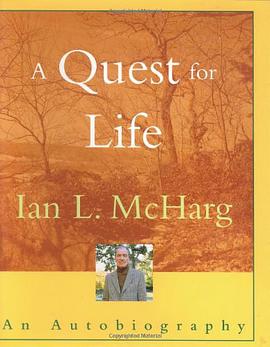
"Show me any civilization that believes that reality exists only because man can perceive it, that the cosmos was erected to support man on its pinnacle, that man is exclusively divine, and then I will predict the nature of his cities and its landscapes, the hot dog stands, the neon shill, the ticky-tacky houses, the sterile core, the mined and ravaged countryside. This is the image of anthropocentric man. He seeks not unity with nature but conquest, yet unity he finds, when his arrogance and ignorance are stilled and he lies dead under the greensward." Ian L. McHarg Multiply and Subdue the Earth, 1969 "No living American has done more to usher the gentle science of ecology out of oblivion and into mainstream thought than Ian McHarg—a teacher, philosopher, designer, and activist who changed the way we view and shape our environment." From the foreword by Stewart L. Udall Published in cooperation with the Center for American Places, Harrisonburg, Virginia A Quest for Life is the autobiography of a man who stands alongside Rachel Carson, Lewis Mumford, and Aldo Leopold as one of the giants of the environmental movement. In a robust and singular voice, Ian McHarg recounts the story of a life that has foreshadowed and eventually shaped environmental consciousness in the twentieth century. Along the way we meet prominent figures in the environmental movement, the design fields, and the government, from Walter Gropius to Lady Bird Johnson, all presented in rich and telling anecdotes. Early in A Quest for Life McHarg presents us with an arresting image. Describing the view from his boyhood home on the outskirts of Glasgow, he tells us that in one direction he could see the industrial miasma of smokestacks, tenements, and treeless streets, and, in another, the glories of the Scottish countryside. "I was born and bred," he writes, "on a fulcrum with two poles, city and countryside." Confronted with such a stark contrast, the man who was to become "the founder of ecological planning" began at an early age to turn literally from inhumane urban development and toward the beauty and power of Nature. Each chapter of this book illuminates key stages in McHarg's life and in the evolution of his environmental awareness. We see him as a youth standing on a hillside beside the impressive Donald Wintersgill who, with the wave of his cane, lays out an entire village complete with lakes and forests, and thus introduces the astonished McHarg to the profession of landscape architecture. In some of the bloodiest battles of the Second World War he witnesses the magnitude of human destructive capability. Later, when he faces a crisis of conscience over his religious training and its exhortation to gain dominion over life and subdue the earth, he begins to develop a deep spiritual appreciation for the sanctity of Nature itself. His training as a designer and planner in the Modernist Bauhaus tradition, with its neglect of the environment; his bouts with tuberculosis that showed him the link between public health and city planning; his famous "Man—The Planetary Disease" speech before powerful industrialists—all stand as emblematic of battles that are still being fought today. A Quest for Life also chronicles the many triumphs in McHarg's career. It offers fresh insight into the revolutionary design method behind his groundbreaking book, Design with Nature, and explores the development of geographical information systems. We learn firsthand about his work on the celebrated regional plans for Denver and the Twin Cities, as well as the Woodlands new town project. His most enduring contribution, however, may prove to be his four decades of teaching at the University of Pennsylvania. Through the generations of landscape architects, designers, and planners he taught there, his influence has spread around the world and into the future. As the compelling, first-person story of a remarkable individual who not only manned the barricades against environmental destruction, but helped lay the foundation for the barricades themselves, A Quest for Life is must reading for landscape architects, designers, conservationists, planners, and others concerned with the preservation of our communities and the natural environment.
作者简介
目录信息
读后感
用户评价
老实说,这本书的书名听起来有些宏大,但正是这种宏大,让我觉得它可能触及了一些真正核心的问题。我不是那种会轻易被华丽辞藻打动的人,我更看重的是文字背后的力量和深度。对于《A Quest for Life》,我希望能从中看到作者对于生命中那些普遍困境的深刻洞察,以及他/她是如何试图去理解和应对这些挑战的。是关于寻找人生目标?是关于如何面对苦难?还是关于人与人之间的连接?这些都是我一直在思考的。这本书的封面设计简洁而有力,没有过多的装饰,这让我感觉作者更注重内容的实在性,而不是表面的浮华。我希望它能够提供一种不同于我以往阅读的体验,它不一定要给我明确的答案,但它一定要能够激发我去思考,去质疑,甚至去重新构建我对生命和世界的认知。我期待这本书能够像一位智者,用沉静而睿智的语言,引导我走向一片更开阔的精神领域。
我喜欢书名中“Quest”这个词,它带有一种冒险和追寻的精神,这与我的人生哲学不谋而合。我一直相信,生活本身就是一场永无止境的探索,我们不断地在尝试、在学习、在成长。而《A Quest for Life》这个名字,预示着这本书将是一次关于生命奥秘的深度挖掘,它可能不是一条平坦的道路,而是充满了迂回和挑战,但正是在这样的过程中,我们才能获得真正的成长和领悟。我希望这本书能够打破我固有的思维模式,挑战我的极限,让我看到生命中那些我从未曾留意过的可能性。我期待它能够给我带来一种振奋人心的力量,让我更加坚定地去追求我所渴望的生活,去发现那些隐藏在我内心深处的力量。我想,这本书不仅仅是为了阅读而存在,更是为了激发行动,为了点燃我内心深处对生命的热情和渴望。
这本书封面就有一种让人想要深入探索的冲动,那种淡淡的金色光晕,仿佛隐藏着无数未知的秘密,又带着一丝静谧的宁静。我一直对那些关于生命本质、关于存在意义的哲学探讨非常着迷,而《A Quest for Life》这个名字,精准地戳中了我的好奇心。它不是那种一眼就能看透的快餐读物,而是需要你静下心来,一点一点地去品味,去咀嚼。我喜欢这种需要思考和感悟的书,它能引发我内心的回响,让我重新审视自己的生活和价值观。在快节奏的现代社会,我们常常被各种琐事淹没,忽略了生命中最重要的事情。我期待这本书能够帮助我找回那些被遗忘的珍贵,它或许会提供新的视角,或许会提出令人深思的问题,但无论如何,我相信它会是一场精神上的洗礼,一场触及灵魂的旅程。我迫不及待地想翻开第一页,让自己的思绪跟随作者一同踏上这场探索之旅,去发现那些隐藏在表象之下的深刻真理。
我一直对那些能够引发深度思考的书籍情有独钟,《A Quest for Life》这个名字,恰恰传递了一种这样的信号。它不像那些轻松的消遣读物,而是暗示着一种深刻的探究,一种对生命本质的追问。在如今这个信息爆炸的时代,我们很容易被碎片化的信息淹没,而忽略了对生命整体的思考。我希望这本书能够提供一个契机,让我能够暂停下来,静下心来,去思考生命中那些真正重要的事情。这本书的封面设计简洁而富有寓意,让我觉得它所承载的内容一定也是经过精心打磨的。我期待它能够为我打开一扇新的窗户,让我看到生命中那些我从未曾发现的维度,并且从中获得一种超越日常的启示。我相信,阅读这本书将不仅仅是一种消遣,更是一种精神的滋养,一次对自我生命的重塑。
这款《A Quest for Life》的书名,有一种古典而又充满力量的美感,让我联想到那些古老的哲人,他们用毕生的精力去探寻生命的真谛。现代社会充斥着太多的噪音和干扰,我们常常迷失在信息洪流中,忘记了生命最根本的追问。我希望这本书能够带我远离尘嚣,进入一个更纯粹、更深沉的精神空间。它不一定需要提供什么惊世骇俗的理论,但我希望它能以一种真诚而感人的方式,触及我内心最柔软的地方。我想,好的书籍就像一位忠实的朋友,在你迷茫时给你指引,在你失落时给你慰藉。《A Quest for Life》对我来说,可能就是这样一位朋友。我期待它能够帮助我理清思绪,找到内心的平静,并且更加清晰地认识到,生命中最宝贵的,或许并非物质上的富足,而是精神上的满足和升华。