
具体描述
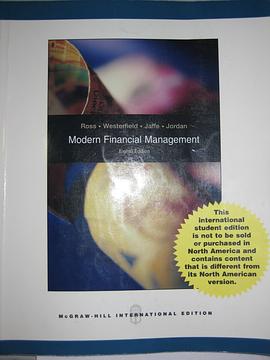
Modern Financial Management, by Ross, Westerfield, and Jaffe is a popular textbook that emphasizes the modern fundamentals of the theory of finance, while providing contemporary examples to make the theory come to life. The authors aim to present corporate finance as the working of a small number of integrated and powerful intuitions, rather than a collection of unrelated topics. They develop the central concepts of modern finance: arbitrage, net present value, efficient markets, agency theory, options, and the trade-off between risk and return, and use them to explain corporate finance with a balance of theory and application. The well-respected author team is known for their clear, accessible presentation of material that makes this text an excellent teaching tool. Brad Jordan, known for his successful work on the RWJ Fundamentals and Essentials books, contributed to this edition. His influence will be seen particularly in the writing style with smoother coverage of topics, and the increased quality in the problem material.
作者简介
Stephen Ross is presently the Franco Modigliani Professor of Finance and Economics at the Sloan School of Management, Massachusetts Institute of Technology. One of the most widely published authors in finance and economics, Professor Ross is recognized for his work in developing the Arbitrage Pricing Theory and his substantial contributions to the discipline through his research in signaling, agency theory, option pricing, and the theory of the term structure of interest rates, among other topics. A past president of the American Finance Association, he currently serves as an associate editor of several academic and practitioner journals. He is a trustee of CalTech, a director of the College Retirement Equity Fund (CREF), and Freddie Mac. He is also the co-chairman of Roll and Ross Asset Management Corporation. Randoloph W. Westerfield is Dean of the Marshall School of Business at University of Southern California and holder of the Robert R. Dockson Dean's Chair of Business Administration. From 1988 to 1993, Professor Westerfield served as the chairman of the School's finance and business economics department and the Charles B. Thornton Professor of Finance. He came to USC from The Wharton School, University of Pennsylvania, where he was the chairman of the finance department and member of the finance faculty for 20 years. His areas of expertise include corporate financial policy, investment management and analysis, mergers and acquisitions, and stock market price behavior. Professor Westerfield has served as a member of the Continental Bank trust committee, supervising all activities of the trust department. He has been consultant to a number of corporations, including AT&T, Mobil Oil and Pacific Enterprises, as well as to the United Nations, the U.S. Department of Justice and Labor, and the State of California. --This text refers to an out of print or unavailable edition of this title.
目录信息
读后感
用户评价
这本书的排版和插图设计也值得称赞,虽然内容非常硬核,但阅读体验却出奇地舒适。不同于一些将公式堆砌到让人头晕的教材,这里的图表往往是经过精心设计的,它们的目标不是展示复杂性,而是揭示简洁性。例如,在讲解跨国公司现金管理的跨国税收优化时,作者用一个流程图清晰地展示了知识产权转移和内部贷款定价的税务链条,极大地降低了理解难度。更重要的是,这本书的选材角度非常贴近实际操作中管理层的痛点。它没有过多纠缠于纯粹的数学证明,而是聚焦于“如果我是CFO,我该如何做”的决策场景。通过一系列基于真实监管环境和会计准则(如IFRS和US GAAP)的对比分析,我深刻体会到,现代财务管理已经不再是一个孤立的部门职能,它与法律、合规、全球化战略紧密交织,这本书成功地展现了这种复杂的集成关系。
这本书的叙事节奏控制得非常到位,章节间的过渡自然流畅,让人在知识的海洋中航行时丝毫没有迷失方向的感觉。尤其在公司估值那一块,作者采用了螺旋上升的讲解方式,从最基础的现金流折现(DCF)开始,逐步引入了期权定价模型在估值中的应用,特别是对于初创企业中包含大量不确定性的股权结构估值,提供了极其详尽的建模步骤。我注意到,书中对“调整贴现率”这一敏感话题的处理相当艺术化,没有简单地给出一个“万能公式”,而是强调了不同估值目的(如并购、内部投资决策、诉讼)下,对系统性风险和非系统性风险权重的动态调整。对于我这种需要定期撰写投资备忘录的专业人士而言,这本书提供的不仅仅是知识点,更是一种思维范式上的切换——如何将理论的严谨性转化为商业判断的敏锐度。它教会我的不是如何计算,而是如何解释计算背后的商业逻辑。
说实话,初次翻开这本《现代财务管理》,我有些担心它会过于偏重枯燥的定量分析,但很快我的疑虑就消散了。这本书在风险管理章节的处理手法堪称一绝,它不仅详细讲解了传统的VaR(风险价值)计算方法,还非常及时地引入了针对新兴市场和流动性风险的压力测试框架。最让我感到惊喜的是,作者花了大量的篇幅来讨论金融科技(FinTech)对传统风险管理职能的颠覆与重塑,这在许多同类教材中是极其罕见的。他们没有回避加密货币或分布式账本技术对资产估值和清算效率带来的冲击,而是将其置于公司治理和合规性的宏大背景下进行讨论。阅读过程中,我仿佛置身于一个顶级投行的风险控制会议室,听着专家们讨论如何利用机器学习模型来预测供应链金融中的信用违约概率。这种前瞻性和对行业脉搏的精准把握,使得这本书远超一本“管理学”读物,更像是一份关于未来十年企业财务健康蓝图的预测报告。
我必须强调,这本书在“资本预算”这一核心模块上所下的功夫,是其他同类书籍难以企及的。它没有满足于仅讲解NPV和IRR的计算,而是将重点放在了“机会成本”和“机会损失”的衡量上。书中详细讨论了如何处理相互排斥项目之间的决策冲突,以及在预算受限情况下,如何运用整数规划(Integer Programming)的简化思路来进行最优项目组合选择。更令我印象深刻的是,它将项目评估的视角从单纯的股东价值最大化拓展到了更广阔的利益相关者理论。作者探讨了如何将社会责任投资(SRI)的指标纳入到财务可行性分析中,并讨论了这种“软性”指标如何通过影响外部融资成本来反作用于项目的净现值。这表明,这本书的作者们具有极强的历史观和前瞻性,他们理解财务管理正处于一个快速的伦理和可持续发展转型期,这本书无疑是为迎接这个新时代的财务领导者们量身打造的指南。
这本书的理论框架构建得非常扎实,特别是关于资本结构决策的部分,作者深入浅出地剖析了MM定理的各种修正和实际应用中的权衡取舍。我过去在理解税盾和破产成本的微妙平衡时总是感到困惑,但这里的阐述清晰地勾勒出了管理层在融资决策时所面临的真实世界约束。比如,书中关于股利政策的讨论,没有止步于传统的信号传递理论,而是引入了行为金融学的视角,探讨了投资者非理性偏好如何影响公司的派息策略,这对于从事企业财务规划的人来说,无疑是提供了更具操作性的洞察。我特别欣赏作者在案例分析中展现出的严谨性,每一个模型推导后,都会紧跟着一个跨国公司的真实案例进行检验,这使得抽象的金融概念立刻变得鲜活起来,不再是教科书上干巴巴的公式堆砌。读完这部分内容,我感觉自己对如何评估一家公司长期价值和短期现金流分配之间的矛盾,有了一种全新的、更加系统化的理解和判断工具。对于那些希望从基础知识跃升到高级财务战略层面的人来说,这本书的深度是无可替代的。
苦啊~不知道能不能过~
现在心情太复杂了,再见CF!再见BAB24!
现在心情太复杂了,再见CF!再见BAB24!
为了实践项目,复习本科金融课程...
QAQ 今天理书这几本砖头不见了。。