
具体描述
From the Back Cover
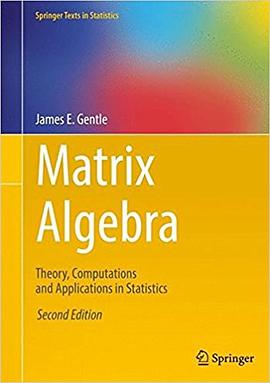
This textbook for graduate and advanced undergraduate students presents the theory of matrix algebra for statistical applications, explores various types of matrices encountered in statistics, and covers numerical linear algebra. Matrix algebra is one of the most important areas of mathematics in data science and in statistical theory, and the second edition of this very popular textbook provides essential updates and comprehensive coverage on critical topics in mathematics in data science and in statistical theory.
Part I offers a self-contained description of relevant aspects of the theory of matrix algebra for applications in statistics. It begins with fundamental concepts of vectors and vector spaces; covers basic algebraic properties of matrices and analytic properties of vectors and matrices in multivariate calculus; and concludes with a discussion on operations on matrices in solutions of linear systems and in eigenanalysis. Part II considers various types of matrices encountered in statistics, such as projection matrices and positive definite matrices, and describes special properties of those matrices; and describes various applications of matrix theory in statistics, including linear models, multivariate analysis, and stochastic processes. Part III covers numerical linear algebra―one of the most important subjects in the field of statistical computing. It begins with a discussion of the basics of numerical computations and goes on to describe accurate and efficient algorithms for factoring matrices, how to solve linear systems of equations, and the extraction of eigenvalues and eigenvectors.
Although the book is not tied to any particular software system, it describes and gives examples of the use of modern computer software for numerical linear algebra. This part is essentially self-contained, although it assumes some ability to program in Fortran or C and/or the ability to use R or Matlab.
The first two parts of the text are ideal for a course in matrix algebra for statistics students or as a supplementary text for various courses in linear models or multivariate statistics. The third part is ideal for use as a text for a course in statistical computing or as a supplementary text for various courses that emphasize computations.
New to this edition
• 100 pages of additional material
• 30 more exercises―186 exercises overall
• Added discussion of vectors and matrices with complex elements
• Additional material on statistical applications
• Extensive and reader-friendly cross references and index
作者简介
James E. Gentle, PhD, is University Professor of Computational Statistics at George Mason University. He is a Fellow of the American Statistical Association (ASA) and of the American Association for the Advancement of Science. Professor Gentle has held several national offices in the ASA and has served as editor and associate editor of journals of the ASA as well as for other journals in statistics and computing. He is author of Random Number Generation and Monte Carlo Methods (Springer, 2003) and Computational Statistics (Springer, 2009).
目录信息
读后感
用户评价
我必须坦诚,这本书在某些章节的处理上,略显激进,但正是这种“不走寻常路”的风格,让我产生了强烈的共鸣。它似乎刻意避开了许多标准课程中被反复强调但实际应用频率不高的内容,转而将笔墨聚焦于现代计算科学的核心议题上。例如,对于稀疏矩阵的运算效率优化,本书提供了一套非常系统化的讲解,从存储格式(CSR, CSC)到迭代求解器的选择,分析得鞭辟入里。这对于从事高性能计算或机器学习底层研究的人来说,简直就是一本实战手册。不过,也正因为这种聚焦,我个人认为,对于那些第一次接触线性代数,需要打下最扎实基础的本科新生来说,可能需要配合其他更传统的参考资料。这本书更像是为那些已经具备一定数学基础,渴望从“会用”跨越到“精通”的进阶学习者准备的“内功心法”。它挑战了许多固有的教学范式,鼓励读者去思考“为什么是这样”,而不是仅仅记住“应该这样做”。阅读体验是充满思辨性的,需要读者投入相当的专注力。
这本《Matrix Algebra》的出版,着实让人眼前一亮,尤其是对于那些在工程、物理、甚至是经济学领域摸爬滚打多年的老手来说。我花了数周时间沉浸其中,最大的感受是它的视角非常独特。它并没有将矩阵代数仅仅视为一堆枯燥的公式和符号的堆砌,而是将其置于一个更宏大、更具应用性的背景下去考察。书中的讲解深入浅出,即便是对于初次接触线性代数概念的读者,也能找到清晰的路径。特别是关于特征值和特征向量的章节,作者的处理方式充满了洞察力,没有过多纠缠于繁琐的代数推导,而是巧妙地运用几何直觉来构建理解的桥梁。例如,书中对主成分分析(PCA)的引入,并非草草带过,而是详尽地展示了如何利用矩阵分解来提取数据中的核心信息,这种实用主义的倾向,极大地提升了阅读的兴趣和知识的留存率。它仿佛是一位经验丰富的导师,耐心地引导你穿过概念的迷雾,最终让你明白这些数学工具在解决真实世界难题时的强大威力。这本书的排版也值得称赞,图表清晰,逻辑链条严密,让人在阅读过程中很少感到迷失方向,可以说是一次非常扎实的知识构建之旅。
对于习惯了图形化和交互式学习的当代读者,《Matrix Algebra》提供了一种近乎“复古”的深度阅读体验。它的魅力在于其内容的纯粹性与逻辑的严密性。这本书几乎没有使用任何花哨的软件截图或界面演示,所有的论证都基于纯粹的数学逻辑和严谨的符号推导。这种极简主义的处理方式,迫使我们的大脑去构建属于自己的内部模型。我尤其喜欢它在介绍张量(Tensor)概念时的过渡处理。它没有生硬地抛出张量的定义,而是通过矩阵的外积和高维数组的视角逐步展开,构建了一个非常自然的升级路径。这种层层递进的结构,避免了概念爆炸,让读者能够稳健地向前推进。尽管篇幅不薄,但通读下来,感觉时间花得非常值得,因为它训练的不仅仅是计算能力,更是一种严谨的逻辑思维模式,一种看待复杂系统分解与重组的全新框架。
坦白讲,我期望这本书能在量子计算或深度学习的背景下有更多的实例展示,这方面的应用是目前该领域最热门的话题之一。不过,我们也不能否认,本书扎实的理论基础是任何高级应用的前提。本书在处理矩阵分解,特别是奇异值分解(SVD)的部分,达到了教科书级别的深度和清晰度。作者对于SVD的几何意义——即矩阵如何描述旋转、缩放和平移的组合变换——的阐释,是我读过的最精妙的版本之一。它将原本复杂的三步分解过程可视化为一系列基础的几何操作,极大地增强了读者的直观理解。此外,书中对矩阵范数(Norms)的讨论也极其全面,不仅涵盖了L1, L2范数,还深入探讨了Frobenius范数及其在优化问题中的作用。这本书的价值不在于追赶最新的应用热点,而在于牢牢把握那些“不变的真理”,为读者搭建一个坚不可摧的数学地基,确保无论未来的技术如何发展,这些核心的代数原理都将是驱动创新的核心动力。
说实话,我拿到这本书的时候,心里是有些忐忑的。毕竟市面上的线性代数教材汗牛充栋,想要从中脱颖而出,难度不小。然而,《Matrix Algebra》成功地做到了差异化。它的叙述风格极其个人化,不像某些教科书那样板着一张脸,而是充满了对数学美学的热爱和探索欲。尤其欣赏它对于抽象代数结构与具体数值计算之间关系的探讨。很多教材只是将两者割裂开来,但在本书中,你会发现它们是如何相辅相成的。比如在讨论矩阵求逆和数值稳定性时,作者没有止步于介绍高斯消元法,而是引入了矩阵的条件数概念,并用生动的比喻解释了微小误差如何被放大,这对于任何需要进行大规模数值模拟的读者来说,都是宝贵的经验之谈。更难能可贵的是,它并没有忽视历史的脉络,偶尔穿插的数学家小传和理论发展背景,让冰冷的数学知识瞬间有了温度和人情味。这种讲述方式,使得原本可能让人望而生畏的领域,变得可亲近、可触及,仿佛作者正在你的耳边轻声细语地分享他的心爱之物。