
具体描述
Much of the modern way of thinking about history and historiography in fact begins with the great Greek historian Thucydides, an Athenian general in the latter half of the fifth century b.c.e. It is also Thucydides who provides us with the historical framework for fifth-century Greece, a period of progress and creativity rarely equaled in human history. His work, The Peloponnesian War, recounts that destructive conflict and also includes the only surviving contemporary record of the rise of the Athenian empire. Thucydides teaches his readers that the most powerful states in the world can come to a humiliating end, that a careless tyranny, especially toward the weak, and, nearly two millennia before Machiavelli, that absolute power corrupts absolutely.
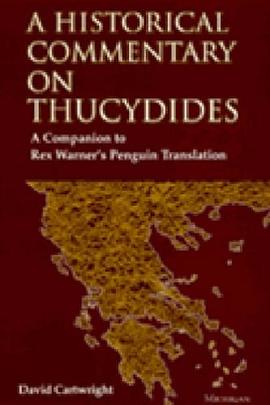
In A Historical Commentary on Thucydides, David Cartwright aims to guide the Greekless reader through Thucydides' fascinating yet demanding narrative. Cartwright's is the only such full-length, one-volume commentary and companion: it is based on Rex Warner's Penguin translation of Thucydides--the most widely used translation--and requires no knowledge of Greek. The introduction to A Historical Commentary on Thucydides includes a brief biography of Thucydides: his approach, aims, and methods are discussed, as are the general character of his work and his contribution to historiography. The commentary gives brief accounts of the people and places mentioned by Thucydides and puts events in their immediate and wider contexts. Cartwright provides occasional summaries, explains Greek concepts and technical terms, and offers interpretations of difficult or controversial passages. The author also picks out important historiographical issues and discusses the themes' underlying events.
For both first-time readers and seasoned students, this commentary gives broad access to one of antiquity's most profound and difficult writers. Historians, classicists, and anyone else interested in the cultural and intellectual achievements of ancient Greece will find A Historical Commentary on Thucydides a welcome addition to their library.
David Cartwright is Head of Classics at Dulwich College, London, England.
作者简介
目录信息
读后感
用户评价
阅读体验的流畅性,很大程度上取决于作者对叙事节奏的把控,而这本书在这方面的处理可谓炉火纯青。作者似乎深谙如何在高密度的史实分析与引人入胜的文学描绘之间找到微妙的平衡点。行文之间,时而如同精确的解剖刀,将复杂的政治角力剖析得淋漓尽致,逻辑链条严密到令人拍案叫绝;时而又转为富有洞察力的哲思,将那些古老的冲突放置于人性永恒的坐标系下进行衡量。这种叙事上的张弛有度,使得即便是对古代地缘政治不甚了解的读者,也能被故事内在的戏剧性所吸引。每一次阅读的深入,都像是跟随一位经验丰富的向导,穿梭于迷宫般的历史事件之中,他既能指明正确的方向,又能适时地停下来,让你细细品味眼前这片废墟或辉煌所蕴含的教训。节奏的拿捏精准,保证了即便篇幅宏大,读者的注意力也能始终被牢牢锁定。
这本书在论证方法上的严谨性,简直达到了令人叹服的境界。它不像一些流于表面的通史读物,仅仅是罗列事实,而是真正深入到历史事件的肌理之中,对每一个关键决策、每一次外交斡旋、甚至每一次战役的部署,都进行了多维度的交叉印证和批判性审视。作者似乎拥有一种近乎偏执的求真精神,他毫不避讳地揭示了历史记载中的模糊地带和潜在的偏见,并通过详尽的注释和旁征博引,构建起一个坚不可摧的论证体系。阅读过程中,我常常需要停下来,反复咀嚼那些被精心构建起来的论据链条,体会其中环环相扣的推理过程。这种对细节的执着,使得书中提出的任何观点,都显得有根有据,极具说服力,让人在不知不觉中,便被其深厚的学术功底所折服。
这本书的装帧设计着实让人眼前一亮,从拿到手的那一刻起,就能感受到一种沉甸甸的历史厚重感。纸张的选择非常考究,触感温润,那种略微粗粝又不失细腻的质感,非常适合用来承载如此宏大的历史叙事。墨水的印刷清晰有力,字体排版得当,即便是初次接触这类学术著作的读者,也不会感到阅读上的负担。封面设计简约而不失格调,那种古典的几何构图和低调的色彩搭配,仿佛在无声地诉说着书中所蕴含的深刻智慧与时间沉淀。整体来看,出版社在制作工艺上确实下足了功夫,这不仅是一本供人阅读的书籍,更像是一件值得收藏的艺术品。当你将它置于书架之上,它与其他书籍并列时,那种独特的气质和内敛的庄重感,立刻便能将周围的环境提升一个层次。我个人非常欣赏这种对物理载体的尊重,它暗示了内容本身也同样值得我们以敬畏之心去对待和探索。
全书的翻译质量无疑是决定其可读性的关键因素,而此版本在这方面展现出了极高的水准。译者显然不仅精通原文的学术语境,更具备将古老文本的精髓用现代读者能够接受且充满力量的语言重新表达出来的能力。许多原著中晦涩难懂的古语概念和复杂的修辞手法,都被巧妙地转化成了清晰、有力且富有韵律感的现代汉语表达。阅读过程中,几乎没有出现那种生硬、佶屈聱牙的“翻译腔”,取而代之的是一种行云流水的阅读快感,仿佛作者本人就是用这种语言在直接与我们对话。这种高质量的翻译,极大地降低了理解门槛,让那些原本可能望而却步的专业内容,变得触手可及,无疑拓宽了该领域研究成果的受众范围,功德无量。
与其他同类题材的著作相比,这本书最突出的特点之一,在于其对“人性驱动力”的深刻洞察与哲学反思。作者似乎并不满足于仅仅记录“发生了什么”,他更热衷于探索“为什么会发生”。在那些宏大的战争场面和权谋斗争背后,作者总能敏锐地捕捉到潜藏在决策者内心深处的恐惧、野心、荣誉感与理性计算的复杂交织。这种对人类本性不变性的探索,使得书中的历史事件并非仅仅是遥远的过去,而仿佛是今日世界的缩影。他笔下的人物,不论其身份地位如何,都具有一种令人信服的、饱满的“人味儿”,他们的选择既体现了时代的局限,又折射出跨越时空的道德困境。每一次的阅读,都像是一次关于权力、正义与生存本能的深刻冥想。