
具体描述
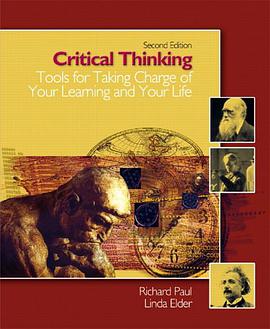
Critical Thinking is about becoming a better thinker in every aspect of your life: in your career, and as a consumer, citizen, friend, parent, and lover. Discover the core skills of effective thinking; then analyze your own thought processes, identify weaknesses, and overcome them. Learn how to translate more effective thinking into better decisions, less frustration, more wealth and above all, greater confidence to pursue and achieve your most important goals in life.
作者简介
DR. RICHARD W. PAUL is Director of Research and Professional Development at the Center for Critical Thinking and the Chair of the National Council for Excellence in Critical Thinking. He has authored eight books and more than 200 articles on critical thinking. In over 35 years of teaching experience, he has won numerous awards and honors, including Distinguished Perry Lecturer for the year 2000.
DR. LINDA ELDER is an educational psychologist, President for the Foundation for Critical Thinking, and Executive Director of the Center for Critical Thinking. She is highly published and has done original research into the relation of thought and emotion. She is a regular keynoter at the International Conference on Critical Thinking and is a recognized leader in the field.
目录信息
A Start-up Definition of Critical Thinking
How Skilled Are You as a Thinker?
Good Thinking Requires Hard Work
The Concept of Critical Thinking
Become a Critic of Your Thinking
Establish New Habits of Thought
Develop Confidence in Your Ability to Reason and Figure Things Out
1. Becoming a Fair-minded Thinker.
Weak vs. Strong Critical Thinking
What Does Fair-Mindedness Require?
Intellectual Humility: Strive to Discover the Extent of Their Ignorance
Intellectual Courage: Develop the Courage to Challenge Popular Beliefs
Intellectual Empathy: Learn to Empathically Enter Opposing Views
Intellectual Integrity: Hold Yourself to the Same Standards to Which They Hold Others
Intellectual Perseverance: Refuse to Give Up Easily, Work Your Way through Complexities and Frustration
Confidence in Reason: Respect Evidence and Reasoning and Value Them as Tools for Discovering the Truth
Intellectual Autonomy: Value Independence of Thought
Recognize the Interdependence of Intellectual Virtues
Conclusion
2. The First Four Stages of Development: At What Level Would You Place Yourself?
Stage One: The Unreflective Thinker
Stage Two: The Challenged Thinker
Stage Three: The Beginning Thinker
Stage Four: The Practicing Thinker
3. Self-Understanding.
Monitor the Egocentrism in Your Thought and Life
Make a Commitment to Fair-Mindedness
Recognize the Mind’s Three Distinctive Functions
Understand That You Have a Special Relationship to Your Mind
Connect Academic Subjects to Your Life and Problems
Learn Both Intellectually and Emotionally
4. The Parts of Thinking.
Reasoning Is Everywhere in Human Life
Reasoning Has Parts
A First Look at the Elements of Thought
An Everyday Example: Jack and Jill
Analysis of the Example
How the Parts of Thinking Fit Together
The Relationship between the Elements
The Best Thinkers Think to Some Purpose
The Best Thinkers Take Command of Concepts
The Best Thinkers Assess Information
Inert Information
Activated Ignorance
Activated Knowledge
The Best Thinkers Distinguish Between Inferences and Assumptions
The Best Thinkers Think through Implications
The Best Thinkers Think across Points of View
The Point of View of the Critical Thinker
Conclusion
5. The Standards for Thinking.
Taking a Deeper Look at Intellectual Standards
Clarity • Accuracy • Precision • Relevance • Depth • Breadth • Logicalness • Significance • Fairness
Bringing Together the Elements of Reasoning and the Intellectual Standards
Purpose, Goal, or End in View • Question at Issue or Problem to Be Solved • Point of View or Frame of Reference • Information, Data, Experiences • Concepts, Theories, Ideas • Assumptions • Implications and Consequences • Inferences
Brief Guidelines for Using Intellectual Standards
6. Asking Questions That Lead to Good Thinking.
The Importance of Questioning
Dead Questions Reflect Inert Minds
Three Categories of Questions
Become a Socratic Questioner
Focus Your Thinking on the Type of Question Being Asked • Focus Your Questions on Universal Intellectual Standards for Thought • Focus Your Questions on the Elements of Thought • Focus Your Questions on Prior Questions • Focus Your Questions on Domains of Thinking
Conclusion
7. Master the Thinking, Master the Content.
Go Beyond Superficial Memorization to Deep Learning
The Relation of Content to Thinking
Understand Content through Thinking and Thinking through Content
All Content is Organized by Concepts
All Content is Logically Interdependent
Think Through Your Classes Using Your Knowledge of Thinking
A Caution
8. Discover How the Best Thinkers Learn.
18 Ideas for Improving Your Studies
The Logic of a Typical College Class
Becoming a Skilled Thinker
The Design of a Typical College Class and the Typical College Student
Figure Out the Underlying Concept of Your Courses
Figure Out the Form of Thinking Essential to Courses or Subjects
Think Within the Logic of the Subject
A Case: The Logic of Biochemistry
Make the Design of the Course Work for You
Sample Course: American History, 1600—1800
Reading, Writing, Speaking, Listening, and Thinking
Figure Out the Logic of an Article or Essay
Figure Out the Logic of a Textbook
Criteria for Evaluating an Author’s Reasoning
A Test to Repeat in Every Class & Subject
9. Redefining Grades as Levels of Thinking and Learning.
Develop Strategies for Assessing Your Learning
Use Student Profiles to Assess Your Performance
Exemplary Students (Grade of A)
High Performing Students (Grade of B)
Mixed-Quality Students (Grade of C)
Low-Performing Students (Grade of D or F)
Apply Student Profiles to Assess Your Performance Within Specific Disciplines
Exemplary Thinking as a Student of Psychology(Grade of A)
High-Performing Thinking as a Student of Psychology(Grade of B)
Mixed-Quality Thinking as a Student of Psychology(Grade of C)
Low-Performing Thinking as a Student of Psychology(Grade of D or F)
Conclusion
10. Making Decisions and Solving Problems.
PART I: MAKING DECISIONS
Evaluating Patterns in Decision-Making
“Big” Decisions
The Logic of Decision-Making
Recognizing the Need for an Important Decision • Accurately Recognizing the Alternatives • Putting More Time into Your Decision-Making • Being Systematic • Dealing with One Major Decision at a Time • Developing Knowledge of Your Ignorance
Dimensions of Decision-Making
The Early Decisions (2—11 Years of Age)
Adolescent Decisions (12—17 Years of Age)
Conclusion
PART II: SOLVING PROBLEMS
Becoming an Activist Problem-Solver
Evaluating Patterns in Your Problem-Solving
Dissolving Pseudo-Problems
False Needs and Irrational Ends
“Big” Problems
Dimensions of Problem-Solving
Avoiding the Pitfalls of Problem-Solving
Analyze Problems Using the Elements of Thought
The Art of Problem-Solving
11 Deal With Your Irrational Mind.
PART I: TAKE CHARGE OF YOUR EGOCENTRIC NATURE.
Understand Egocentric Thinking
Understand Egocentrism as a Mind within the Mind
Successful Egocentric Thinking
Unsuccessful Egocentric Thinking
Rational Thinking
Two Egocentric Functions
Egocentric Domination
Egocentric Submission
Pathological Tendencies of the Human Mind
Challenge the Pathological Tendencies of Your Minds
The Challenge of Rationality
PART II: TAKE CHARGE OF YOUR SOCIOCENTRIC THINKING.
The Nature of Sociocentrism
Social Stratification
Sociocentric Thinking Is Unconscious and Potentially Dangerous
Sociocentric Uses of Language
Disclose Sociocentric Thinking through Conceptual Analysis
Reveal Ideology at Work through Conceptual Analysis
Conclusion:
Work to Free Yourself from Egocentric and Sociocentric Thought
12. How to Detect Media Bias and Propaganda in National and World News.
Democracy and the News Media
Myths That Obscure the Logic of the News Media
Objectivity in the News Media
Point of View
Forms of Objectivity
The Perception of Bias in the Mainstream
Propaganda and News Story Writing
Protecting the Home Audience from Guilt Feelings
Fostering Sociocentric Thinking
Slanting Stories to Favor Privileged Views
How to Obtain Useful Information from Propaganda and Standard News Stories
Steps in Becoming a Critical Consumer of the “News”
Media Awareness of Media Bias
Sensitivity to Advertisers
Sensitivity to Government
Sensitivity to Powerful Interests
Sensitivity to Their Competitors
The Bias toward “Novelty” and “Sensationalism”
Critical Consumers of the News
Questions for the News Media
Is It Possible for the News Media to Reform?
Is the Emergence of a “Critical Society” Possible?
Finding Alternative Sources of Information
Becoming an Independent Thinker
Buried, Ignored, or Underreported Stories
Using the Internet
Additional Alternative News Sources
Conclusion
An Abbreviated Glossary
13. Fallacies: The Art of Mental Trickery & Manipulation.
Truth & Deception in the Human Mind
Three Types of Thinkers
Uncritical Persons (intellectually unskilled thinkers)
Skilled Manipulators (weak-sense critical thinkers)
Fair-minded Critical Persons (strong-sense critical thinkers)
The Concept of Fallacies of Thought
Naming Fallacies
Mistakes Versus Fallacies
There is No Exhaustive List of Fallacies
Faulty Generalizations
Analyzing Generalizations
Post Hoc Generalizations
Analogies and Metaphors
44 Foul Ways to Win an Argument
Accuse Your Opponent of Doing What He is Accusing You of or worse
Accuse Him of Sliding down A Slippery Slope (that leads to disaster)
Appeal to Authority
Appeal to Experience
Appeal to Fear
Appeal to Pity (or sympathy)
Appeal to Popular Passions
Appeal to Tradition or Faith (“the tried and true”)
Assume a Posture of Righteousness
Attack the person (and not the argument)
Beg the Question
Call for Perfection (Demand impossible conditions)
Create a False Dilemma (the Great Either/Or)
Devise Analogies (and Metaphors) That Support Your View (even if they are misleading or “false”).
Question Your Opponent’s Conclusions
Create Misgivings: Where There’s Smoke, There’s Fire
Create A Straw Man
Deny or Defend Your Inconsistencies
Demonize His Side Sanitize Yours
Evade Questions, Gracefully
Flatter Your Audience
Hedge What You Say
Ignore the Evidence
Ignore the Main Point
Attack Evidence (That Undermines Your Case)
Insist Loudly on a Minor Point Use the Hard-Cruel-World Argument (to justify doing what is usually considered unethical).
Make (Sweeping) Glittering Generalizations
Make Much of Any Inconsistencies in Your Opponent’s Position
Make Your Opponent Look Ridiculous (“Lost in the Laugh”)
Oversimplify the Issue
Raise Nothing But Objections
Rewrite History (Have It Your Way)
Seek Your Vested Interests
Shift the Ground.
Shift the Burden of Proof
Spin, Spin, Spin
Talk in Vague Generalities.
Talk Double Talk Tell Big Lies Treat Abstract Words and Symbols As If They Were Real Things
Throw In A Red Herring (or two)
Throw in Some Statistics
Use Double Standards (whenever you can)
Fallacy Detection: Analyzing a Speech from the Past
Fallacy Detection: Analyzing a Current Presidential Speech
Fallacy Detection: Analyzing a Speech from a Presidential Candidate
Avoid Two Extremes: 1) Finding Fallacies Only in the Thinking of Others (None in Yourself), and 2) Finding an Equal Number of Fallacies in Everything you Read. Conclusion: Fallacies in an Ideal (And in a Real) World
14. Developing as an Ethical Reasoner.
Why People Are Confused About Ethics
The Fundamentals of Ethical Reasoning
Ethical Concepts and Principles • The Universal Nature of Ethical Principles • Distinguishing Ethics from Other Domains of Thinking • Ethics and Religion • Ethics and Social Conventions • Ethics and the Law • Ethics and Sexual Taboos • Understanding Our Native Selfishness
Conclusion
15. Learning & Using Information Critically & Ethically, Part One: A Critique of Disciplines
The Ideal of Knowledge Acquisition
True Loyalty to a Discipline
The Gap between Fact and Ideal
The Ideal Compared to the Real
The Ideal of Mathematics: Abstract Quantification
The Ideal of Science: Physics, Chemistry, Astronomy, Geology, Biology
The Ideal of Science: History, Sociology, Anthropology, Economics, Psychology
The Ideal of the Arts and Humanities: Music, Painting, Sculpture, Architecture, Dance, Literature, Philosophy
Conclusion
16. Learning & Using Information Critically & Ethically, Part Two: The Method & a Model Case
Realistic Understanding
Be a Critic, Not a Cynic
Recognize the Mental Nature of Knowledge
Develop Awareness of the Harm from Misuse of Information
Question Academic and “Expert” Information
Question the Status of Knowledge in a Field
A Model Case: Questioning Psychology and the Mental Health Professions
The Milligram Experiment
Scientific Studies in the Psychology
A Dark Side of the Mental Health Professions
Legitimizing Deeply Held Social Beliefs
Questioning “Psychotherapy”
Learning from Suspect Claims of Psychology and the Mental Health Professions
Thinking Psychologically: A Postscript
17. Strategic Thinking, Part One.
Understanding and Using Strategic Thinking
Components of Strategic Thinking
The Beginnings of Strategic Thinking
Key Idea 1 Thoughts, Feelings, and Desires are Interdependent
Key Idea 2 There Is a Logic to This, and You Can Figure It Out
Key Idea 3 For Thinking to Be of High Quality, We Must Routinely Assess It
18. Strategic Thinking, Part Two.
Key Idea 4 Understanding Our Native Egocentrism as a Default Mechanism
Key Idea 5 We Must Become Sensitive to the Egocentrism of Those around Us
Key Idea 6 The Mind Tends to Generalize Beyond the Original Experience
Key Idea 7 Egocentric Thinking Appears to the Mind as Rational
Key Idea 8 The Egocentric Mind Is Automatic in Nature
Key Idea 9 We Often Pursue Power Through Dominating or Submissive Behavior
Key Idea 10 Humans Are Naturally Sociocentric Animals
Key Idea 11 Developing Rationality Requires Work
Conclusion
19. Becoming an Advanced Thinker.
Practicing Skilled Thinking
Stage Five: Reaching the Advanced Stage of Development
Stage Six: Becoming a Master Thinker
Qualities of Mind of a Master Thinker
The Ideal Thinker
APPENDICES
A. Critical Questions About Critical Thinking
B. Sample Analyses of “The Logic of . . .”
C Article: “Iraq Is a Pediatrician’s Hell: No Way to Stop the Dying”
Glossary
References
Index
· · · · · · (收起)