
具体描述
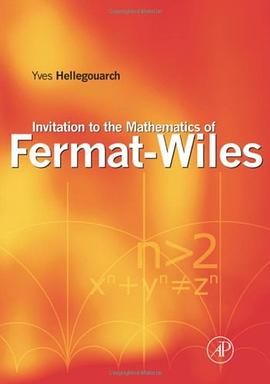
Assuming only modest knowledge of undergraduate level math, "Invitation to the Mathematics of Fermat-Wiles" presents diverse concepts required to comprehend Wiles' extraordinary proof. Furthermore, it places these concepts in their historical context. This book can be used in introduction to mathematics theories courses and in special topics courses on Fermat's last theorem. It contains themes suitable for development by students as an introduction to personal research as well as numerous exercises and problems. However, the book will also appeal to the inquiring and mathematically informed reader intrigued by the unraveling of this fascinating puzzle. It rigorously presents the concepts required to understand Wiles' proof, assuming only modest undergraduate level math. It sets the math in its historical context. It contains several themes that could be further developed by student research and numerous exercises and problems. It is written by Yves Hellegouarch, who himself made an important contribution to the proof of Fermat's last theorem.
作者简介
Yves Hellegouarch studied at the École Normale Supérieure in Paris. He has been teaching at the University of Caen since 1970. In 1972 he wrote a thesis, "Elliptic Curves and Fermat's Equation."
目录信息
1.1 Diophantus and his Arithmetica
1.2 Translations of Diophantus
1.3 Fermat
1.4 Infinite Descent
1.5 Fermat’s “Theorem” in Degree 4
1.6 The Theorem of Two Squares
1.6.1 A Modern Proof
1.6.2 “Fermat-Style” Proof of the Crucial Theorem
1.6.3 Representations as Sums of Two Squares
1.7 Euler-Style Proof of Fermat’s Last Theorem for n=3
1.8 Kummer, 1847
1.8.1 The Ring of Integers of Q(ξ)
1.8.2 A Lemma of Kummer on the Units of Z[ξ]
1.8.3 The Ideals of Z[ξ]
1.8.4 Kummer’s Proof (1847)
1.8.5 Regular Primes
1.9 The Current Approach
Exercises and Problems
2 Elliptic Functions
2.1 Elliptic Integrals
2.2 The Discovery of Elliptic Functions in 1718
2.3 Euler’s Contribution (1753)
2.4 Elliptic Functions: Structure Theorems
2.5 Weierstrass-Style Elliptic Functions
2.6 Eisenstein Series
2.7 The Weierstrass Cubic
2.8 Abel’s Theorem
2.9 Loxodromic Functions
2.10 The Function ρ
2.11 Computation of the Discriminant
2.12 Relation to Elliptic Functions
Exercises and Problems
3 Numbers and groups
3.1 Absolute Values on Q
3.2 Completion of a Fequipped with an Absolute Value
3.3 The Field of p-adic Numbers
3.4 Algebraic Closure of a Field
3.5 Generalities on the Linear Representations of Groups
3.6 Galois Extensions
3.6.1 The Galois Correspondence
3.6.2 Questions of Dimension
3.6.3 Stability
3.6.4 Conclusions
3.7 Resolution of Algebraic Equations
3.7.1 Some General Principles
3.7.2 Resolution of the Equation of Degree Three
Exercises and Problems
4 Elliptic Curves
4.1 Cubics and Elliptic Curves
4.2 B´ezout’s Theorem
4.3 Nine-Point Theorem
4.4 Group Laws on an Elliptic Curve
4.5 Reduction Modulo p
4.6 N-Division Points of an Elliptic Curve
4.6.1 2-Division Points
4.6.2 3-Division Points
4.6.3 n-Division Points of an Elliptic Curve Defined Over Q
4.7 A Most Interesting Galois Representation
4.8 Ring of Endomorphisms of an Elliptic Curve
4.9 Elliptic Curves Over a Finite Field
4.10 Torsion on an Elliptic Curve Defined Over Q
4.11 Mordell–Weil Theorem
4.12 Back to the Definition of Elliptic Curves
4.13 Formulae
4.14 Minimal Weierstrass Equations (Over Z)
4.15 Hasse–Weil L-Functions
4.15.1 Riemann Zeta Function
4.15.2 Artin Zeta Function
4.15.3 Hasse–Weil L-Function
Exercises and Problems
5 Modular Forms
5.1 Brief Historical Overview
5.2 The Theta Functions
5.3 Modular Forms for the Modular Group SL2(Z)/{I,−I}
5.3.1 Modular Properties of the Eisenstein Series
5.3.2 The Modular Group
5.3.3 Definition of Modular Forms and Functions
5.4 The Space of Modular Forms of Weight k for SL2(Z)
5.5 The Fifth Operation of Arithmetic
5.6 The Petersson Hermitian Product
5.7 Hecke Forms
5.7.1 Hecke Operators for SL2(Z)
5.8 Hecke’s Theory
5.8.1 The Mellin Transform
5.8.2 Functional Equations for the Functions L(f,s)
5.9 Wiles’ Theorem
Exercises and Problems
6 New Paradigms, New Enigmas
6.1 A Second Definition of the Ring Zp of p-adic Integers
6.2 The Tate Module Tl(E)
6.3 A Marvellous Result
6.4 Tate Loxodromic Functions
6.5 Curves EA,B,C
6.5.1 Reduction of Certain Curves EA,B,C
6.5.2 Property of the Field Kp Associated to Eap,bp,cp
6.5.3 Summary of the Properties of Eap,bp,cp
6.6 The Serre Conjectures
6.7 Mazur–Ribet’s Theorem
6.7.1 Mazur–Ribet’s Theorem
6.7.2 Other Applications
6.8 Szpiro’s Conjecture and the abc Conjecture
6.8.1 Szpiro’s Conjecture
6.8.2 abc Conjecture
6.8.3 Consequences
Exercises and Problems
Appendix: The Origin of the Elliptic Approach to Fermat’s Last Theorem
· · · · · · (收起)
读后感
用户评价
这本书的封面设计和排版简直是一场视觉盛宴,让人忍不住想立刻翻开它。纸张的质感厚实而富有弹性,墨水的印刷清晰锐利,即便是最复杂的公式也能看得一清二楚,这对于需要长时间研读数学著作的读者来说,无疑是一个巨大的加分项。装帧工艺看起来极其考究,书脊的缝合紧密,预示着它能够承受反复翻阅的考验。从第一印象来看,出版方显然投入了大量的精力和资源来确保这本书的物理品质达到顶级水准,这本身就传递出一种信息:这本书的内容值得被如此郑重地对待和珍藏。特别是那深沉的蓝色调,带着一种古典的、知识的重量感,让人在捧读时自然而然地就进入了一种严肃的学习状态,仿佛手中捧着的不是一本普通的教材,而是一份跨越时空的数学宣言。
这本书的篇幅看似浩瀚,但其内容的组织结构却展现出惊人的逻辑性和连贯性。章节之间的过渡处理得极其自然,仿佛一气呵成,使得整个阅读体验如同跟随一条规划完善的河流前行,不会在岔路口迷失方向。我注意到作者在每章末尾都设置了“思考题与延伸阅读”板块,这些设计绝非可有可无的填充物,它们巧妙地将本章知识点与后续内容进行了钩连,同时也鼓励读者进行批判性思考,而不是被动接受。这种精心的结构安排,充分体现了作者对教学法深刻的理解,这本书不仅仅是知识的罗列,更是一套完整的学习方法论的体现,引导读者如何高效地吸收和内化复杂的数学体系。
这本书的价值远远超出了其作为一本纯粹的数学参考书的定位。它散发出来的那种对数学美学的敬畏之情,是通过字里行间渗透出来的。作者对证明过程的优雅性的追求,以及对数学思想如何影响人类认知的探讨,让人在解题之余,还能感受到一种深层次的哲学思辨。它成功地将枯燥的演算过程,转化成了一场智力上的探险之旅,激发了读者内心深处对真理和完美的渴望。读完一部分,我常常需要停下来,不是因为不懂,而是被那种纯粹的数学之美所震撼,它让人重新审视自己与逻辑和抽象世界的联系。
我花了大量时间去研究这本书的引言部分,它的叙事口吻非常独特,既有对数学历史宏大背景的勾勒,又不失对具体概念引入时的细腻铺陈。作者似乎非常擅长于将抽象的数学思想“人格化”,用一种近乎讲故事的方式,引导读者逐步理解那些高深莫测的定理。我特别欣赏它在概念构建上的渐进性,它没有直接跳到最难的部分,而是耐心地搭建起必要的桥梁,确保即便是背景稍弱的读者也能跟上节奏。这种“慢工出细活”的教学方法,极大地降低了初学者的畏难情绪,让人感觉数学的殿堂并非高不可攀,而是需要耐心探索的迷宫。那种循序渐进、抽丝剥茧的论证过程,读起来非常过瘾,每一次小小的理解突破都带来极大的满足感。
与其他同类书籍相比,这本书在符号使用的规范性上达到了一个近乎苛刻的水平。每一个变量的定义、每一个操作符的含义,都被反复强调和精确界定,这在处理涉及多领域交叉的复杂数学证明时,显得尤为重要。我发现自己在阅读过程中,几乎不需要停下来猜测作者的意图,信息传递的效率非常高。这种严谨性对于追求精确性的读者来说,是无可替代的优势。此外,书中对一些历史上的数学争论和不同流派的观点也进行了中立且深入的探讨,使得读者不仅学到了“是什么”,更理解了“为什么会是这样”,这种多维度的视角极大地丰富了对数学的理解层次。