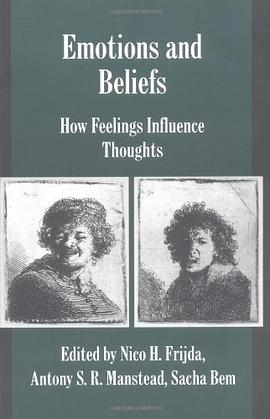
具体描述
作者简介
I Overview
1 What the Mind's Not / Daniel T. Gilbert 3
2 The History of Dual-Process Notions, and the Future of Preconscious Control / Gordon B. Moskowitz, Ian Skurnik, Adam D. Galinsky 12
II Dual-Process Theories in Attitudes and Social Cognition, and Single-Process Countermodels
A Attitudes (and Beyond)
3 The Elaboration Likelihood Model: Current Status and Controversies / Richard E. Petty, Duane T. Wegener 41
4 The Heuristic-Systematic Model in Its Broader Context / Serena Chen, Shelly Chaiken 73
5 The MODE Model of Attitude-Behavior Processes / Russel H. Fazio, Tamara Towles-Schwen 97
6 Depth of Processing, Belief Congruence, and Attitude-Behavior Correspondence / Icek Ajzen, James Sexton 117
B Person Perception
7 Spontaneous versus Intentional Inferences in Impression Formation / James S. Uleman 141
8 A Dual-Process Model of Overconfident Attributional Inferences / Yaacov Trope, Ruth Gaunt 161
9 Modes of Social Thought: Implicit Theories and Social Understanding / Sheri R. Levy, Jason E. Plaks, Carol S. Dweck 179
10 Dual-Processing Accounts of Inconsistencies in Responses to General versus Specific Cases / Steven J. Sherman, Denise R. Beike, Kenneth R. Ryalls 203
C Stereotyping in Particular
11 The Continuum Model: Ten Years Later / Susan T. Fiske, Monica Lin, Steven L. Neuberg 231
12 Dual Processes in the Cognitive Representation of Persons and Social Categories / Marilynn B. Brewer, Amy S. Harasty Feinstein 255
13 On the Dialectics of Discrimination: Dual Processes in Social Stereotyping / Galen V. Bodenhausen, C. Neil Macrae, Jeffrey W. Sherman 271
D One or Two Processing Modes in Social Cognition?
14 Separate or Equal?: Bimodal Notions of Persuasion and a Single-Process "Unimodel" / Arie W. Kruglanski, Erik P. Thompson, Scott Spiegel 293
15 Parallel Processing of Stereotypes and Behaviors / Ziva Kunda 314
16 Associative and Rule-Based Processing: A Connectionist Interpretation of Dual-Process Models / Eliot R. Smith, Jamie DeCoster 323
III Issues of Cognitive Control in Processing and Judgment
17 Automaticity and Control in Stereotyping / Patricia G. Devine, Margo J. Monteith 339
18 The Cognitive Monster: The Case against the Controllability of Automatic Stereotype Effects / John A. Bargh 361
19 The Role of Cognitive Control: Early Selection versus Late Correction / Larry L. Jacoby, Colleen M. Kelley, Brian D. McElree 383
IV Issues of Affect and Self-Regulation in Dual-Process Theories
20 Deliberative versus Implemental Mindsets in the Control of Action / Peter M. Gollwitzer, Ute Bayer 403
21 Sufficient and Necessary Conditions in Dual-Process Models: The Case of Mood and Information Processing / Herbert Bless, Norbert Schwarz 423
22 Affect in Attitude: Immediate and Deliberative Perspectives / Roger Giner-Sorolla 441
23 Some Basic Issues Regarding Dual-Process Theories from the Perspective of Cognitive-Experiential Self-Theory / Seymour Epstein, Rosemary Pacini 462
24 Processes Underlying Metacognitive Judgments: Information-Based and Experience-Based Monitoring of One's Own Knowledge / Asher Koriat, Ravit Levy-Sadot 483
25 Promotion and Prevention as a Motivational Duality: Implications for Evaluative Processes / E. Tory Higgins 503
V Applications and Extensions of Dual-Process Theorizing
26 Exploring the Boundary between Fiction and Reality / Deborah A. Prentice, Richard J. Gerrig 529
27 Motives and Modes of Processing in the Social Influence of Groups / Wendy Wood 547
28 The Social Contingency Model: Identifying Empirical and Normative Boundary Conditions on the Error-and-Bias Portrait of Human Nature / Philip E. Tetlock, Jennifer S. Lerner 571
29 On the Relationship between Social and Cognitive Modes of Organization / Reuben M. Baron, Stephen J. Misovich 586
30 Dualities and Continua: Implications for Understanding Perceptions of Persons and Groups / David L. Hamilton, Steven J. Sherman, Keith B. Maddox 606
31 When Do Decent People Blame Victims?: The Differing Effects of the Explicit/Rational and Implicit/Experiential Cognitive Systems / Melvin J. Lerner, Julie H. Goldberg 627
Author Index 641
Subject Index 650
目录信息
读后感
用户评价
从阅读体验来看,这本书的索引和术语表设计得非常人性化。面对如此密集的专业名词和复杂概念,一个高效的检索系统是至关重要的。这本书的后部附带的详尽术语对照表,几乎可以替代一本小型专业词典,极大地缩短了我在查阅不熟悉的概念时所花费的时间。此外,参考文献的引用格式统一且规范,每一条引文都能清晰地追溯到原始出处,这为我后续的拓展阅读指明了清晰的路径,避免了在浩瀚的文献海洋中迷失方向。总的来说,这本书无疑是社会心理学领域内一本里程碑式的著作,它不仅提供了前沿的理论框架,更在细节的处理上体现了对读者体验的极致关怀,是一本可以反复研读、每次都能获得新感悟的深度学术力作。
这本书的装帧设计非常考究,硬壳封面带着一种沉甸甸的历史感,让人一上手就觉得不是那种可以随意翻阅的快餐读物。封面的字体选择也颇有深意,那种略带古典气息的衬线体,似乎在暗示着本书对心理学领域核心范式的深刻探讨。内页的纸张质感极佳,即便是长时间阅读,眼睛也不会感到明显的疲劳,这对于需要仔细研读理论模型的读者来说,简直是一种福音。我尤其欣赏其排版布局,章节之间的留白恰到好处,使得复杂的理论结构在视觉上得到了很好的梳理,即便是初次接触这个领域的读者,也能相对清晰地把握住脉络。不过,对于某些篇幅较长的模型推演,如果能配上更直观的图示辅助理解,可能会更臻完美。整体而言,这本书的物理呈现,已经为一场深度的学术旅程奠定了坚实的物质基础,它不仅仅是一本书,更像是一件值得收藏的学术珍品,散发着一种对知识本身的尊重与敬畏。
真正让我感到震撼的,是作者在批判性分析时所展现出的那种近乎悲悯的审慎态度。他没有急于宣布任何一种模型为“最终真理”,而是以一种历史的眼光,审视了这些理论在特定历史背景下的诞生逻辑和它们在面对新的实验范式时的脆弱性。这种对知识迭代过程的尊重,比任何强有力的断言都更具力量。书中对于“系统一”与“系统二”的早期争论脉络梳理得极为清晰,它不再是简单的二元对立,而是被放置在一个动态的、资源竞争的框架下进行考察。这种细腻的过渡和情境依赖性的强调,有效地打破了许多人对认知过程的僵化理解。我个人认为,这本书最宝贵之处在于它教会了我们如何“思考”理论,而不是仅仅“接受”理论,这才是高等学术研究的精髓所在。
这本书的语言风格,与其说是在写教科书,不如说是在进行一场与读者的严肃对话。作者的笔触冷静、客观,几乎没有冗余的形容词或煽情性的措辞,每一个句子都承载着明确的学术信息量。这种高度凝练的表达方式,虽然要求读者必须全神贯注,稍有走神便可能错过关键的逻辑跳跃,但一旦跟上其思路,便能感受到一种清晰、高效的知识传递过程。我发现,阅读此书的过程,更像是在攀登一座知识的山峰,每一步都需要精确的着力点和平衡感。对于已经有扎实心理学背景的人来说,这本书无疑是一次理论深度的淬炼;但对于刚刚踏入这一领域的新手,可能需要借助一些辅助读物来铺垫基础概念,否则初期的陡峭感可能会让人望而却步。这本书的价值在于挑战你的认知极限,而非简单地提供答案。
我花了整整一周的时间来消化前三章的内容,可以说,作者在构建其论证体系时所展现出的逻辑严谨性,简直令人叹为观止。他并非简单地罗列既有的研究成果,而是以一种近乎外科手术般的精准度,解剖了传统认知模型中存在的内在矛盾与解释力的局限性。特别是对决策过程的分解,那种从宏观的直觉反应到微观的认知资源分配的层层递进,让我对人类心智运作的复杂性有了全新的认识。书中引用的案例数据,大多来源于跨文化、跨年龄段的纵向研究,这极大地增强了理论的普适性和说服力,避免了许多社会心理学著作容易陷入的“西方中心主义”窠臼。唯一让我略感不足的是,在讨论如何将这些理论转化为有效的干预措施时,深度稍显不足,更偏向于描述性的理论构建,而较少探讨实操层面的应用潜力,这也许是这类偏向基础理论著作的共同特点吧,但对于期待实际应用指导的读者来说,或许会稍感意犹未尽。
persuasion教材,相对晦涩
persuasion教材,相对晦涩
认知科学双过程理论的基本读物,也算个论文集。
认知科学双过程理论的基本读物,也算个论文集。
persuasion教材,相对晦涩