
具体描述
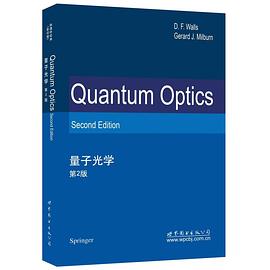
《量子光学(第2版)(英文版)》是量子光学领域里实验和理论分析新全面的一本教材。
作者简介
D. F. Walls (D.L. 沃尔斯, 新西兰)是国际知名学者,在物理学界和光学界都享有盛誉。本书凝聚了作者多年科研和教学成果,适用于科研工作者、高校教师和研究生。
目录信息
2 Quantisation of the Electromagnetic Field
2.1 Field Quantisation
2.2 Fock or Number States
2.3 Coherent States
2.4 Squeezed States
2.5 Two—Photon Coherent States
2.6 Variance in the Electric Field
2.7 Multimode Squeezed States
2.8 Phase Properties of the Field
Exercises
References
Further Reading
3 Coherence Properties of the Electromagnetic Field
3.1 Field—Correlation Functions
3.2 Properties of the Correlation Functions
3.3 Correlation Functions and Optical Coherence
3.4 First—Order Optical Coherence
3.5 Coherent Field
3.6 Photon Correlation Measurements
3.7 Quantum Mechanical Fields
3.7.I Squeezed State
3.7.2 Squeezed Vacuum
3.8 Phase—Dependent Correlation Functions
3.9 Photon Counting Measurements
3.9.1 Classical Theory
3.9.2 ConstantIntensity
3.9.3 Fluctuating Intensity—Short—Time Limit
3.10 Quantum Mechanical Photon Count Distribution
3.10.1 Coherent Light
3.10.2 Chaotic Light
3.10.3 Photo—Electron Current Fluctuations
Exercises
References
Further Reading
4 Representations of the Electromagnetic Field
4.1 Expansion in Number States
4.2 Expansion in Coherent States.
4.2.1 P Representation
4.2.2 Wigner’s Phase—Space Density
4.2.3 Q Function
4.2.4 R Representation.
4.2.5 Generalized P Representations
4.2.6 Positive P Representation
Exercises
Keferences
5 Quantum Phenomena in Simple Systems in Nonlinear Optics
5.1 Single—Mode Quantum Statistics
5.1.1 Degenerate Parametric Amplifier
5.1.2 Photon Statistics
5.1.3 Wigner Function
5.2 Two—Mode Quantum Correlations
5.2.1 Non—degenerate Parametric Amplifier
5.2.2 Squeezing
5.2.3 Quadrature Correlations and the Einstein—Podolsky—Rosen Paradox
5.2.4 Wigner Function
5.2.5 Reduced Density Operator
5.3 Quantum Limits to Amplification
5.4 Amplitude Squeezed State with Poisson Photon Number Statistics.
Exercises
References
6 Stochastic Methods
6.1 Master Equation
6.2 Equivalent c—Number Equations
6.2.1 Photon Number Representation
6.2.2 P Representation.
6.2.3 Properties of Fokker—Planck Equations.
6.2.4 Steady State Solutions—Potential Conditions.
6.2.5 Time Dependent Solution
6.2.6 Q Representation
6.2.7 Wigner Function
6.2.8 Generalized P Representation
6.3 Stochastic Differential Equations
6.3.1 Use of the Positive P Representation
6.4 Linear Processes with Constant Diffusion
6.5 Two Time Correlation Functions in Quantum Markov Processes
6.5.1 Quantum Regression Theorem
6.6 Application to Systems with a P Representation
6.7 Stochastic Unravellings
6.7.1 Simulating Quantum Trajectories
Exercises
References
Further Reading
7 Input—Output Formulation of Optical Cavities
7.1 Cavity Modes
7.2 Linear Systems
7.3 Two—Sided Cavity
7.4 Two Time Correlation Functions
7.5 Spectrum ofSqueezing
7.6 Parametric Oscillator
7.7 Squeezing in the Total Field
7.8 Fokker—Pianck Equation
Exercises
References
Further Reading.
8 Generation and Applications of Squeezed Light
8.1 Parametric Oscillation and Second Harmonic Generation
8.1.1 Semi—Classical Steady States and Stability Analysis
8.1.2 Parametric Oscillation
8.1.3 Second Harmonic Generation
8.1.4 Squeezing Spectrum
8.1.5 Parametric Oscillation
8.1.6 Experiments
8.2 Twin Beam Generation and Intensity Correlations
8.2.1 Second Harmonic Generation
8.2.2 Experiments
8.3 Applications of Squeezed Light
8.3.1 Interferometric Detection of Gravitational Radiation
8.3.2 Sub—Shot—Noise Phase Measurements
8.3.3 Quantum Information
Exercises
References
Further Reading
9 Nonlinear Quantum Dissipative Systems
9.I Optical Parametric Oscillator:Complex P Function
9.2 Optical Parametric Oscillator:Positive P Function
9.3 Quantum Tunnelling Time
9.4 Dispersive Optical Bistability.
9.5 Comment on the Use of the Q and Wigner Representations
Exercises
9.A Appendix
9.A.I Evaluation of Moments for the Complex P function for Parametric Oscillation(9.17)
9.A.2 Evaluation of the Moments for the Complex P Function for Optical Bistability(9.48)
References
Further Reading
10 Interaction of Radiation with Atoms
10.1 Quantization of the Many—Electron System
10.2 Interaction of a Single Two—Level Atom with a Single Mode Field
10.3 Spontaneous Emission from aTwo—Level Atom.
10.4 Phase Decay in a Two—Level System
10.5 Resonance Fluorescence
Exercises
References
Further Reading
1l CQED
1.1.1 Cavity QED
1.1.1 I Vacuum Rabi Splitting
1.1.1.2 Single Photon Sources
1.1.1.3 Cavity QED with N Atoms
1.1.2 Circuit QED
Exercises
References
Further Reading
12 Quantum Theory of the Laser
12.1 Master Equation
12.2 Photon Statistics
12.2.1 Spectrum of Intensity Fluctuations
12.3 Laser Linewidth
12.4 Regularly Pumped Laser
12.A Appendix:Derivation of the Single.Atom Increment
Exercises
References
……
13 Bells Inequalities in Quantum Optics
14 Quantum Nondemolition Measurements
15 Quantum Coherence and Measurement Theory
16 Quantum Information.
17 Ion Traps
18 Light Forces
19 Bose—Einstein Condensation
Index
· · · · · · (收起)
读后感
用户评价
我花了整整一个周末啃完了这本书的第三章,老实说,那种感觉就像是攀登一座知识的珠穆朗玛峰,每一步都踏实,但抬头望去,总觉得顶峰还在遥不可及之处。这本书的难度系数绝对不是为入门者准备的,它对读者预设的数学和物理基础要求相当高,很多推导过程省略了中间步骤,直接跳到了精妙的结论,这让我在某些涉及复杂矩阵和微扰理论的部分感到有些措手不及。但是,一旦我耐下性子,查阅了必要的背景知识,重新审视作者给出的简化模型,那种顿悟的快感是无与伦比的。它没有用华丽的辞藻来粉饰冰冷的代码和公式,而是用最严谨、最无可辩驳的数学语言,构建了一个完整的理论体系。对我而言,这本书与其说是一本教材,不如说是一部需要反复研习的经典文献汇编,需要读者付出与理论本身同等的专注和敬意。它不是那种能让你在咖啡馆里轻松翻阅的读物。
这本书的排版和校对工作做得非常出色,这对于一本涉及大量符号和复杂公式的物理书籍来说,是至关重要的。我注意到在阅读过程中,几乎没有遇到任何印刷错误或者符号混淆的情况,这极大地节省了我反复核对的时间,让我能够更专注于理解内容本身。从宏观的薛定谔方程在光场中的应用,到微观的真空涨落如何影响光子的发射速率,全书的逻辑脉络清晰得如同精心设计的晶体结构。特别是它对量子信息领域基础的光学实现路径的梳理,视角独特且全面,为我梳理了当前领域内几大主流技术路线的优劣和内在联系。这本书的深度和广度,使其成为我案头必备的工具书之一,可以肯定的是,在未来的很长一段时间里,我都会不断地从中汲取养分。
这本关于“量子光学”的书籍,简直是打开了一扇通往微观世界奇妙之门!我得说,作者在处理那些极其抽象的概念时,展现出了惊人的洞察力和清晰的表达能力。书中的插图和图示,虽然只是辅助,却有效地帮助我构建了那些在日常经验中完全无法想象的物理图像。我尤其欣赏它对光子与物质相互作用基本原理的阐述,那种层层递进的逻辑推导,让人在感到挑战的同时,也充满了豁然开朗的喜悦。它没有停留在高中物理那种简单的光和电磁波的描述上,而是深入到了量子场论的边缘地带,虽然有些部分读起来需要放慢速度,甚至需要反复咀络,但这正是它价值所在——它迫使你真正地去思考和理解“量子性”的本质。对于一个渴望从现象层面深入到机理层面的学习者来说,这本书无疑是提供了一条坚实而富有启发性的阶梯。我感觉自己不再是旁观者,而是一名初涉禁地的探险者,正努力解读宇宙深处最基础的语言。
这本书最让我感到振奋的地方,在于它对实验物理的深刻关注。很多量子光学著作往往沉溺于理论推导的优雅,而对如何“观测”和“操控”量子态的实际操作着墨不多。然而,这本书似乎在理论和实验之间架起了一座坚固的桥梁。作者对于激光器的最新进展、量子纠缠的实际制备过程,乃至单光子探测器的噪声控制等工程细节,都有独到的见解和详尽的介绍。这使得我阅读时能够清晰地想象出,在实验室环境中,这些精密的仪器是如何协同工作,将那些宏大的量子概念具象化的。它不仅告诉你“为什么”,更重要的是,它巧妙地展示了“如何做”。这种面向实践的视角,极大地激发了我未来在科研领域进行探索的欲望,它让我看到了理论的终点,恰恰是下一次实验的起点。
坦白讲,我最初被这本书的封面设计所吸引,那种冷峻的蓝色调和简洁的排版,透露着一种严肃的学术气息。然而,阅读体验却远超我的预期。作者在叙述中流露出的那种对物理学的热情是难以掩盖的,尤其是在探讨光场压缩态和非线性光学效应的部分,文字中仿佛能感受到那种能量的涌动和光线的扭曲。它成功地在保持高度学术严谨性的同时,避免了陷入枯燥的教科书腔调。每一章的结尾,作者都会设置一些富有启发性的思考题,它们往往不是简单的数值计算,而是要求对物理图像进行更深层次的哲学思考或模型拓展。这种设计极大地提升了阅读的互动性和趣味性,让我感觉自己不是在被动接受知识,而是在与一位经验丰富的导师进行高水平的思维碰撞。