
具体描述
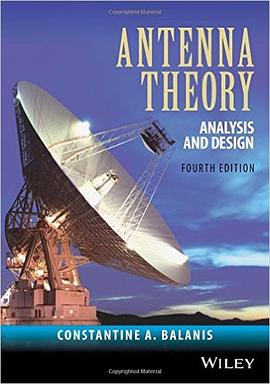
This book introduces the fundamental principles of antenna theory and explains how to apply them to the analysis, design, and measurements of antennas. Due to the variety of methods of analysis and design, and the different antenna structures available, the applications covered in this book are made to some of the most basic and practical antenna configurations. Among these antenna configurations are linear dipoles; loops; arrays; broadband antennas; aperture antennas; horns; microstrip antennas; and reflector antennas. The text contains sufficient mathematical detail to enable undergraduate and beginning graduate students in electrical engineering and physics to follow the flow of analysis and design. Readers should have a basic knowledge of undergraduate electromagnetic theory, including Maxwell’s equations and the wave equation, introductory physics, and differential and integral calculus.
作者简介
Constantine A. Balanis received his BSEE degree from the Virginia Tech in 1964, his MEE degree from the University of Virginia in 1966, his PhD in Electrical Engineering from The Ohio State University in 1969, and an Honorary Doctorate from the Aristotle University of Thessaloniki in 2004. From 1964 to 1970, he was with the NASA Langley Research Center in Hampton, VA, and from 1970 to 1983, he was with the Department of Electrical Engineering of West Virginia University. In 1983 he joined Arizona State University and is now Regents' Professor of Electrical Engineering. Dr. Balanis is also a life fellow of the IEEE.
目录信息
Preface xiii
About the Companion Website xix
1 Antennas 1
1.1 Introduction 1
1.2 Types of Antennas 3
1.3 Radiation Mechanism 7
1.4 Current Distribution on a Thin Wire Antenna 15
1.5 Historical Advancement 18
1.6 Multimedia 21
References 22
2 Fundamental Parameters and Figures-of-Merit of Antennas 25
2.1 Introduction 25
2.2 Radiation Pattern 25
2.3 Radiation Power Density 35
2.4 Radiation Intensity 37
2.5 Beamwidth 40
2.6 Directivity 41
2.7 Numerical Techniques 55
2.8 Antenna Efficiency 60
2.9 Gain, Realized Gain 61
2.10 Beam Efficiency 65
2.11 Bandwidth 65
2.12 Polarization 66
2.13 Input Impedance 75
2.14 Antenna Radiation Efficiency 79
2.15 Antenna Vector Effective Length and Equivalent Areas 81
2.16 Maximum Directivity and Maximum Effective Area 86
2.17 Friis Transmission Equation and Radar Range Equation 88
2.18 Antenna Temperature 96
2.19 Multimedia 100
References 103
Problems 105
3 Radiation Integrals and Auxiliary Potential Functions 127
3.1 Introduction 127
3.2 The Vector Potential A for an Electric Current Source J 128
3.3 The Vector Potential F for A Magnetic Current Source M 130
3.4 Electric and Magnetic Fields for Electric (J) and Magnetic (M) Current Sources 131
3.5 Solution of the Inhomogeneous Vector Potential Wave Equation 132
3.6 Far-Field Radiation 136
3.7 Duality Theorem 137
3.8 Reciprocity and Reaction Theorems 138
References 143
Problems 143
4 Linear Wire Antennas 145
4.1 Introduction 145
4.2 Infinitesimal Dipole 145
4.3 Small Dipole 155
4.4 Region Separation 158
4.5 Finite Length Dipole 164
4.6 Half-Wavelength Dipole 176
4.7 Linear Elements Near or On Infinite Perfect Electric Conductors (PEC), Perfect Magnetic Conductors (PMC) and Electromagnetic Band-Gap (EBG) Surfaces 179
4.8 Ground Effects 203
4.9 Computer Codes 216
4.10 Multimedia 216
References 218
Problems 220
5 Loop Antennas 235
5.1 Introduction 235
5.2 Small Circular Loop 236
5.3 Circular Loop of Constant Current 250
5.4 Circular Loop with Nonuniform Current 259
5.5 Ground and Earth Curvature Effects for Circular Loops 268
5.6 Polygonal Loop Antennas 269
5.7 Ferrite Loop 270
5.8 Mobile Communication Systems Applications 272
5.9 Multimedia 272
References 275
Problems 277
6 Arrays: Linear, Planar, and Circular 285
6.1 Introduction 285
6.2 Two-Element Array 286
6.3 N-Element Linear Array: Uniform Amplitude and Spacing 293
6.4 N-Element Linear Array: Directivity 312
6.5 Design Procedure 318
6.6 N-Element Linear Array: Three-Dimensional Characteristics 319
6.7 Rectangular-to-Polar Graphical Solution 322
6.8 N-Element Linear Array: Uniform Spacing, Nonuniform Amplitude 323
6.9 Superdirectivity 345
6.10 Planar Array 348
6.11 Design Considerations 360
6.12 Circular Array 363
6.13 Multimedia 367
References 367
Problems 368
7 Antenna Synthesis and Continuous Sources 385
7.1 Introduction 385
7.2 Continuous Sources 386
7.3 Schelkunoff Polynomial Method 387
7.4 Fourier Transform Method 392
7.5 Woodward-Lawson Method 398
7.6 Taylor Line-Source (Tschebyscheff-Error) 404
7.7 Taylor Line-Source (One-Parameter) 408
7.8 Triangular, Cosine, and Cosine-Squared Amplitude Distributions 415
7.9 Line-Source Phase Distributions 416
7.10 Continuous Aperture Sources 417
7.11 Multimedia 420
References 420
Problems 421
8 Integral Equations, Moment Method, and Self and Mutual Impedances 431
8.1 Introduction 431
8.2 Integral Equation Method 432
8.3 Finite Diameter Wires 439
8.4 Moment Method Solution 448
8.5 Self-Impedance 455
8.6 Mutual Impedance Between Linear Elements 463
8.7 Mutual Coupling in Arrays 474
8.8 Multimedia 480
References 480
Problems 482
9 Broadband Dipoles and Matching Techniques 485
9.1 Introduction 485
9.2 Biconical Antenna 487
9.3 Triangular Sheet, Flexible and Conformal Bow-Tie, and Wire Simulation 492
9.4 Vivaldi Antenna 496
9.5 Cylindrical Dipole 500
9.6 Folded Dipole 505
9.7 Discone and Conical Skirt Monopole 512
9.8 Matching Techniques 513
9.9 Multimedia 523
References 524
Problems 525
10 Traveling Wave and Broadband Antennas 533
10.1 Introduction 533
10.2 Traveling Wave Antennas 533
10.3 Broadband Antennas 549
10.4 Multimedia 580
References 580
Problems 582
11 Frequency Independent Antennas, Antenna Miniaturization, and Fractal Antennas 591
11.1 Introduction 591
11.2 Theory 592
11.3 Equiangular Spiral Antennas 593
11.4 Log-Periodic Antennas 598
11.5 Fundamental Limits of Electrically Small Antennas 614
11.6 Antenna Miniaturization 619
11.7 Fractal Antennas 627
11.8 Multimedia 633
References 633
Problems 635
12 Aperture Antennas 639
12.1 Introduction 639
12.2 Field Equivalence Principle: Huygens’ Principle 639
12.3 Radiation Equations 645
12.4 Directivity 648
12.5 Rectangular Apertures 648
12.6 Circular Apertures 667
12.7 Design Considerations 675
12.8 Babinet’s Principle 680
12.9 Fourier Transforms in Aperture Antenna Theory 684
12.10 Ground Plane Edge Effects: The Geometrical Theory of Diffraction 702
12.11 Multimedia 707
References 707
Problems 709
13 Horn Antennas 719
13.1 Introduction 719
13.2 E-Plane Sectoral Horn 719
13.3 H-Plane Sectoral Horn 733
13.4 Pyramidal Horn 743
13.5 Conical Horn 756
13.6 Corrugated Horn 761
13.7 Aperture-Matched Horns 766
13.8 Multimode Horns 769
13.9 Dielectric-Loaded Horns 771
13.10 Phase Center 773
13.11 Multimedia 774
References 775
Problems 778
14 Microstrip and Mobile Communications Antennas 783
14.1 Introduction 783
14.2 Rectangular Patch 788
14.3 Circular Patch 815
14.4 Quality Factor, Bandwidth, and Efficiency 823
14.5 Input Impedance 826
14.6 Coupling 827
14.7 Circular Polarization 830
14.8 Arrays and Feed Networks 832
14.9 Antennas for Mobile Communications 837
14.10 Dielectric Resonator Antennas 847
14.11 Multimedia 858
References 862
Problems 867
15 Reflector Antennas 875
15.1 Introduction 875
15.2 Plane Reflector 875
15.3 Corner Reflector 876
15.4 Parabolic Reflector 884
15.5 Spherical Reflector 920
15.6 Multimedia 923
References 923
Problems 925
16 Smart Antennas 931
16.1 Introduction 931
16.2 Smart-Antenna Analogy 931
16.3 Cellular Radio Systems Evolution 933
16.4 Signal Propagation 939
16.5 Smart Antennas’ Benefits 942
16.6 Smart Antennas’ Drawbacks 943
16.7 Antenna 943
16.8 Antenna Beamforming 946
16.9 Mobile Ad hoc Networks (MANETs) 960
16.10 Smart-Antenna System Design, Simulation, and Results 964
16.11 Beamforming, Diversity Combining, Rayleigh-Fading, and Trellis-Coded Modulation 972
16.12 Other Geometries 975
16.13 Multimedia 976
References 976
Problems 980
17 Antenna Measurements 981
17.1 Introduction 981
17.2 Antenna Ranges 982
17.3 Radiation Patterns 1000
17.4 Gain Measurements 1003
17.5 Directivity Measurements 1010
17.6 Radiation Efficiency 1012
17.7 Impedance Measurements 1012
17.8 Current Measurements 1014
17.9 Polarization Measurements 1014
17.10 Scale Model Measurements 1019
References 1024
Appendix I: f (x)= sin(x) x 1027
Appendix II: fN(x)= |||| sin(Nx) N sin(x) |||| N =1, 3, 5, 10, 20 1029
Appendix III: Cosine and Sine Integrals 1031
Appendix IV: Fresnel Integrals 1033
Appendix V: Bessel Functions 1035
Appendix VI: Identities 1041
Appendix VII: Vector Analysis 1045
Appendix VIII: Method of Stationary Phase 1055
Appendix IX: Television, Radio, Telephone, and Radar Frequency Spectrums 1061
Index 1065
· · · · · · (收起)
读后感
这是本经典的天线书籍,几乎可以说是包罗万象,应有尽有。 作者是IEEE的fellow,功力极深。 可惜的是居然轮到我来第一个评论这本书,豆瓣在人文社科领域很好,希望在技术领域也能否有所突破,成为技术领域的书籍交流中心。 我在等待。
这是本经典的天线书籍,几乎可以说是包罗万象,应有尽有。 作者是IEEE的fellow,功力极深。 可惜的是居然轮到我来第一个评论这本书,豆瓣在人文社科领域很好,希望在技术领域也能否有所突破,成为技术领域的书籍交流中心。 我在等待。
可能是没有影印版吧,这本书受到的关注要少很多,最近从图书馆借到此书,条理清晰,数学与逻辑拿捏得很平衡,以前看克劳斯的书觉得少了的东西,这本书都有了。
这是本经典的天线书籍,几乎可以说是包罗万象,应有尽有。 作者是IEEE的fellow,功力极深。 可惜的是居然轮到我来第一个评论这本书,豆瓣在人文社科领域很好,希望在技术领域也能否有所突破,成为技术领域的书籍交流中心。 我在等待。
这是本经典的天线书籍,几乎可以说是包罗万象,应有尽有。 作者是IEEE的fellow,功力极深。 可惜的是居然轮到我来第一个评论这本书,豆瓣在人文社科领域很好,希望在技术领域也能否有所突破,成为技术领域的书籍交流中心。 我在等待。
用户评价
老实说,《Antenna Theory》这本书的阅读体验,有点像是在参加一场高水平的学术研讨会,每一页都充斥着精炼的理论和严谨的推导。我尤其喜欢书中对于不同类型天线(如微带天线、阵列天线等)的分类讲解,以及它们各自的优缺点和适用场景。作者在介绍每种天线时,都会先从其基本结构和工作原理讲起,然后逐步深入到其设计方法和性能分析。我特别对书中关于天线测量和仿真技术的部分印象深刻,它让我了解到,理论设计最终需要通过实际的测量和仿真来验证和优化,这是一种科学严谨的闭环过程。虽然书中大量的公式和图表有时会让人望而却步,但我发现,一旦你坚持下去,并且努力去理解那些公式背后的物理意义,你就会发现其中蕴含的深刻智慧。这本书为我打开了天线设计领域的一扇窗户,让我看到了更广阔的天地,也激发了我对这一领域更深入探索的兴趣。
这本书简直是我的“精神食粮”!我原本以为自己对天线设计已经有了相当的了解,但《Antenna Theory》却像是一个打开新世界的大门。它不仅仅是列出了一堆公式和参数,更重要的是,它深入剖析了天线工作的“为什么”和“怎么做”。我特别欣赏书中对于各种影响天线性能的因素的细致讨论,比如材料损耗、阻抗匹配、环境影响等等,这些都是在实际工程中常常被忽视但又至关重要的问题。书中的案例分析也非常实用,很多都是我们日常接触到的通信设备中的天线设计实例,读起来非常有代入感。我记得其中有一章详细讲解了如何优化一个定向天线的增益和带宽,我按照书中的方法尝试着在脑海中进行模拟,发现了很多之前没有注意到的细节。这本书让我意识到,天线设计并非一蹴而就,而是需要对基础理论有深刻的理解,并且能够结合实际应用场景进行灵活的调整和优化。虽然阅读过程并不轻松,需要时常停下来思考和回顾,但我认为这种深入的探索是值得的,它极大地提升了我解决实际问题的能力。
我最近花了几个月的时间,终于啃完了那本厚重的《Antenna Theory》。坦白说,拿到这本书的时候,内心是既期待又有些忐忑的。这本书在业界的名声很大,许多工程师和研究者都视它为“圣经”,但同时也听说它的内容非常扎实,需要花费大量的时间和精力去消化。打开第一页,迎面而来的是密密麻麻的公式和理论推导,那一刻我感觉自己像是被推入了知识的汪洋大海。从基础的麦克斯韦方程组开始,到电磁波的传播特性,再到各种天线模型的设计原理,每一个章节都充满了深度和挑战。我尤其喜欢其中关于偶极子天线和环形天线的详细解析,作者通过清晰的图示和循序渐进的讲解,将抽象的电磁场概念具象化,让我能够理解天线在不同结构下的辐射模式是如何形成的。虽然很多时候我需要反复阅读、查阅资料,甚至在纸上进行大量的演算才能真正理解其中的奥妙,但当最终理解一个复杂的公式或者一个关键的设计原则时,那种成就感是难以言喻的。这本书不仅仅是知识的堆砌,更是思维方式的训练,它教会了我如何从微观的电磁现象出发,宏观地分析和设计一个实际的天线系统。
我必须承认,阅读《Antenna Theory》的过程就像是在攀登一座险峻的山峰。起初,我被那些晦涩的数学语言和复杂的物理概念所震撼,感觉自己像是迷失在一片未知的领域。然而,我并没有因此放弃,而是抱着一种“探险”的心态,一步一个脚印地向前迈进。书中关于近场和远场理论的讲解,以及如何通过这些理论来预测天线的辐射特性,让我对天线的工作原理有了全新的认识。作者在阐述每一个理论时,都力求严谨和准确,并且提供了充足的数学推导作为支撑,这对于我这样希望深入理解事物本质的读者来说,无疑是极大的福音。尽管在某些章节,我需要花费数倍于平时的精力去理解,甚至需要翻阅其他参考资料来辅助理解,但每一次突破性的理解都给我带来了巨大的惊喜。这本书不只是告诉你“是什么”,更重要的是它揭示了“为什么”。我感觉自己不仅仅是在学习一项技术,更是在学习一种严谨的科学思维方式,这种思维方式对于我在其他工程领域的研究也大有裨益。
我最近刚读完《Antenna Theory》,这本书给我留下了非常深刻的印象。它的内容非常全面,涵盖了天线设计和分析的各个方面,从最基础的理论知识到最前沿的研究方向,几乎无所不包。我尤其欣赏作者在讲解过程中所展现出的逻辑清晰和条理性。书中对于不同天线参数(如增益、方向性、效率、阻抗等)的定义和计算方法都进行了详细的阐述,并且提供了大量的图表和实例来帮助读者理解。我感觉这本书不仅仅是一本教科书,更像是一位经验丰富的老前辈在指导我如何进行天线设计。我特别对书中关于天线互耦和极化特性的讨论记忆犹新,这让我意识到,在复杂的天线系统中,这些看似微小的因素往往会对整体性能产生巨大的影响。虽然阅读这本书需要投入相当多的时间和精力,并且需要一定的专业基础,但我认为,对于任何希望在天线领域有所建树的工程师和研究者来说,这本书都绝对是不可或缺的宝贵财富。