
具体描述
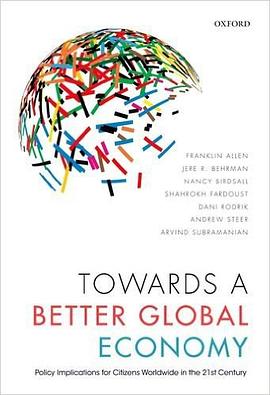
Substantial progress in the fight against extreme poverty was made in the last two decades. But the slowdown in global economic growth and significant increases in income inequality in many developed and developing countries raise serious concerns about the continuation of this trend into the 21st century. The time has come to seriously think about how improvements in official global governance, coupled with and reinforced by rising activism of 'global citizens' can lead to welfare-enhancing and more equitable results for global citizens through better national and international policies.
This book examines the factors that are most likely to facilitate the process of beneficial economic growth in low-, middle-, and high-income countries. It examines past, present, and future economic growth; demographic changes; the hyperglobalization of trade; the effect of finance on growth; climate change and resource depletion; and the sense of global citizenship and the need for global governance in order to draw longer-term implications, identify policy options for improving the lives of average citizens around the world, and make the case for the need to confront new challenges with truly global policy responses. The book documents how demographic changes, convergence, and competition are likely to bring about massive shifts in the sectoral and geographical composition of global output and employment, as the center of gravity of the global economy moves toward Asia and emerging economies elsewhere. It shows that the legacies of the 2008-09 crisis-high unemployment levels, massive excess capacities, and high debt levels-are likely to reduce the standard of living of millions of people in many countries over a long period of adjustment and that fluctuations in international trade, financial markets, and commodity prices, as well as the tendency of institutions at both the national and international level to favor the interests of the better-off and more powerful pose substantial risks for citizens of all countries. The chapters and their policy implications are intended to stimulate public interest and facilitate the exchange of ideas and policy dialogue.
作者简介
Franklin Allen, Nippon Life Professor of Finance and Economics and Co-Director, Wharton Financial Institutions Center, Jere R. Behrman, William R. Kenan Jr. Professor of Economics and Sociology, University of Pennsylvania, Nancy Birdsall, President, Center for Global Development, Shahrokh Fardoust, President, International Economic Consultants, LLC, and former Director of Strategy and Operations, Development Economics, World Bank, Dani Rodrik, Albert O. Hirschman Professor, Institute for Advanced Study, Andrew Steer, President and CEO, World Resources Institute, Arvind Subramanian, Senior Fellow, Peterson Institute for International Economics and Center for Global Development
Franklin Allen is the Nippon Life Professor of Finance and Professor of Economics at the Wharton School of the University of Pennsylvania and co-director of the Wharton Financial Institutions Center. He is a former president of the American Finance Association. He has written three books with Douglas Gale, on financial innovation, comparative financial systems, and financial crises. He is the co-author (with Richard Brealey and Stewart Myers) of the 8th-11th editions of the textbook Principles of Corporate Finance. He holds a DPhil from the University of Oxford.
Jere R. Behrman is the William R. Kenan, Jr. Professor of Economics and Sociology and Population Studies Center Research Associate at the University of Pennsylvania. His research is in empirical microeconomics, economic development, early childhood development, labor economics, human resources (education, training, health, nutrition), economic demography, household behaviors, and life-cycle and intergenerational relations. He has published more than 370 professional articles and 33 books, been a research consultant with numerous international organizations, conducted research or lectured in more than 40 countries, and served as principal investigator on more than 75 research projects. He is a Fellow of the Econometric Society, a 40th Anniversary Fulbright Fellow, the recipient of the 2008 biennial Carlos Diaz-Alejandro Prize for outstanding research contributions to Latin America, and a member of the U.S. National Institutes of Child Health and Development (NICHD) Advisory Council.
Nancy Birdsall is the founding president of the Center for Global Development. Before launching the center, she served as executive vice president of the Inter-American Development Bank; held research, policy, and management positions at the World Bank, including as director of the Policy Research Department; and served as Senior Associate and Director of the Economic Reform Project at the Carnegie Endowment for International Peace. She is the author, co-author, or editor of more than a dozen books and many scholarly papers. Her most recent publications include Cash on Delivery: A New Approach to Foreign Aid (2010) and New Ideas on Development after the Financial Crisis (2011), coedited with Francis Fukuyama. She holds a PhD from Yale University.
Shahrokh Fardoust is the president of International Economic Consultants, LLC. He has more than 30 years of experience in economic development. At the World Bank, he served as Director of Strategy and Operations in the Development Economics Vice Presidency, Senior Adviser to the Director-General of the Independent Evaluation Group of the World Bank Group, and Senior Economic Adviser to the Chief Economist. He has published in the areas of economic development, national and subnational economic policy, long-term forecasting, and international monetary system. He contributed to and co-edited Post Crisis Growth and Development: A Development Agenda for the G20 (2010). He is member of the SovereigNET Advisory Council at the Fletcher School at Tufts University. He holds an MA and PhD from the University of Pennsylvania.
Dani Rodrik is the Albert O. Hirschman Professor in the School of Social Science of the Institute for Advanced Study at Princeton. He was awarded the inaugural Albert O. Hirschman Prize of the Social Science Research Council and the Leontief Award for Advancing the Frontiers of Economic Thought. He is affiliated with the National Bureau of Economic Research, the Centre for Economic Policy Research (London), and the Center for Global Development, among other research organizations. The author of The Globalization Paradox (2011) and One Economics, Many Recipes (2007), Professor Rodrik has published widely on international economics and globalization, economic growth and development, and political economy. He holds honorary doctorates from the University of Antwerp and Pontificia Universidad Catolica del Peru and a PhD from Princeton University.
Andrew Steer is the president and CEO of the World Resources Institute (WRI). He has three decades of experience working on international development on the front line in Asia and Africa and at a senior level in international policy roles. Before joining WRI, he served as Special Envoy for Climate Change at the World Bank. He was a member of UN Secretary-General Ban Ki-Moon's High Level Panel on Sustainable Energy for All and served on the B20 Board on Green Growth. He holds a PhD from the University of Pennsylvania.
Arvind Subramanian is the Dennis Weatherstone Senior Fellow at the Peterson Institute for International Economics and a senior fellow at the Center for Global Development. He is the author of Eclipse: Living in the Shadow of China's Economic Dominance (2011) and the co-author (with Olivier Jeanne and John Williamson) of Who Needs to Open the Capital Account? (2012). In 2011, Foreign Policy named him one of the world's top 100 global thinkers. Before joining the Peterson Institute, Dr Subramanian was an assistant director in the Research Department of the International Monetary Fund. He holds a DPhil from the University of Oxford.
目录信息
读后感
用户评价
这本书的结构安排简直是教科书级别的典范,它构建了一个层层递进的知识阶梯。第一部分建立基础的宏观视角,第二部分聚焦于金融市场和资本流动,而最精彩的部分,我认为是在探讨“全球治理机构的未来”。作者对世界银行、国际货币基金组织这些“老牌”机构的解构,既尖锐又充满洞察力。他指出,这些机构的设计初衷是基于战后特定的地缘政治格局,在面对二十一世纪全新的权力分布和数字化经济挑战时,其僵化的反应机制已成为阻碍有效治理的顽疾。他甚至提出了一些非常大胆的改革设想,比如建立一个更加去中心化的、基于技术信任的全球清算系统。虽然这些设想在现实中推行的难度可想而知,但这种敢于挑战现状、尝试构建新范式的勇气和逻辑推演的严谨性,令人折服。这本书的论证逻辑极其清晰,即便是在讨论最为晦涩的国际金融监管问题时,也总能找到一个锚点,将读者牢牢固定在讨论的核心。
这本书的阅读体验,非常具有启发性,尤其是在处理“可持续发展”与“经济增长”这一永恒矛盾时。作者的立场是极其审慎和务实的,他并没有陷入那种“非黑即白”的道德说教,而是提供了一个基于历史成本效益分析的中间道路。他深入分析了技术进步在解决环境问题上的双刃剑效应——一方面,新科技催生了新的产业和财富;另一方面,这些新产业对资源的攫取速度也达到了前所未有的程度。让我印象深刻的是他对“时间折扣率”在气候变化谈判中的作用的剖析。他将复杂的经济学概念转化为日常的决策困境:我们愿意为子孙后代牺牲多少眼前的利益?这种对代际公平的探讨,让这本书超越了纯粹的经济学范畴,触及了伦理和哲学的层面。读完后,我发现自己看待每一次关于能源政策的讨论时,都会不自觉地代入作者的框架,去权衡短期利益与长期风险,这是一种非常难得的思维转变。
这本书,嗯,怎么说呢,简直是为那些在金融风暴后感到迷茫,对现有国际经济秩序心存疑虑的读者量身定做的。作者的笔触极其细腻,他没有直接抛出那些高深的经济学理论模型,而是通过一系列生动的故事和历史片段,将全球经济体系的运行逻辑层层剥开。我记得其中有一章,详细描述了上世纪七十年代布雷顿森林体系解体前后,各国央行决策者们在幕后如何博弈、如何权衡国家利益与全球稳定之间的微妙关系,那种紧张感几乎要穿透纸面。他成功地将宏观的经济趋势具象化为一个个鲜活的决策瞬间,让我这个非专业人士也能清晰地感受到,那些决定我们生活质量的重大经济决策,其背后是何等的复杂与充满变数。读完这部分,我对“全球化”这个词的理解不再是教科书上的定义,而是体会到了它背后蕴含的权力结构和利益纠葛。这本书的价值在于,它没有提供简单的答案,而是提供了一套更深刻、更具批判性的提问框架,引导你去审视那些被我们视为理所当然的经济常识。
说实话,这本书的深度让我不得不放慢阅读速度,很多段落需要反复咀嚼。最让我感到震撼的是作者对“文化资本”和“经济权力”之间关系的研究。他巧妙地将社会学中的“文化霸权”概念引入到对国际贸易协定和知识产权保护的分析中。他论证道,在许多看似公平的贸易谈判桌上,主导方往往通过植入自身的商业规范和法律框架,从而在无形中限制了发展中国家的创新和自主发展空间。这不仅仅是钱的问题,更是规则制定权和话语权的问题。作者的文风在这里变得尤为犀利,充满了对系统性不公的深刻揭示。这本书的语言精准而富有张力,仿佛不是在写一篇分析报告,而是在进行一场严肃的智力辩论,每一个论据都经过了精心的挑选和打磨,让人很难找到反驳的漏洞。它迫使我重新审视自己对于“公平竞争环境”的理解,意识到经济领域的权力博弈远比我们日常所见的市场价格波动要复杂和深远得多。
坦白讲,我刚开始接触这本书时,心里是有点打鼓的,毕竟“全球经济”这四个字听起来就让人望而生畏,生怕又是那种充斥着术语和枯燥图表的读物。然而,这本书的叙事方式却像是一场精心编排的交响乐,高潮迭起,转折巧妙。特别值得称赞的是作者对“区域经济一体化”的分析。他没有像某些评论家那样,仅仅关注欧盟或北美自贸区的成功或失败案例,而是深入挖掘了那些“边缘地带”——比如东南亚、拉丁美洲的小型经济体——在强权经济体主导下的挣扎与创新。那种对小国如何在夹缝中求生存的描写,简直是充满了人文关怀和历史的厚重感。书中引述的那些一手资料,比如某国财政部长的日记片段,或者某个跨国企业高管的内部备忘录,都极大地增强了文章的说服力。它让我意识到,所谓的全球经济,不是一个铁板一块的结构,而是无数个相互碰撞、相互适应的微观行动的总和。这种由下而上的观察视角,是很多宏大叙事中缺失的。