
具体描述
During the last three decades, there have been enormous advances in our understanding of the neural mechanisms of selective attention at the network as well as the cellular level.
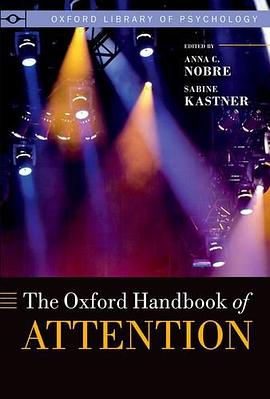
The Oxford Handbook of Attention brings together the different research areas that constitute contemporary attention research into one comprehensive and authoritative volume. In 40 chapters, it covers the most important aspects of attention research from the areas of cognitive psychology, neuropsychology, human and animal neuroscience, computational modelling, and philosophy.
The book is divided into 4 main sections. Following an introduction from Michael Posner, the books starts by looking at theoretical models of attention. The next two sections are dedicated to spatial attention and non-spatial attention respectively. Within section 4, the authors consider the interactions between attention and other psychological domains. The last two sections focus on attention-related disorders, and finally, on computational models of attention.
Aimed at both scholars and students, the Oxford Handbook of Attention provides a concise and state-of-the-art review of the current literature in this field.
作者简介
Anna Christina (Kia) Nobre is Professor of Cognitive Neuroscience at the University of Oxford, where she directs the Oxford Centre for Human Brain Activity and heads the Brain & Cognition Laboratory. She is Adjunct Professor at Northwestern University. Nobre received her Ph.D. (1993) and did postdoctoral research at Yale University with Gregory McCarthy, before moving to Harvard Medical School as Instructor to work with M-Marsel Mesulam. Her research using intracranial and non-invasive electrophysiological recordings made seminal contributions to the understanding of neural systems for word recognition and attention in the human brain. Her current research uses a multi-methodological approach to look at how perception and cognition are modulated according to task goals, expectations, and memories; and to understand how these dynamic regulatory mechanisms are affected by ageing, psychiatric conditions, and neurodegenerative disorders.
Sabine Kastner is Professor of Neuroscience and Psychology at Princeton University, where she heads the Neuroscience of Attention and Perception Laboratory in the Princeton Neuroscience Institute and Department of Psychology, and serves as the Scientific Director of Princeton's neuroimaging facility. She received M.D. (1993) and Ph.D. degrees (1994) and performed postdoctoral studies at NIH (1996-2000) with Leslie Ungerleider and Bob Desimone. Her functional brain imaging studies provided groundbreaking insights into visual perceptual and cognitive processes in the human brain. Kastner uses a translational approach that combines neuroimaging and electrophysiology to study the neural basis of visual perception, attention, and awareness in healthy humans, patients with brain lesions and animal models. Kastner's contributions to the field of cognitive neuroscience were recognized with the Young Investigator Award from the Cognitive Neuroscience Society in 2005
目录信息
1: Michael Posner: Current landscape and historical context
Part B: Theoretical Models of Attention
2: Jeremy Wolfe: Feature integration and guided search
3: Polly Dalton and Nilli Lavie: Perceptual/Executive load theory
4: Sabine Kastner and John Serences: A multi-level account of selective attention
5: Marsel Mesulam and Professor Anna Christina Nobre: Large-scale network model of control
6: Mark Stokes and John Duncan: Multiple-demand network and adaptive coding
Part C: Spatial Attention
7: Marisa Carrasco: Spatial covert attention: Perceptual Modulation
8: Jan Theeuwes: Spatial orienting and attentional capture
9: Diane Beck and Sabine Kastner: Neural systems of spatial attention (fMRI)
10: Martin Eimer: The time course of spatial attention: Insights from event-related brain potentials
11: Marlene Cohen and John Maunsell: Neuronal Mechanisms of Spatial Attention in Visual Cerebral Cortex
12: Jacqueline Gottlieb: Cellular mechanisms of attentional control: Frontal
13: Kelsey L. Clark, Behrad Noudoost, and Robert J. Schafer and Professor Tirin Moore: Neuronal mechanisms of attentional control: Frontal cortex
14: Yuri B. Saalmann and Sabine Kastner: Neural mechanisms of Spatial Attention in the Visual Thalamus
15: Richard J. Krauzlis: Attentional Functions of the Superior Colliculus
16: Charles Spence: Orienting attention: a crossmodal perspective
17: Charles E. Schroeder, Jose L. Herrero and Saskia Haegens: Neuronal Dynamics and the Mechanistic Bases of Selective Attention
18: Trevor Robbins: The neuropharmacology of attention
19: Michael Posner: Developing attention and self-regulation in childhood
Part D: Non-spatial Attention
20: Miranda Scolari, Edward F. Ester, and John Serences: Feature- and object-based attentional modulation in the human visual system
21: Stefan Treue: Object- and feature-based attention: monkey physiology
22: Kimron Shapiro and Simon Hanslmayr: The Role of Brain Oscillations In The Temporal Limits of Attention
23: Patrick Cavanagh, Lorella Battelli, and Alex O. Holcombe: Dynamic Attention
24: Anna Christina Nobre: Temporal orienting
Part E: Interactions between Attention and Other Psychological Domains
25: Luiz Pessoa: Attention, Motivation, and Emotion
26: Attention and executive functions
27: Earl K. Miller and Timothy J. Buschman: Neural mechanisms for the executive control of attention
28: Brice A. Kuhl and Marvin M. Chun: Memory and Attention
29: Christopher Summerfield and Tobias Egner: Attention and decision-making
30: Heiner Deubel: Attention and action
Part F: Attention-related Disorders
31: Geraint Rees: Attention and awareness
32: Theodore P. Zanto & Adam Gazzaley: Attention and Aging
33: Guiseppe Vallar: Unilateral Spatial Neglect
34: Sanjay Manohar, Valerie Bonnelle and Masud Husain: Neurological disorders of attention
35: Lynn C. Robertson: Balint's syndrome and the Study of Attention
36: Ian H. Robertson and Redmond G O'Connell: Rehabilitation of Attention Functions
Part G: Computational Models
37: Claus Bundesen and Thomas Habekost: Theory of visual attention
38: Laurent Itti and Ali Borji: Bottom up and contextual effects
39: Angela Yu: Bayesian models
Part H: Conclusions
40: Anna Christina Nobre and Sabine Kastner: Attention: Time Capsule 2013
· · · · · · (收起)
读后感
用户评价
读完一部分章节后,我开始思考这本书对于我们日常决策制定和信息过载问题的实际指导意义。它并没有直接提供“如何更专注”的快速指南,但它通过对基础机制的详尽阐述,间接地为我们理解自身的认知瓶颈提供了工具。例如,书中对“负荷理论”的深入探讨,让我清晰地认识到,为什么在进行多重任务时效率会急剧下降——这不是意志力薄弱的问题,而是资源分配的物理限制。这种从基础原理到实际限制的推导过程,是这本书最深刻的价值之一。它的语言风格是典型的学术文体,精准、客观,甚至有些冷峻,这使得读者必须主动去挖掘隐藏在数据和模型背后的“人味儿”。我希望未来的版本能增加更多的案例研究,将那些抽象的概念更直观地与现实生活中的复杂情境联系起来,但这也许会削弱其作为基础手册的严谨性,这是一个很难平衡的问题。
整体而言,这是一部百科全书式的作品,其信息密度之高令人咋舌。它不是那种适合在睡前放松时阅读的材料,而是需要专心致志、可能还需要一杯浓咖啡来陪伴的“硬核”读物。我最喜欢它对认知建模的讨论,即如何将复杂的人类行为转化为可计算、可预测的数学模型。书中展示了不同学派在构建这些模型时所采取的不同路径和假设,这种方法论层面的对比,极大地拓宽了我对“科学解释”本身的理解。阅读这本书的过程,更像是一场与领域内最顶尖专家的深度对话,他们以极其清晰且结构化的方式,将数十年来的研究成果汇集成册。对于任何严肃对待认知科学、心理学或神经科学研究的人来说,这本书无疑是一座里程碑式的参考资料,它为我们划定了该领域当前的知识边界,同时也暗示了未来突破的方向。它的厚度和深度,要求读者不仅是知识的接收者,更应是批判性的思考者。
这本厚重的著作,初翻阅时便给人一种庄严而深邃的感觉,装帧大气,纸张的质感也相当不错,握在手中便能感受到它所承载的学术重量。我本是带着对人类心智运作机制的强烈好奇心来接触这类前沿理论的,期望能从中窥见一些关于“专注力”这个日常却又极度复杂的认知过程的奥秘。然而,在初步浏览目录结构时,我发现其涵盖的范围之广,几乎囊括了从神经科学基础到认知心理学、再到哲学探讨的各个层面,这无疑是一项宏大的工程。它并非那种轻松愉快的科普读物,更像是一份为专业人士准备的详尽地图集,每一个章节都像是一个精密绘制的区域,需要读者投入大量的时间和精力去仔细辨识其中的脉络。我特别欣赏其对历史回顾的梳理,能清晰地看到“注意力”这一概念是如何在不同时代、不同学派的学者手中被塑形和重新定义的。这种跨学科的整合,使得即便是对某一特定领域(比如我们常谈的“选择性注意”)有所涉猎的人,也能获得一个更具全局性的视野,明白我们的认知系统是如何作为一个整体在运作的。它提供了一种框架,帮助我重新审视自己日常生活中那些不经意的走神和瞬间的聚焦,将这些模糊的体验置于一个有理有据的科学背景之下。
我必须承认,阅读体验是相当具有挑战性的,它要求读者具备相当的理论基础和耐心。书中对实验范式的描述细致入微,每一个实验设计背后的逻辑推演都清晰可见,这对于想要深入理解研究方法论的同行来说,无疑是宝贵的财富。不过,对于我这样一位主要关注应用层面的探索者而言,有时会感觉自己仿佛被卷入了一场无休止的术语和模型的迷宫中。大量的专业术语和模型图表需要反复对照才能勉强跟上作者的思路,这使得阅读速度不得不放缓到几乎是“啃”的地步。尽管如此,当你终于穿透一层复杂的数学或神经解剖学的描述,触及到核心论点时,那种豁然开朗的感觉是无与伦比的——它揭示了大脑处理信息时那种令人惊叹的效率和精妙的资源分配机制。书中的某些章节对不同文化背景下注意力模型的比较分析尤为引人入胜,它提醒我们,即便是看似普适的认知功能,也可能受到文化和环境的深刻影响,这种深度的对比分析,远超出了我原先对“注意力研究”的朴素想象。
这本书的编纂质量体现了极高的学术水准,它的结构组织得像一座精心规划的知识殿堂,导论部分为整个研究领域奠定了坚实的基调,随后各个分册(或章节)则像是不同侧翼的延伸,各有侧重却又紧密相连。我尤其欣赏它在不同理论流派之间的平衡处理,没有偏袒任何一方,而是将各种竞争性的理论并置,让读者自行评判其优劣和适用范围。这种严谨的学术态度,使得它成为了一个可靠的参考工具,而不是一个单纯的观点输出平台。在涉及前沿的脑成像技术应用时,作者们非常谨慎地描述了当前技术的局限性,避免了过度解读数据,这在当前这个“神经科学成果爆炸”的时代显得尤为可贵。它引导读者思考,我们究竟看到了什么,以及我们还没有看到什么。对于希望在这一领域进行深入研究的后学者来说,这本书简直就是一本必备的“武功秘籍”,它不仅教授了招式,更重要的是解释了招式背后的原理和限制。