
具体描述
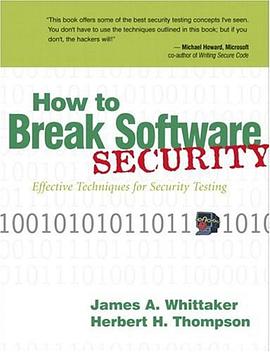
How to Break Software Security describes the general problem of software security in a practical perspective from a software tester's point of view. It defines prescriptive techniques (attacks that testers can use on their own software) that are designed to ferret out security vulnerabilities in software applications. The book's style is easy to read and provides readers with the techniques and advice to hunt down security bugs and see that they're destroyed before the software is released. Accompanying the book is a CD-ROM containing Holodeck, which tests for security vulnerabilities. There are also a number of bug-finding tools, freeware, and an easy-to-use port scanner included on the CD-ROM.
How to Break Software Security presents a deep exploration into the inner workings of modern software defenses, revealing how vulnerabilities emerge and persist despite rigorous design efforts. The book begins by dissecting common misconceptions about secure coding, challenging readers to rethink assumptions around encryption, access control, and authentication mechanisms. Drawing on real-world case studies, it examines multiple incidents where flawed logic or oversight led to critical breaches—illustrating how even well-intentioned implementations can create exploitable weaknesses. The author delves into the psychology behind software design choices, emphasizing the tension between usability and security, speed of development, and robust protection. Through detailed analysis of threat models and attack surfaces, the text exposes how developers often prioritize functionality over hardened safeguards, leaving systems exposed to injection flaws, privilege escalation, and insecure defaults. Special attention is given to supply chain risks, highlighting how third-party components introduce hidden vulnerabilities that propagate through deployment pipelines. Readers encounter practical insights into identifying subtle flaws—such as improper session management, insufficient input validation, or flawed cryptographic practices—often overlooked during routine reviews. The book offers a structured approach to security testing, integrating both manual techniques and automated tools tailored to different development environments. It stresses the importance of continuous assessment, embedding security checks throughout the software lifecycle rather than treating them as afterthoughts. Interviews with seasoned engineers reveal how organizational culture shapes security outcomes—from early threat modeling during architecture phases to ongoing monitoring in production. The narrative balances technical depth with accessibility, making complex concepts understandable for developers, architects, and security professionals alike. It challenges the myth that perfect software security is attainable, advocating instead for resilient systems designed to detect, contain, and recover from inevitable compromises. Through vivid examples of breaches in financial systems, healthcare platforms, and cloud infrastructures, the text underscores the evolving nature of cyber threats and the need for adaptive defense strategies. It concludes with a forward-looking perspective on emerging technologies—zero trust frameworks, secure DevOps pipelines, and formal verification methods—as essential tools in the ongoing effort to strengthen software integrity. More than a technical manual, How to Break Software Security invites readers to cultivate a critical mindset, fostering vigilance and proactive thinking crucial in today’s high-stakes digital landscape.