

具體描述
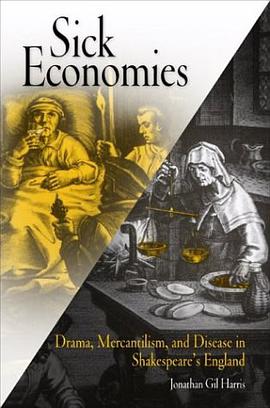
Sick Economies Drama, Mercantilism, and Disease in Shakespeare's England Jonathan Gil Harris "Sick Economies, wholeheartedly committed to the recovery of noncanonical early modern writing, shows what can happen when a keen literary intelligence is applied to nonliterary texts. The result is a truly interdisciplinary and refreshingly readable book."--Times Literary Supplement "In this important book Harris explores the early modern discourse of mercantilism, tracing its merger with the discourse of bodily illness."--Choice "Harris has successfully argued a decidedly unique angle of interpretation. What may have initially struck the reader as an impossibly broad scope of inquiry is revealed, through rigorous textual analysis, as an intriguing interdisciplinary perspective that will certainly impact subsequent scholarship."--Comitatus "This book offers great insight into the Renaissance discourses of the body, the emergence of mercantile theory, and early modern drama." --Seventeenth-Century News From French Physiocrat theories of the blood-like circulation of wealth to Adam Smith's "invisible hand" of the market, the body has played a crucial role in Western perceptions of the economic. In Renaissance culture, however, the dominant bodily metaphors for national wealth and economy were derived from the relatively new language of infectious disease. Whereas traditional Galenic medicine had understood illness as a state of imbalance within the body, early modern writers increasingly reimagined disease as an invasive foreign agent. The rapid rise of global trade in the sixteenth century, and the resulting migrations of people, money, and commodities across national borders, contributed to this growing pathologization of the foreign; conversely, the new trade-inflected vocabularies of disease helped writers to represent the contours of national and global economies. Grounded in scrupulous analyses of cultural and economic history, Sick Economies: Drama, Mercantilism, and Disease in Shakespeare's England teases out the double helix of the pathological and the economic in two seemingly disparate spheres of early modern textual production: drama and mercantilist writing. Of particular interest to this study are the ways English playwrights, such as Shakespeare, Jonson, Heywood, Massinger, and Middleton, and mercantilists, such as Malynes, Milles, Misselden, and Mun, rooted their conceptions of national economy in the language of disease. Some of these diseases--syphilis, taint, canker, plague, hepatitis--have subsequently lost their economic connotations; others--most notably consumption--remain integral to the modern economic lexicon but have by and large shed their pathological senses. Breaking new ground by analyzing English mercantilism primarily as a discursive rather than an ideological or economic system, Sick Economies provides a compelling history of how, even in our own time, defenses of transnational economy have paradoxically pathologized the foreign. In the process, Jonathan Gil Harris argues that what we now regard as the discrete sphere of the economic cannot be disentangled from seemingly unrelated domains of Renaissance culture, especially medicine and the theater. Jonathan Gil Harris is Professor of English at George Washington University and the author of Foreign Bodies and the Body Politic: Discourses of Social Pathology in Early Modern England. 2003 | 272 pages | 6 1/8 x 9 1/4 ISBN 978-0-8122-3773-3 | Cloth | $69.95s | GBP45.50 ISBN 978-0-8122-0219-9 | Ebook | $69.95s | GBP45.50 World Rights | Literature, Cultural Studies Short copy: Sick Economies: Drama, Mercantilism, and Disease in Shakespeare's England teases out the double helix of the pathological and the economic in two seemingly disparate spheres of early modern textual production: drama and mercantilist writing.
作者簡介
目錄資訊
讀後感
用戶評價
相關圖書
















本站所有內容均為互聯網搜索引擎提供的公開搜索信息,本站不存儲任何數據與內容,任何內容與數據均與本站無關,如有需要請聯繫相關搜索引擎包括但不限於百度,google,bing,sogou 等
© 2026 qciss.net All Rights Reserved. 小哈圖書下載中心 版权所有