
具体描述
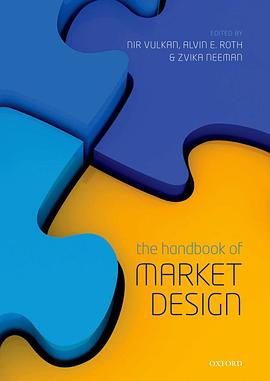
Includes chapters by Alvin Roth, winner of the Nobel Prize in Economics 2012, including research for which he was awarded the prize
A comprehensive overview that presents the latest research in applied market design
Brings together all major researchers in the area, across disciplines- economics, engineering, computer science
Chapters on matching markets where there is a need to match large two-sided populations of agents such as medical residents and hospitals, law clerks and judges, patients and kidney donors, to one another
Active and fast-growing area of economics, lots of research, theory, and applications
No other book on this subject
Economists often look at markets as given, and try to make predictions about who will do what and what will happen in these markets Market design, by contrast, does not take markets as given; instead, it combines insights from economic and game theory together with common sense and lessons learned from empirical work and experimental analysis to aid in the design and implementation of actual markets In recent years the field has grown dramatically, partially because of the successful wave of spectrum auctions in the US and in Europe, which have been designed by a number of prominent economists, and partially because of the increase use of the Internet as the platform over which markets are designed and run There is now a large number of applications and a growing theoretical literature.
The Handbook of Market Design brings together the latest research from leading experts to provide a comprehensive description of applied market design over the last two decades In particular, it surveys matching markets: environments where there is a need to match large two-sided populations to one another, such as medical residents and hospitals, law clerks and judges, or patients and kidney donors It also examines a number of applications related to electronic markets, e-commerce, and the effect of the Internet on competition between exchanges
Readership: Academics and graduate students in economics, computer science. Government employees. Consultants in economics and management.
作者简介
Edited by Nir Vulkan, Associate Professor of Economics, Saïd Business School, University of Oxford, Alvin E. Roth, Professor of Economics, Stanford University and Nobel Laureate in Economics 2012, and Zvika Neeman, Associate Professor, Berglas School of Economics, Tel Aviv University
Alvin E. Roth was awarded the Nobel Prize in Economics 2012 for his work on market design. He received his B.S. from Columbia University in 1971 and Ph.D. from Stanford University in 1974. He taught at the University of Illinois from 1974-82, at the University of Pittsburgh from 1982-98, at Harvard University from 1998-2012, and he now teaches at Stanford.
Nir Vulkan is an Economics Professor at the Said Business School and a Fellow of Worcester College, Oxford University. He has written many articles on market design and is author of 'The Economics of E- Commerce' (Princeton University Press, 2003). He has worked with many software and e-commerce companies designing markets mainly on the Internet, which are used by humans and software agents. His algorithms for automated trading have been used by hedge funds to trade futures in markets all over the world.
Zvika Neeman is a microeconomic and game theorist who specializes in mechanism design. He teaches at the Berglas School of Economics at Tel Aviv University. Prior to that, he held positions at Boston University and at the Hebrew University of Jerusalem.
Contributors:
Atila Abdulkadiroglu, Duke University
Lawrence M. Ausubel, University of Maryland
Sarbartha Bandyopadhyay, EconJobMarket.org.
Gary Bolton, Smeal College of Business, Penn State
Andrew Byde, Acunu Ltd
Peter Cramton, University of Maryland
Robert W. Day, University of Connecticut
Sam Dinkin, Power Auctions LLC
Martin Dufwenberg, University of Arizona
Benjamin Edelman, Harvard Business School
Aytek Erdil, University of Cambridge
Haluk Ergin, University of California, Berkeley
Emel Filiz-Ozbay, University of Maryland
Joshua Gans, University of Toronto
Uri Gneezy, University of California San Diego
Ernan Haruvy, University of Texas at Dallas
Aviad Heifetz, Open University of Israel
Nathaniel Higgins, Johns Hopkins School of Advanced International Studies
Fedor Iskhakov, University of Technology Sydney
Terence Johnson, University of Notre Dame.
Elena Katok, Penn State University
Alon Klement, Radzyner School of Law
Paul Klemperer, Oxford University
Soohyung Lee, University of Maryland
David McArthur, University of Maryland
Paul Milgrom, Stanford University
Zvika Neeman, Tel Aviv University
Axel Ockenfels, University of Cologne
Erkut Y. Ozbay, University of Maryland
Michael Peters, University of British Columbia
Chris Preist, University of Bristol
Ashok Rai, Williams College
Alvin E. Roth, Stanford University
John Rust, Georgetown University
Tuomas Sandholm, Carnegie Mellon University.
Ella Segev, Ben-Gurion University
Tomas Sjöström, Rutgers University
Tayfun Sönmez, Boston College
Scott Stern, Sloan School, MIT
Andrew Stocking, Congressional Budget Office
Eric Talley, University of California Berkeley
Utku Unver, Boston College
Nir Vulkan, Saïd Business School
Joel Watson, University of California, San Diego
John Watson, Institute of Evidence-Based Change
Robert Wilson, Stanford Business School
目录信息
Part I: General Principles
1: Alvin E. Roth: What Have We Learned From Market Design?
2: Gary Bolton: Not Up To Standard: Stress Testing Market Designs for Misbehavior
3: Paul Klemperer: Using and Abusing Auction Theory
Part II: Cases
Section II.A: Matching Markets
4: Tayfun Sönmez and Utku Unver: Market Design for Kidney Exchange
5: Atila Abdulkadiroglu: School Choice
6: Aytek Erdil and Haluk Ergin: Improving Efficiency in School Choice
7: Sarbartha Bandyopadhyay, Fedor Iskhakov, Terence Johnson, Soohyung Lee, David McArthur, John Rust, Joel Watson, and John Watson: Can the Job Market for Economists be Improved?
8: Joshua Gans and Scott Stern: Designing Markets for Ideas
9: Ashok Rai and Tomas Sjöström: Redesigning Microcredit
10: Benjamin Edelman: The Design of Online Advertising Markets
Section II.B: Auctions
11: Paul Klemperer: The Product-Mix Auction: a New Auction Design for Differentiated Goods
12: Paul Milgrom and Robert W. Day: Optimal Incentives in Core-Selecting Auctions
13: Peter Cramton, Samuel Dinkin, and Robert Wilson: Auctioning Rough Diamonds: A Competitive Sales Process for BHP Billiton's Ekati Diamonds
Section II.C: E Commerce
14: Axel Ockenfels and Alvin E. Roth: Ending Rules in Internet Auctions: Design and Behavior
15: Andrew Byde and Nir Vulkan: Designing Markets for Mixed Use of Humans and Automated Agents
16: Tuomas Sandholm: Very-Large-Scale Generalized Combinatorial Multi-Attribute Auctions: Lessons from Conducting $60 Billion of Sourcing
17: Nir Vulkan and Chris Priest: Designing Automated Markets for Communication Bandwith
Section II.D: Law Design
18: Zvika Neeman and Alon Klement: A Mechanism Design Approach to Legal Problems
19: Aviad Heifetz, Ella Segev, and Eric Talley: Legislation with Endogenous Preferences
Part III: Experiments
20: Lawrence M. Ausubel, Peter Cramton, Emel Filiz-Ozbay, Nathaniel Higgins, Erkut Ozbay, and Andrew Stocking: Common-Value Auctions with Liquidity Needs: An Experimental Test of a Troubled Assets Reverse Auction
21: Uri Gneezy and Martin Dufwenberg: Information Disclosure in Auctions: An Experiment
22: Elena Katok: Buyer Determined Procurement Auctions Experiments
23: Uri Gneezy and Ernan Haruvey: The Inefficiency of Splitting the Bill
Part IV: Competing Designs
24: Michael Peters: Competing Mechanisms
25: Zvika Neeman and Nir Vulkan: Three Case Studies of Competing Designs in Financial Markets
· · · · · · (收起)