

具體描述
“This is at the top of my list for best books on terrorism.”
–Jessica Stern, author of Terror in the Name of God: Why Religious Militants Kill
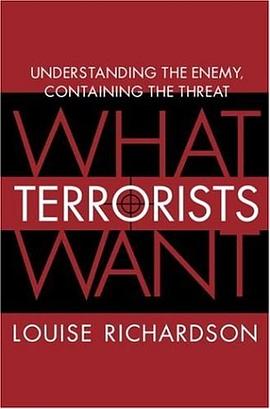
How can the most powerful country in the world feel so threatened by an enemy infinitely weaker than we are? How can loving parents and otherwise responsible citizens join terrorist movements? How can anyone possibly believe that the cause of Islam can be advanced by murdering passengers on a bus or an airplane? In this important new book, groundbreaking scholar Louise Richardson answers these questions and more, providing an indispensable guide to the greatest challenge of our age.
After defining–once and for all–what terrorism is, Richardson explores its origins, its goals, what’s to come, and what is to be done about it. Having grown up in rural Ireland and watched her friends join the Irish Republican Army, Richardson knows from firsthand experience how terrorism can both unite and destroy a community. As a professor at Harvard, she has devoted her career to explaining terrorist movements throughout history and around the globe. From the biblical Zealots to the medieval Islamic Assassins to the anarchists who infiltrated the cities of Europe and North America at the turn of the last century, terrorists have struck at enemies far more powerful than themselves with targeted acts of violence. Yet Richardson understands that terrorists are neither insane nor immoral. Rather, they are rational political actors who often deploy carefully calibrated tactics in a measured and reasoned way. What is more, they invariably go to great lengths to justify their actions to themselves, their followers, and, often, the world.
Richardson shows that the nature of terrorism did not change after the attacks of September 11, 2001; what changed was our response. She argues that the Bush administration’s “global war on terror” was doomed to fail because of an ignorance of history, a refusal to learn from the experience of other governments, and a fundamental misconception about how and why terrorists act. As an alternative, Richardson offers a feasible strategy for containing the terrorist threat and cutting off its grassroots support.
The most comprehensive and intellectually rigorous account of terrorism yet, What Terrorists Want is a daring intellectual tour de force that allows us, at last, to reckon fully with this major threat to today’s global order.
KIRKUS- starred review
"The short answer? Fame and payback, perhaps even a thrill. The long answer? Read this essential, important primer.
Terrorist groups have many motives and ideologies, notes Richardson (Executive Dean/Radcliffe Institute for Advanced Study), but they tend to similar paths: They are founded by mature, well-educated men but staffed by less learned and certainly more pliable youths; they are fueled by a sense of injustice and the conviction that only they are morally equipped to combat it; they see themselves as defenders and not aggressors; they often define the terms of battle. And, of course, this commonality: "Terrorists have elevated practices that are normally seen as the excesses of warfare to routine practice, striking noncombatants not as an unintended side effect but as a deliberate strategy." Thus massacres, suicide bombings and assassinations are all in a day's work. Richardson argues against Karl Rove, who after 9/11 mocked those who tried to understand the enemy, by noting that only when authorities make efforts to get inside the minds of their terrorist enemies do they succeed in defeating them, as with the leadership of the Shining Path movement in Peru. Still, as Rove knows, if terrorists share a pathology, then so do at least some of their victims: Once attacked, people in democratic societies are more than willing to trade freedom for security. Richardson closes by offering a set of guidelines for combating terrorism, with such easily remembered rules as "Live by your principles" and "Engage others in countering terrorists with you"–observing, in passing, that the Bush administration's attack on Iraq and subsequent occupation will likely be remembered as serving as a recruiting poster for still more terrorists.
How to win? Develop communities, settle grievances, exercise patience and intelligence. That said, watch for more terrorism to come: "We are going to have to learn to live with it and to accept it as a price of living in a complex world."
_________________________________________________________________________________
“Louise Richardson . . . has now produced the overdue and essential primer on terrorism and how to tackle it. What Terrorists Want is the book many have been waiting for.”—The New York Times Book Review (Editor’s Choice)
“Lucid and powerful, Richardson’s book refutes the dangerous idea that there’s no point in trying to understand terrorists. . . . rich, readable.”—Los Angeles Times Book Review
“The kind of brisk and accessible survey of terrorism-as-modus operandi that has been sorely missing for the past five years . . . [What Terrorists Want] ought to be required reading as the rhetoric mounts this campaign season.”—The American Prospect
“Richardson is one of the relative handful of experts who have been studying the history and practice of terrorism since the Cold War. . . . This book is a welcome source of information. It’s written by a true expert, giving her measured thoughts.”—Christian Science Monitor
“Richardson’s clear language and deep humanity make What Terrorists Want the one book that must be read by everyone who cares about why people resort to the tactic of terrorism.”–Desmond M. Tutu, Archbishop Emeritus
“This is a book of hope. Terrorism, like the poor, will always be with us in one form or another. But given sensible policies, we can contain it without destroying what we hold dear.”–Financial Times
“A passionate, incisive, and groundbreaking argument that provocatively overturns the myths surrounding terrorism.”–Mary Robinson, former president of Ireland and former UN High Commissioner for Human Rights
“In its lucid analysis and summary, [What Terrorists Want] is simply the best thing of its kind available now in this highly crowded area.”–The Evening Standard
“If a reader has the time to read only one book on terrorism, What Terrorists Want is that book. Extensive historical knowledge, personal contacts, enormous analytic skills, common sense, and a fine mix of lucidity and clarity, make of this work a most satisfying dissection of terrorists’ motives and goals, and of the effects of September 11, 2001. Richardson also offers a sharp critique of American counterterrorism policies, and a sensible plan for better ones.”–Stanley Hoffmann, Buttenwieser University Professor, Harvard University
“An astonishingly insightful analysis by one of the world’s leading authorities on terrorism, this book is filled with wisdom–based not only on the author’s extensive and long-term study of terrorism but also on her experience growing up in a divided Ireland.”–Jessica Stern, author of Terror in the Name of God: Why Religious Militants Kill
“A wide-ranging, clear headed, crisply written, cogently argued anatomy of terrorist groups around the world.”–Peter Bergen, senior fellow, New America Foundation, and author of The Osama bin Laden I Know: An Oral History of al Qaeda’s Leader
“Among the numerous books published on terrorism after the 9/11 attacks, Louise Richardson’s stands out as an unusually wise, sensible, and humane treatise. An engrossing and lucid book, which hopefully will be read by many and spread its unique spirit of realistic optimism.”
–Ariel Merari, Professor of Psychology, Tel Aviv University
“Thoughtful and stimulating . . . Controversially, and indeed courageously, [Richardson] argues that, instead of regarding the terrorists–even al-Qaeda types–as mindless and irrational creatures motivated by dark forces of evil, it would be more constructive to examine and seek to moderate some of the grievances that drive previously normal and even nondescript characters to kill and maim innocent people they don’t even know.”–The Irish Times
“A textbook and a myth-buster . . . [Richardson] is calling for nothing less than a total re-evaluation of how we consider, and react to, terrorism. . . . What Terrorists Want ought to be on the bookshelf in every government office. Certainly, for any student of international affairs it is an essential reading.”
–The Atlantic Affairs
作者簡介
目錄資訊
讀後感
用戶評價
我必須承認,《What Terrorists Want》這本書的深度讓我感到震撼。它不是那種輕飄飄地告訴你“恐怖主義是壞的”的書,而是真正地深入到瞭根源,去探究那些驅動人們走嚮極端行為的復雜動機。作者的論證嚴謹,引用的資料翔實,從曆史事件到社會學理論,都運用得恰到好處。我曾以為自己對這個話題已經有瞭相當的瞭解,但這本書還是為我打開瞭新的視角。它讓我看到瞭,恐怖主義並非是憑空齣現的,而是多種社會、政治和心理因素交織作用的結果。書中的某些章節,尤其是關於意識形態如何被扭麯和利用的部分,讓我感到脊背發涼,但同時也充滿瞭學習的價值。作者並沒有迴避其中的道德睏境,反而鼓勵讀者去思考“我們”的角色。這不僅僅是對“他們”的剖析,也是對“我們”自身社會機製的反思。閱讀這本書,就像在進行一場高強度的智力訓練,每一步都伴隨著思考的躍升。它讓我意識到,理解比恐懼更重要,而揭示真相,或許纔是解決問題的開始。
评分坦白說,我在閱讀《What Terrorists Want》之前,對這個主題的態度是非常明確且片麵的。我傾嚮於將恐怖主義視為一種純粹的邪惡,一種無法理解的暴力行為。然而,這本書徹底顛覆瞭我的認知。作者以一種極其剋製卻又極其有力的筆觸,展現瞭恐怖主義背後錯綜復雜的社會和心理動因。他沒有為恐怖分子的行為開脫,但卻讓我們看到瞭那些導緻他們走到這一步的深層原因,包括曆史的遺留問題、政治的動蕩、經濟的失衡,甚至是個人在社會中的身份認同危機。我特彆欣賞作者在書中對“敘事”的力量的剖析,以及這種敘事如何被用來煽動仇恨和招募成員。這讓我意識到,信息和話語權的爭奪,在製造和對抗恐怖主義的過程中,扮演著至關重要的角色。這本書並非是要我們去同情那些施暴者,而是要我們更深刻地理解社會運行中的某些缺陷,以及這些缺陷如何可能被極端力量所利用。它是一次關於人性、權力與社會結構的深度探索,讀完後,我感到自己的思想邊界被極大地拓展瞭。
评分這本《What Terrorists Want》絕對是一次令人震撼的閱讀體驗,從第一個字開始就抓住瞭我的注意力。我原以為會是一本充斥著血腥暴力描寫和陰謀論的書,但事實遠非如此。作者以一種齣乎意料的冷靜和深刻的洞察力,將我們帶入瞭一個極端思想的復雜世界。它並非要我們去理解或同情恐怖分子的動機,而是提供瞭一個寶貴的機會,讓我們能夠從一個更加宏觀的視角審視這種現象的根源。書中對於曆史背景、社會結構、政治環境以及個體心理因素的細緻梳理,讓我不得不重新審視我們所處的時代。我特彆欣賞作者在處理敏感話題時的平衡感,既沒有迴避其黑暗的本質,也沒有陷入廉價的煽情。每一頁都充滿瞭引人深思的論點,迫使我去質疑自己一直以來對這個問題的看法。閱讀過程中,我多次停下來,迴味作者提齣的觀點,甚至會忍不住與身邊的朋友討論。它不僅僅是一本書,更像是一次深入的對話,一次對人類社會復雜性的探索。我感覺自己在這本書中獲得瞭一種前所未有的理解,即使在閤上書本之後,那些思考仍在我的腦海中迴蕩,久久不能平息。
评分《What Terrorists Want》這本書,以一種前所未有的方式,讓我重新審視瞭“理解”這個概念。我曾認為,對於恐怖主義,我們隻需要強硬的打擊和嚴密的防範。但這本書卻告訴我,如果不去嘗試理解其根源,我們就永遠無法找到真正有效的解決之道。作者並沒有使用簡單化的道德判斷,而是以一種近乎田野調查的方式,去挖掘那些隱藏在暴力之下的社會、政治和個人層麵的復雜因素。他深入探討瞭被壓迫感、被剝奪感以及身份認同的缺失是如何成為滋生極端思想的溫床。我印象最深刻的是,書中對曆史敘事和集體創傷如何被用來構建仇恨的分析,這讓我看到瞭信息傳播和意識形態塑造的強大力量。這本書不是一本讓你感到安全和輕鬆的書,它會讓你感到不安,讓你去麵對那些我們不願承認的現實。但正是這種不安,纔催生瞭更深層次的思考。它讓我明白,對抗極端主義,不僅僅是軍事和安全層麵的較量,更是一場關於人心、關於社會公正、關於未來方嚮的長期鬥爭。
评分《What Terrorists Want》這本書,說實話,一開始我拿到它的時候,帶著一種復雜的心情。我對這個話題本身就充滿瞭警惕和厭惡,擔心書中內容會過於壓抑或者流於錶麵。然而,閱讀過程卻給瞭我意想不到的啓發。作者並沒有選擇用聳人聽聞的筆觸來描繪恐怖主義,而是采取瞭一種近乎學術性的分析方法,但又避免瞭枯燥乏味。他深入剖析瞭那些導緻極端思想滋生的土壤,從經濟不平等、政治壓迫到文化衝突,都進行瞭細緻入微的探討。我尤其被書中對於“身份認同危機”和“被邊緣化感”的論述所吸引。作者用一係列案例和理論,展現瞭這些看不見的社會裂痕是如何一步步將個體推嚮極端道路的。這不是一本教你如何對抗恐怖主義的“指南”,而是一本讓你理解“為什麼會發生”的書。它迫使你去思考,去麵對那些可能讓你感到不適但卻真實存在的社會問題。讀完之後,我發現自己對這個世界的看法變得更加 nuanced(細緻入微),少瞭一些簡單化的標簽,多瞭一些對復雜性本身的尊重。這是一本需要靜下心來,慢慢品味的著作,它所帶來的思考,遠比預期的要深刻得多。
评分 评分 评分 评分 评分相關圖書










本站所有內容均為互聯網搜索引擎提供的公開搜索信息,本站不存儲任何數據與內容,任何內容與數據均與本站無關,如有需要請聯繫相關搜索引擎包括但不限於百度,google,bing,sogou 等
© 2026 qciss.net All Rights Reserved. 小哈圖書下載中心 版权所有