
具体描述
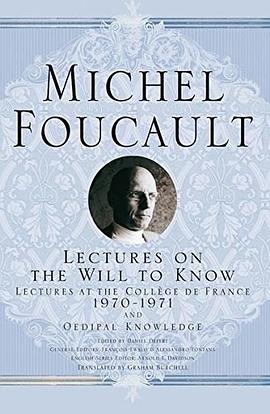
This volume gives us the transcription of the first of Michel Foucault's annual courses at the Collège de France. Its publication marks a milestone in Foucault's reception and it will no longer be possible to read him in the same way as before.
In these lectures the reader will find the deep unity of Foucault's project from Discipline and Punish (1975), dominated by the themes of power and the norm, to The Use of Pleasure and The Care of the Self (1984), devoted to the ethics of subjectivity.
Lectures on the Will to Know remind us that Michel Foucault's work only ever had one object: truth. Discipline and Punish completed an investigation of the role of juridical forms in the formation of truth-telling, the preparatory groundwork for which is found here in these lectures. Truth arises in conflicts, in rival claims for which the rituals of judicial judgment provide the possibility of deciding between who is right and who is wrong.
At the heart of ancient Greece there is a succession of different and opposing juridical forms and ways of dividing true and false into which the disputes between sophists and philosophers are soon inserted. In Oedipus the King, Sophocles stages the peculiar force of forms of telling the truth: they establish power just as they depose it. Against Freud, who will make Oedipus the drama of a shameful sexual desire, Michel Foucault shows that the tragedy articulates the relations between truth, power, and law. The history of truth is that of the tragedy.
Beyond the irenicism of Aristotle, who situated the will to truth in the desire for knowledge, Michel Foucault deepens the tragic vision of truth inaugurated by Nietzsche, who Foucault, in a secret dialogue with Deleuze, rescues from Heidegger's reading.
After this course, who will dare speak of a skeptical Foucault?
作者简介
Michel Foucault, acknowledged as the pre-eminent philosopher of France in the 1970s and 1980s, continues to have enormous impact throughout the world in many disciplines.
Arnold I. Davidson, Series Editor, is the Robert O. Anderson Distinguished Service Professor at the University of Chicago, USA, and Professor of the Philosophy of Cultures at the Università Ca'Foscari, Venice. He is co-editor of the volume Michel Foucault: Philosophie.
Graham Burchell is a translator. As well as translating Foucault's lectures at the Collège de France he has written essays on Foucault's work and was an editor of and contributor to the influential volume The Foucault Effect. Studies in Governmentality.
目录信息
Translator's Note
1. 9 December 1970
2. 16 December 1970
3. 6 January 1971
4. 13 January 1971
5. 27 January 1971
6. 3 February 1971
7. 10 February 1971
8. 17 February 1971
9. 24 February 1971
10. 3 March 1971
11. 10 March 1971
12. 17 March 1971
13. Lecture On Nietzsche
14. Course Summary
15. Course Context
Index Of Greek Terms
Index Of Names
Index Of Notions
· · · · · · (收起)
读后感
用户评价
这部作品的独特之处在于,它成功地将一种宏大的、几近形而上的主题——求知意志——与细腻的个体心理体验交织在一起,形成了一种独特的阅读张力。它没有采用标准的教科书结构,反而更像是一系列相互关联的、不断深化的**思想实验**的集合。例如,书中对“认知惰性”如何从个体层面渗透到群体范式转变中的论述,提供了一种极为犀利的社会批判视角。作者似乎在暗示,最大的知识障碍并非来自外部信息的缺乏,而是源于我们内部构建的认知壁垒和路径依赖。对于寻求心灵震撼和智力挑战的读者而言,这本书提供了远超一般学术著作的价值。它不是用来被“读完”的,而是用来被“消化”和“反刍”的,每一次重读,都会因自身经验的积累而解锁新的层次和意义。
这部作品以其深邃的思想和广阔的视野,为我们揭示了人类认知边界的持续拓展与内在驱动力的复杂性。作者并未满足于对既有知识体系的简单梳理,而是着力于挖掘“求知”这一行为背后的哲学根源与心理机制。读完全书,我仿佛进行了一场思维的深度漫游,从古老的理性主义思辨,到当代科学范式的更迭,每一个章节都充满了对“我们如何知道”的深刻追问。特别是关于知识的**目的性**与**非目的性**之间的张力论述,让人不得不反思,我们孜孜以求的真理,究竟是外在于我们的宏大叙事,还是我们自身构建心智世界的内在必然?全书的论证逻辑严密,又不乏对人类经验的细腻描摹,这种知性与感性的完美融合,使得原本可能枯燥的理论探讨变得引人入胜,强迫读者跳出舒适区,直面认知的悖论与挑战。它不仅仅是一本关于知识论的书,更像是一面镜子,映照出我们时代最深刻的求索精神。
这本书的文风,可以用“冷峻而富有洞察力”来概括。作者的文字精准、毫不拖泥带水,每一个句子的背后都似乎承载着深厚的学术积累,但又奇妙地避免了学究气的沉闷。我最欣赏的是它处理**知识与行动关系**的方式。许多探讨认知的书籍往往止步于理论思辨,但该书却不断将抽象的概念拉回到具体的实践情境中,审视知识如何在实际的人类干预和塑造世界中发挥作用,以及这种作用反过来如何重塑了我们的认知框架。它探讨了“看见”与“理解”之间的鸿沟,并探讨了技术进步如何加剧了这一鸿沟,使我们感觉自己知道得更多,却理解得更少。读完后,我感觉自己对日常的信息摄入和知识的传播机制有了一种全新的、近乎解剖学的审视视角。
如果说许多哲学著作试图为“知道”提供一个安稳的立足点,那么这部作品则更像是在我们脚下挖空了地基,逼迫我们正视虚无的边缘。它的力量不在于提供了答案,而在于**系统性地瓦解了那些我们习以为常的认知确定性**。书中对“确定性渴求”的剖析尤其触动我,作者将其视为人类在面对宇宙的浩瀚与自身的有限性时产生的一种本能防御机制。读到关于“知识的自我消耗”一节时,我深感震撼——每当我们看似掌握了一个真理,这个真理也随之完成了它的历史使命,成为新的障碍。这种不断自我超越、永不满足的求知冲动,被作者描绘得既悲壮又充满生命力。它要求读者不仅要思考“我学到了什么”,更要思考“我为什么必须去学,以及这种学习的尽头在哪里”。这本书无疑会成为我案头长期翻阅的参考书。
这本书的叙事节奏和论证方式,呈现出一种独特的、近乎巴洛克式的复杂美感。它不是那种开门见山、直接给出结论的快餐式读物,而是通过层层递进、相互印证的论述结构,构建起一个庞大而精密的思想迷宫。我特别欣赏作者在处理那些边界模糊、难以定义的概念时所展现出的**学术克制**与**批判力度**。例如,在探讨“无知之知”的价值时,作者没有简单地赞美谦逊,而是将其置于权力结构与知识生产的宏大背景下进行解构,展示了认知受限如何成为一种社会机制。阅读过程中,需要极高的专注力去跟上作者在不同学科领域间穿梭的步伐——从现象学到后结构主义,再到认知科学的最新进展。对于那些习惯于线性阅读的读者来说,这或许会是一次挑战,但正是这种“费力”的阅读体验,最终带来的洞察才显得尤为珍贵和深刻。
知识与权力的交织,阅读到后面越精彩,但前面 亚里士多德的部分还是不知道在讲什么(
知识与权力的交织,阅读到后面越精彩,但前面 亚里士多德的部分还是不知道在讲什么(
知识与权力的交织,阅读到后面越精彩,但前面 亚里士多德的部分还是不知道在讲什么(
知识与权力的交织,阅读到后面越精彩,但前面 亚里士多德的部分还是不知道在讲什么(
知识与权力的交织,阅读到后面越精彩,但前面 亚里士多德的部分还是不知道在讲什么(