具体描述
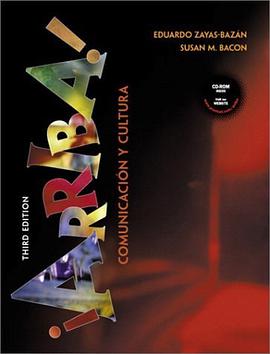
This book exemplifies learning the Spanish language within its cultural context—an approach that incorporates the products, perspectives, and practices important to understanding the Hispanic culture, while including the vocabulary and structures that are required to communicate within it. It contains fifteen lecciones,</U> topically organized and designed to encourage communication and offer insight into the language and culture of over 300 million people. Chapter topics include Spanish names and nicknames; universities in Spanish speaking countries; shopping; reading advertisements; making travel arrangements; expressing wishes and daily routines; persuading others; exchanging money at the bank; and the media. For individuals interested in learning the culture behind the vocabulary and grammar of the Spanish language.
¡Arriba! Comunicación y cultura with CD-ROM, Third Edition A Dynamic Journey into Contemporary Spanish Language and Culture This comprehensive third edition of ¡Arriba! Comunicación y cultura offers an engaging and academically rigorous exploration of the Spanish language, designed for students beginning their journey or seeking to solidify foundational proficiency. Moving beyond rote memorization, the textbook is meticulously structured around authentic communicative tasks and rich cultural contexts, ensuring students develop practical language skills applicable to real-world interactions. Core Pedagogical Philosophy: Communication First The central philosophy underpinning ¡Arriba! is contextualized communicative competence. Each unit is built around a central theme—ranging from daily life, travel, education, and current events—providing a relevant framework for introducing grammatical structures and vocabulary. Grammar is not presented in isolation; rather, it emerges naturally from the communicative needs of the scenarios discussed. This inductive approach encourages students to actively discover rules through usage, mirroring the natural process of language acquisition. Key Features and Content Highlights: 1. Authentic Cultural Immersion: Cultural literacy is interwoven seamlessly with linguistic instruction. The text features numerous "Ventana Cultural" (Cultural Window) sections that delve into the diverse realities of Spanish-speaking countries across Europe, Latin America, and the United States. These sections move beyond superficial stereotypes, offering nuanced insights into: Social Norms and Etiquette: Understanding appropriate register, greetings, and social protocols in different Hispanic settings. Contemporary Issues: Discussions on topics such as environmentalism in Central America, historical memory in Spain, and the role of technology in contemporary urban centers. Art, Music, and Literature: Brief introductions to influential figures and movements that shape the cultural landscape, often accompanied by excerpts from contemporary media. The third edition has significantly updated cultural readings to reflect the latest societal trends and demographic shifts within the Spanish-speaking world, ensuring relevance for today’s learners. 2. Structured and Progressive Grammar Acquisition: The grammatical framework is meticulously scaffolded, ensuring that complex concepts are introduced incrementally. The structure supports both recognition and production: Clear Presentation: Grammar points are initially presented visually and contextually within dialogues and readings. Focused Practice: Dedicated exercises, ranging from controlled drills to more open-ended communicative activities, reinforce understanding. Emphasis on Verbs: Mastery of the Spanish verb system remains a priority. Extensive coverage is dedicated to the present tense, the two past tenses (preterite and imperfect), the subjunctive mood (introduced systematically through trigger phrases and required contexts), and the command forms. The use of the tú versus usted forms is consistently addressed within the context of politeness and social distance. Pronoun Mastery: Detailed attention is given to direct, indirect, and reflexive pronouns, including their complex placement rules when combined with infinitives or the command forms. 3. Vocabulary Development Through Thematic Units: Vocabulary acquisition is tied directly to the thematic units, ensuring that students learn words they are immediately able to use. Themes include: Unit 1: El mundo personal: Family, descriptions, routines, and expressing likes/dislikes (Present Tense focus). Unit 2: La vida urbana y el entorno: Describing locations, giving directions, and discussing architecture (Introduction to comparative structures). Unit 3: Viajes y comunicación: Planning trips, describing past experiences (Preterite vs. Imperfect differentiation). Unit 4: La salud y el cuerpo: Discussing well-being, making appointments, and describing physical states (Gustar and impersonal expressions). Unit 5: El pasado y la historia: Narrating historical events and personal anecdotes (Subjunctive introduction in noun clauses). 4. Integrated Skills Approach: Every unit actively integrates the four core skills: Listening Comprehension: Audio segments feature native speakers from various regions, exposed at natural speeds. Exercises focus not just on extracting specific details but on understanding the overall message and intent. Reading Comprehension: Texts are varied, including short narratives, informational articles, advertisements, and personal correspondence, challenging students to adapt their reading strategies. Speaking Practice: Activities are heavily weighted towards pair and group work, requiring negotiation of meaning, role-playing, and spontaneous interaction based on the unit’s target language. Writing Development: Guided writing tasks—such as composing emails, formal invitations, or short descriptive essays—help students transition from sentence-level accuracy to cohesive paragraph construction. 5. The Companion CD-ROM: A Digital Reinforcement Tool The included CD-ROM serves as an invaluable multimedia resource, designed for both classroom-based activities and independent study. It complements the textbook by providing: Interactive Grammar Tutorials: Self-paced modules that allow students to review difficult concepts, offering immediate feedback on their performance. Expanded Audio Library: Access to supplementary recordings for extra listening practice, often featuring cultural interviews or short dramatizations related to the unit themes. Vocabulary Flashcards and Games: Engaging activities designed to aid memorization and rapid recall of key lexicon. Cultural Video Clips: Short, authentic video segments showcasing cultural practices discussed in the text, bringing the content to life. Target Audience: ¡Arriba! Comunicación y cultura, Third Edition is ideally suited for first-year (and sometimes second-semester introductory) college-level Spanish courses, or for intensive high school programs. Its robust structure provides the necessary scaffolding for beginners while offering enough depth and cultural complexity to maintain engagement throughout the academic year. The emphasis on practical communication ensures students finish the course ready to use Spanish in practical, meaningful ways.