
具体描述
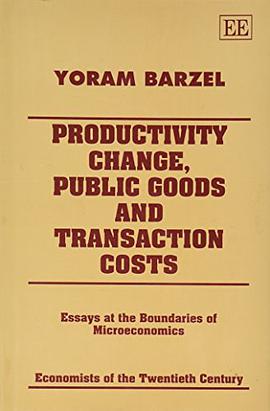
This collection of Barzel's articles and papers from the 1960s through the 1990s reveals how the economist's research in microeconomics has evolved, and features his work on production functions and productivity, optimal timing, economic analysis of slavery, and the rise and fall of Jewish lending in the Middle Ages. The collection includes an autobiographical sketch in which Barzel details his education, the development of his ideas, and his influences.
作者简介
目录信息
Acknowledgementsix
Introductionxi
PART I PRODUCTION FUNCTIONS AND PRODUCTIVITY
1'Some Observations on the Index Number Problem', Econometrica, 31(3) (July 1963), pp. 391-9.3
2 'Productivity in the Electric Power Industry, 1929-1955% Review of Economics and Statistics, XLV(4) (November 1963), pp. 395-408.12
3 'The Production Function and Technical Change in the Steam-Power Industry', Journal of Political Economy, LХХII(2) (April 1964), pp. 133-50.26
4 'Productivity and the Price of Medical Services', Journal of Political Economy, 77(6), (November/December 1969), pp. 1014-27.44
5 'The Rate of Technical Progress: The "Indianapolis 500"', Journal of Economic Theory, 4(1) (February 1972), pp. 72-81.58
PART II OPTIMAL TIMING
6'Optimal Timing of Innovations', Review of Economics and Statistics, L(3) (August 1968), pp. 348-55.71
7 'The Market for a Semipublic Good: The Case of the American Economic Review', American Economic Review, LXI(4) (September 1971), pp. 665-74.79
8 'Investment, Scale, and Growth', Journal of Political Economy, 79(2) (March/April 1971), pp. 214-31.89
PART III LABOR
9'The Determination of Daily Hours and Wages', The Quarterly Journal of Economics, LXXXVII (May 1973), pp. 220-38.109
10 'Assets, Subsistence, and The Supply Curve of Labor' with Richard J. McDonald, American Economic Review, LХIII(4) (September 1973), pp. 621-33.128
11 'The Effect of the Utilization Rate on the Division of Labor' with Ben T. Yu, Economic Inquiry, XXII(l) (January 1984), pp. 18-27. 141
PART IV PUBLIC CHOICE
12 'Two Propositions on the Optimum Level of Producing Collective Goods', Public Choice, Spring (1969), pp. 31-7.153
13 'Private Schools and Public School Finance', Journal of Political Economy, 81(1) (January/February 1973), pp. 174-86.160
14 'Is the Act of Voting Rational?' with Eugene Silberberg, Public Choice, XVI (Fall 1973), pp. 51-8.173
15 'Voting Behavior, Efficiency, and Equity' with Robert T. Deacon, Public Choice, XXI (Spring 1975), pp, 1-14.181
PART V INDUSTRIAL ORGANIZATION
16 'Excess Capacity in Monopolistic Competition', Journal of Political Economy, 78(5) (September/October 1970), pp. 1142-9.197
PART VI DEMAND ANALYSIS
17 'The Testability of the Law of Demand' in William F. Sharpe and Cathryn M. Cootner (eds), Financial Economics: Essays in Honor of Paul Cootner, Prentice-Hall Inc., 1982, pp. 233-45.207
18 'The Demand Curves for Giffen Goods are Downward Sloping' with Wing Suen, Economic Journal, 102(413) (July 1992), pp. 896-905. 220
PART VII PROPERTY RIGHTS AND TRANSACTION COSTS
19 'A Theory of Rationing by Waiting', Journal of Law and Economics, XVII(l) (April 1974), pp. 73-95.233
20 'An Alternative Approach to the Analysis of Taxation', Journal of Political Economy, 84(6) (December 1976), pp. 1177-97. 256
21 'An Economic Analysis of Slavery', Journal of Law and Economics, XX(1) (April 1977), pp. 87-110.277
22 'Some Fallacies in the Interpretation of Information Costs', Journal of Law and Economics, XX(2) (October 1977), pp. 291-307.301
23 'Competitive Tying Arrangements: The Case of Medical Insurance', Economic Inquiry, XIX(4) (October 1981), pp. 598-612.318
24 'Measurement Cost and the Organization of Markets', Journal of Law and Economics, XXV (April 1982), pp. 27-48.333
25 'Transaction Costs: Are They Just Costs?', Journal of Institutional and Theoretical Economics, 141(1) (March 1985), pp. 4-16.355
26 'The Entrepreneur's Reward for Self-Policing', Economic Inquiry, XXV (January 1987), pp. 103-16.368
27 'Knight's "Moral Hazard" Theory of Organization', Economic Inquiry, XXV (January 1987), pp. 117-20.382
28 'The Allocation of Resources by Voting' with Tim R. Sass, The Quarterly Journal of Economics, 94 (August 1990), pp. 745-71.386
29 'The Origins of Democracy in England' with Edgar Kiser, Rationality and Society, 3(4) (October 1991), pp. 396-122.413
30 'Ronald Coase on the Nature of Social Cost as a Key to the Problem of the Firm' with Levis A. Kochin, Scandinavian Journal of Economics, 94(1) (1992), pp. 19-31, 33-6. 440
31 'Confiscation by the Ruler: The Rise and Fall of Jewish Lending in the Middle Ages', Journal of Law and Economics, XXXV (April 1992), pp. 1-13.457
Name index471
· · · · · · (收起)
读后感
用户评价
读完第一部分后,我的第一感受是,作者在处理那些传统经济学模型难以触及的“非正式约束”时,展现出了惊人的洞察力。那些关于社会规范、信任程度如何影响资源配置效率的论述,读来让人深有共鸣。这并非是那种生硬地将社会学概念堆砌到经济学框架中的尝试,而是真正实现了跨学科的深度融合。特别是书中关于“信息不对称”如何通过特定的文化背景被放大或削弱的案例分析,提供了非常扎实的实证视角支撑。我能想象到,在实际的商业谈判或国际合作中,正是这些“看不见的成本”在悄悄地决定着最终的成败。这本书迫使我重新审视自己对“效率”的定义,它不再仅仅是数学公式上的最优解,而是包含了大量难以量化的社会资本在内的复杂系统均衡。对于那些对行为经济学或制度经济学抱有浓厚兴趣的实践者而言,书中提供的分析工具无疑是锋利的匕首,能精准地切入问题的核心。
说实话,我原本对这类主题的书籍抱持着一丝审慎的态度,担心其会陷入纯粹的学院派自说自话。然而,这本书的最终效果却远远超出了我的预期,它成功地将高深的理论工具“实战化”了。书中对于如何量化那些传统统计方法难以捕捉的“摩擦成本”的讨论,堪称一绝。它提供了一套近乎操作手册般的方法论,指导读者如何从看似混乱的现实数据中提炼出具有解释力的变量。这不再是纸上谈兵,而是真刀真枪的分析工具箱。读完后,我感觉自己仿佛完成了一次高级的思维训练营,不仅仅是吸收了知识,更是重塑了分析问题的底层算法。对于那些希望自己的研究或决策能够真正影响到现实世界,并希望用最可靠的逻辑去支撑自身判断的读者,这本书是不可多得的指南针,它指引的方向清晰而坚定,目标直指复杂世界的本质。
从排版和结构上看,这本书的编排体现了极高的专业水准。每一个章节的过渡都设计得如同精心铺设的轨道,确保读者在思想的陡峭斜坡上也能保持平稳的前行。作者在构建复杂体系时,始终保持着清晰的逻辑主线,避免了陷入冗余的数学推导泥潭。它成功地在“理论的严谨性”与“读者的可接近性”之间找到了一条微妙的平衡线。例如,在引入一个关键性假设时,作者会先用一个直观的叙事场景进行铺垫,待读者形成初步直觉后,再用精确的符号语言进行固化。这种教学法的巧妙运用,使得即便是需要花费大量精力去啃读的章节,其学习曲线也保持在一个令人愉悦的梯度上。对于希望系统性掌握某一研究领域的学者而言,这本书的结构本身就是一本极佳的教材范例,清晰、有力、层层递进,让人对整体知识框架的把握一目了然。
这本厚重的著作,甫一翻开,便扑面而来的是一股严谨的学术气息,仿佛置身于一个充斥着复杂模型与精妙逻辑的殿堂。作者对于宏观经济现象的剖析,并非停留在表面现象的描述,而是深入到驱动这些现象背后的微观机制。我尤其欣赏其构建理论框架的精妙之处,它如同一个精密的仪器,能够捕捉到那些在日常观察中容易被忽略的细微互动。比如,对于某种特定的政策干预在不同市场结构下可能产生的溢出效应,作者给出了令人耳目一新的解释框架。这种深度挖掘和系统化的构建,使得即便是相对熟悉的经济学概念,在书中也焕发出了新的光彩。阅读过程更像是一场智力上的攀登,每攻克一个复杂的证明或理解一个微妙的假设,都会带来巨大的满足感。对于那些致力于学术研究,渴望挑战自我思维边界的读者来说,这本书无疑是值得细细品味的珍藏品,它不提供快速的答案,而是教会你如何提出更深刻的问题。
该书的叙事节奏把握得极好,虽然理论深度很高,但行文绝不枯燥。作者似乎很懂得如何通过引入具有时代感和现实意义的例子来支撑其抽象论点。我特别喜欢其中几处对比分析:将历史上的某种贸易壁垒与当代数字经济中的平台治理机制进行类比,这种跨越时空的对话,极大地拓宽了我的思维格局。它让我意识到,许多看似是现代科技带来的新问题,其底层逻辑或许早就在人类社会的发展脉络中留下过印记。阅读时,我常常需要停下来,结合自己过去的工作经验进行反思——“哦,原来我过去遇到的那个瓶颈,可以用这个模型来解释!” 这种“豁然开朗”的体验,是衡量一本好书的关键指标。它不是在灌输知识,而是在激发你自身的联想和批判性思考,仿佛有一个经验丰富但从不干预的导师在你旁边轻声引导。