
具体描述
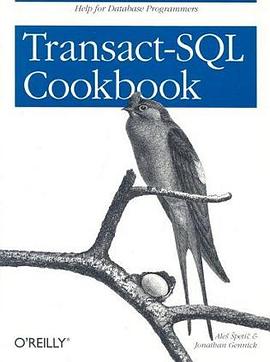
This unique cookbook contains a wealth of solutions to problems that SQL programmers face all the time. The recipes inside range from how to perform simple tasks, like importing external data, to ways of handling issues that are more complicated, like set algebra. Authors Ales Spetic and Jonathan Gennick, two authorities with extensive database and SQL programming experience, include a discussion with each recipe to explain the logic and concepts underlying the solution. SQL (Structured Query Language) is the closest thing to a standard query language that currently exists, and Transact-SQL -- a full-featured programming language that dramatically extends the power of SQL -- is the procedural language of choice for both Microsoft SQL Server and Sybase SQL Server systems. The Transact-SQL Cookbook is designed so you can use the recipes directly, as a source of ideas, or as a way to learn a little more about SQL and what you can do with it. Topics covered include:
<li type="disc">Audit logging. In addition to recipes for implementing an audit log, this chapter also includes recipes for: improving performance where large log tables are involved; supporting multiple-languages; and simulating server push. <li type="disc">Hierarchies. Recipes show you how to manipulate hierarchical data using Transact-SQL. <li type="disc">Importing data. This chapter introduces concepts like normalization and recipes useful for working with imported data tables. <li type="disc">Sets. Recipes demonstrate different operations, such as how to find common elements, summarize the data in a set, and find the element in a set that represents an extreme. <li type="disc">Statistics. This chapter?s recipes show you how to effectively use SQL for common statistical operations from means and standard deviations to weighted moving averages. <li type="disc">Temporal data. Recipes demonstrate how to construct queries against time-based data. <li type="disc">Data Structures. This chapter shows how to manipulate data structures like stacks, queues, matrices, and arrays. With an abundance of recipes to help you get your job done more efficiently, the Transact-SQL Cookbook is sure to become an essential part of your library.
作者简介
目录信息
Dedication
Preface
Why We Wrote This Book
Audience for This Book
Which Platform and Version?
Structure of This Book
Conventions Used in This Book
About the Code
Comments and Questions
Acknowledgments
Chapter 1. Pivot Tables
Section 1.1. Using a Pivot Table
Chapter 2. Sets
Section 2.1. Introduction
Section 2.2. The Students Example
Section 2.3. Implementing Set Difference
Section 2.4. Comparing Two Sets for Equality
Section 2.5. Implementing Partial Intersection
Section 2.6. Implementing Full Intersection
Section 2.7. Classifying Subsets
Section 2.8. Summarizing Classes of Sets
Section 2.9. Aggregating Aggregates
Section 2.10. Summarizing Aggregated Classes
Section 2.11. Including Nonaggregated Columns
Section 2.12. Finding the Top N Values in a Set
Section 2.13. Reporting the Size of a Set's Complement
Section 2.14. Finding the Complement of a Set
Section 2.15. Finding the Complement of a Missing Set
Section 2.16. Finding Complements of Sets with Different Universes
Section 2.17. Comparing a Set with Its Universe
Section 2.18. Dynamic Classification System
Chapter 3. Data Structures
Section 3.1. Types of Data Structures
Section 3.2. Working Example
Section 3.3. Finding Regions
Section 3.4. Reporting Region Boundaries
Section 3.5. Limiting Region Size
Section 3.6. Ranking Regions by Size
Section 3.7. Working with Sequences
Section 3.8. Working with Runs
Section 3.9. Cumulative Aggregates in Lists
Section 3.10. Implementing a Stack
Section 3.11. Implementing Queues
Section 3.12. Implementing Priority Queues
Section 3.13. Comparing Two Rows in an Array
Section 3.14. Printing Matrices and Arrays
Section 3.15. Transposing a Matrix
Section 3.16. Calculating a Matrix Trace
Section 3.17. Comparing Two Matrices for Size
Section 3.18. Adding and Subtracting Matrices
Section 3.19. Multiplying Matrices
Chapter 4. Hierarchies in SQL
Section 4.1. Types of Hierarchies
Section 4.2. Creating a Permission Hierarchy
Section 4.3. Changing Individual Permissions
Section 4.4. Adding New Individual Permissions
Section 4.5. Centralizing Authorization Logic
Section 4.6. Implementing General Hierarchies
Section 4.7. Traversing Hierarchies Recursively
Section 4.8. Manipulating Hierarchies Recursively
Section 4.9. Aggregating Hierarchies
Section 4.10. Preparing Multilevel Operations
Section 4.11. Aggregating Hierarchies Revised
Chapter 5. Temporal Data
Section 5.1. Introduction
Section 5.2. The Schedules Example
Section 5.3. Enforcing Granularity Rules
Section 5.4. Storing Out-of-Range Temporal Values
Section 5.5. Deriving the First and Last Dates of the Month
Section 5.6. Printing Calendars
Section 5.7. Calculating Durations
Section 5.8. Reporting Durations
Section 5.9. Querying Periods
Section 5.10. Querying Periods and Respecting Granularity
Section 5.11. Finding Available Periods
Section 5.12. Finding Common Available Periods
Section 5.13. Excluding Recurrent Events
Section 5.14. Excluding Nonrecurring Events
Section 5.15. Finding Continuous Periods
Section 5.16. Using Calendar Information with Periods
Section 5.17. Using Calendar Information with Durations
Chapter 6. Audit Logging
Section 6.1. Audit Logs
Section 6.2. The Warehouse Example
Section 6.3. Row-Level Logging
Section 6.4. Reporting Log Events
Section 6.5. Generating Current Snapshots
Section 6.6. Generating Time-Restricted Snapshots
Section 6.7. Undoing Table Changes
Section 6.8. Minimizing Audit-Log Space Consumption
Section 6.9. Online Account Balancing
Section 6.10. Activity-Level Logging
Section 6.11. Partitioning Large Log Tables
Section 6.12. Server Push
Chapter 7. Importing and Transforming Data
Section 7.1. Considerations When Importing Data
Section 7.2. Working Examples
Section 7.3. Importing External Data
Section 7.4. Importing Data into a Live System
Section 7.5. Importing with a Single Procedure
Section 7.6. Hiding the Import Procedure
Section 7.7. Folding Tables
Section 7.8. Pivoting Tables
Section 7.9. Joining Arrays with Tables
Section 7.10. Joining Arrays with Master Tables
Section 7.11. Joining Arrays with Multiple Master Records
Section 7.12. Extracting Master Records from Tables
Section 7.13. Generating Master Records Online
Section 7.14. Working with Duplicates
Chapter 8. Statistics in SQL
Section 8.1. Statistical Concepts
Section 8.2. The Light-Bulb Factory Example
Section 8.3. Calculating a Mean
Section 8.4. Calculating a Mode
Section 8.5. Calculating a Median
Section 8.6. Calculating Standard Deviation, Variance, and Standard Error
Section 8.7. Building Confidence Intervals
Section 8.8. Calculating Correlation
Section 8.9. Exploring Patterns with Autocorrelation
Section 8.10. Using a Simple Moving Average
Section 8.11. Extending Moving Averages
Appendix A. The T-Distribution Table
Colophon
Index
· · · · · · (收起)
读后感
用户评价
我必须承认,初次翻开这本书时,我对它抱有比较高的期望,但它最终的表现却让这些期望显得有些保守了。这本书最让我惊喜的地方在于它的实用性和前瞻性。它不仅覆盖了SQL Server的核心特性,还涉及到了许多现代数据库开发中越来越重要的部分,比如**JSON数据处理**和**空间数据操作**的T-SQL集成。我记得我花了整整一个周末来实践关于地理空间查询的那几章,那些以前只在专业GIS软件中才做过的复杂空间关系判断,现在竟然可以直接在数据库层面通过T-SQL实现,这极大地简化了我的应用架构。作者的示例代码质量极高,注释详细,即便是那些涉及到特定版本兼容性的说明也做得非常到位,确保读者能够无缝地将学到的知识迁移到自己的生产环境中,这本书绝对是工具箱里不可或缺的一件利器。
说实话,我原本以为这又是一本堆砌了大量代码示例的“参考手册”,但这本书的深度和广度超出了我的预期。我是一名资深开发人员,日常工作中使用SQL Server已经有些年头了,本以为自己对T-SQL已经驾轻就熟,没想到在深入到并发控制和事务隔离级别这部分时,还是被作者的分析深度所折服。它没有停留在表面的语法讲解,而是深入剖析了底层的工作原理,特别是关于死锁的排查和解决策略,提供了一套非常实用的诊断流程。我当时正为线上一个偶发的事务阻塞问题焦头烂额,这本书里的那一节关于`SNAPSHOT ISOLATION`的介绍,简直像是一道闪电,瞬间照亮了我的思路。作者的文笔非常严谨,数据结构和算法的描述都非常到位,适合那些对性能和稳定性有极致追求的工程师。
这本书简直是为我量身定做的,我作为一个刚接触数据库不久的新手来说,确实对SQL的很多高级操作感到头疼。但是这本书的结构非常清晰,从基础的SELECT语句到复杂的存储过程、触发器,它都用非常生动且易于理解的方式进行了阐述。我特别喜欢它那种“动手实践”的理念,每一章都会给出实际的案例和对应的代码,让我可以一边看一边跟着敲。比如,当我第一次尝试优化一个查询语句时,那些关于索引和执行计划的章节,真是解了我燃眉之急。我感觉作者不仅懂技术,更懂得如何去教别人技术,把那些枯燥的理论讲得引人入胜。我以前觉得SQL的学习过程是填鸭式的,但这本书完全颠覆了我的看法,它更像是一场与数据库专家的深入交流,让人在解决实际问题的过程中自然而然地掌握了知识。我强烈推荐给所有想从“会写SQL”到“写出高效SQL”的朋友们。
对于那些已经在用T-SQL,但总感觉自己“只会用”而“不懂其精髓”的DBA们,我只想说,赶紧入手这本书。我个人的阅读体验是,它提供了一种全新的视角去看待我们每天都在处理的那些常规任务。我尤其欣赏它在**“调试与错误处理”**上的详细介绍,以前我处理错误都是靠猜和查微软文档,效率很低。这本书里提供了一套系统化的调试思路,从使用内置工具到编写健壮的错误捕获逻辑,都有详尽的步骤指导。更别提那些关于性能调优的“黑魔法”,比如如何利用窗口函数进行更复杂的报表生成,比我之前用JOIN和GROUP BY堆砌起来的复杂逻辑要优雅和高效得多。这本书的价值不在于教你写出能运行的代码,而在于教你写出**“健壮且高效”**的代码。
作为一名数据分析师,我的日常工作重点在于数据提取和转换,通常只需要掌握SQL的基础查询能力。然而,自从我开始接触更复杂的ETL流程后,标准的SELECT/INSERT语句已经无法满足需求了。这本书的亮点在于,它非常巧妙地平衡了理论深度和实际应用性。它没有用过多的篇幅去讲解那些数据库管理员才关心的底层硬件优化,而是集中火力在T-SQL语言特性本身上。特别是关于**用户定义函数(UDF)和表值函数(TVF)**的性能对比分析,我感觉受益匪浅。作者清晰地解释了在什么场景下应该优先使用哪种函数,以及避免常见的性能陷阱,这对于我们构建可复用的数据处理模块至关重要。这本书让我从一个单纯的数据消费者,转变成了一个能够构建复杂数据管道的设计者。