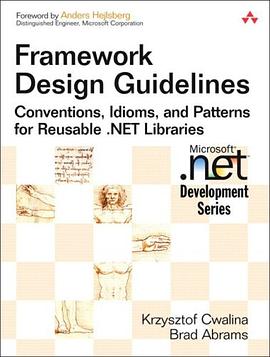

具体描述
A new edition of this title is available, ISBN-10: 0321545613 ISBN-13: 9780321545619 "This book is an absolute must-read for all .NET developers. It gives clear do and don't guidance on how to design class libraries for .NET. It also offers insight into the design and creation of .NET that really helps developers understand the reasons why things are the way they are. This information will aid developers designing their own class libraries and will also allow them to take advantage of the .NET class library more effectively." --Jeffrey Richter, author/trainer/consultant, Wintellect " Framework Design Guidelines will help you in two important ways. First, any .NET developer will benefit from a greater understanding of the design principles that govern the .NET Base Class Library. Second, a deeper understanding of these principles will help you to create software that integrates well with the .NET environment. Quite frankly, this book should be on every .NET developer's bookshelf." --Bill Wagner, founder and consultant, SRT Solutions, author of Effective C# "Not since Brooks' The Mythical Man Month has the major software maker of its time produced a book so full of relevant advice for the modern software developer. This book has a permanent place on my bookshelf and I consult it frequently." --George Byrkit, senior software engineer, Genomic Solutions "This book is a must-read for all architects and software developers thinking about frameworks. The book offers insight into some driving factors behind the design of the .NET Framework. It should be considered mandatory reading for anybody tasked with creating application frameworks." --Peter Winkler, senior software engineer, Balance Technology Inc. "Frameworks are valuable but notoriously difficult to construct: Your every decision must be geared towards making them easy to be used correctly and difficult to be used incorrectly. This book takes you through a progression of recommendations that will eliminate many of those downstream 'I wish I'd known that earlier' moments. I wish I'd read it earlier." --Paul Besly, principal technologist, QA "Filled with information useful to developers and architects of all levels, this book provides practical guidelines and expert background information to get behind the rules. Framework Design Guidelines takes the already published guidelines to a higher level, and it is needed to write applications that integrate well in the .NET area." --Cristof Falk, software engineer Framework Design Guidelines: Conventions, Idioms, and Patterns for Reusable .NET Libraries teaches developers the best practices for designing system frameworks and reusable libraries for use with the Microsoft .NET Framework and WinFX. This book focuses on the design issues that directly affect the programmability of a framework, specifically its publicly accessible APIs. This book can improve the work of any .NET developer producing code that other developers will use. An added benefit is a collection of annotations to the guidelines by various members of the Microsoft .NET Framework and WinFX teams, which provide a lively discussion of the motives behind the guidelines, along with examples of good reasons for breaking the guidelines. Microsoft architects Krzysztof Cwalina and Brad Abrams offer guidelines for framework design from the top down. From their long experience and deep insight, you will learn The general philosophy of framework design Principles and guidelines that are fundamental to overall framework design Naming guidelines for the various parts of a framework, such as namespaces, types, and members Guidelines for the design of types and members of types Issues and guidelines that are important to ensure appropriate extensibilityin your framework Guidelines for working with exceptions, the preferred error reporting mechanism in the .NET Framework and WinFX Guidelines for extending and using types that commonly appear in frameworks Guidelines for and examples of common framework design patterns Guidelines in this book come in four major forms: Do , Consider , Avoid , and Do not . In general, a Do guideline should almost always be followed, a Consider guideline should generally be followed, an Avoid guideline indicates that something is generally not a good idea, and a Do not guideline indicates something you should almost never do. Every guideline includes a discussion of its applicability, and most guidelines include a code example. A companion DVD includes the Designing .NET Class Libraries video series, instructional presentations by the authors on design guidelines for developing classes and components that extend the .NET Framework. A sample API specification and other useful resources are also included.
作者简介
krzysztof cwalina 微软公司公共语言运行库(clr)的项目经理。他曾为.net框架的首个版本设计api,并负责框架中的多个名字空间,包括system.collections、system.diagnostics、system.messaging,等等。他也是fxcop开发组的发起成员之一。目前,他正致力于在整个公司范围内开发推广设计规范,并将其应用到.net框架和winfx中。
brad abrams 微软公司公共语言运行库开发组和.net框架开发组的创始成员之一,目前是lead program manager。brad也是公共语言规范(cls)、.net框架设计规范及ecmaiso cli标准中程序库标准的主编。brad与他人合著了programming in the .net environment,他还是.net framework standard library annotated reference(卷1和卷2)的编辑。读者可以从他的blog:http://blogs.msdn.com/brada/中了解他最新的想法。
葛子昂,1998年毕业于南京理工大学计算机系,目前就职于微软亚洲工程院上海分院,致力于windows server的相关研发。之前曾先后任职于上海育碧电脑软件有限公司和上海旭上电子有限公司,从事游戏软件的开发及图形处理器的设计。
目录信息
读后感
最近在研究API的可用性设计,看了一些资料和文献,了解到微软目前的做法是运用认知维度来进行框架的可用性设计,其中也提到了这本书,不知道本书对于设计一个一般的API或framework是否有帮助。
粗读了一遍,感觉收获很大。 侯捷先生曾在他的《深入浅出MFC第二版》中有云“99.99999%的programmer终其一生不会设计一个application framework”,尽管如此,这本书更多地让我看到了从设计者的角度来观察如何更好地设计和使用框架来进行日常的开发活动。 今...
不知道为什么把书名译成这样,英文原本是:Framework Design Guidelines,多么大气的名字。结果被译成:.NET设计规范。 从目录上看,本书主要还是讲如何设计好一个framework,与平台和语言无关,只是通过.NET平台来举例具体说明,中文书名却把副标题中的.NET当成了...
最近在研究API的可用性设计,看了一些资料和文献,了解到微软目前的做法是运用认知维度来进行框架的可用性设计,其中也提到了这本书,不知道本书对于设计一个一般的API或framework是否有帮助。
结果几乎是考着对比原文看完的,什么"内部受保护的列表",把几乎所有大家都知道的英文关键字都翻译成中文,这就已经够难读的了,而且很多句子都部通顺.怪不得这么快就绝版买不到了. 书是好书,建议所有的.NET程序员都读一下
用户评价
这本书的排版和装帧设计简直是一场视觉上的灾难,如果不是冲着内容,我可能根本无法坚持读下去。字体大小不一,行距时松时紧,很多地方的图表模糊不清,简直考验读者的耐心和视力。不过,一旦强迫自己适应这种“反现代”的阅读体验后,我惊讶地发现,内容的密度高得令人窒息。它没有冗余的形容词,每一个句子都像是一个压缩包,需要反复解压才能体会其全部的含义。这要求读者必须高度集中注意力,并且最好手里常备一支笔,随时准备勾画重点和写下自己的疑问。它不是一本可以边喝咖啡边随便翻阅的书籍,更像是一份需要严谨对待的学术论文集,每一次深入研读,都能挖掘出新的层次。这种对文字的极致凝练,虽然牺牲了阅读的愉悦感,却极大地提升了知识的传递效率,对于追求深度理解的专业人士来说,这或许是一种值得付出的代价。
这本书的价值,很大程度上体现在它对于“边界条件”和“非预期后果”的深刻洞察力上。市面上很多设计指南往往只关注“如何做成功”,但这本书却花了大量的篇幅去讨论“为什么会失败”,以及在何种极端情况下设计会崩溃。作者似乎有一种近乎偏执的对系统脆弱性的关注,这使得全书弥漫着一种审慎和警惕的气氛。我最欣赏的是那些关于“权衡取舍”(Trade-offs)的讨论,它们极其坦诚,毫不回避优秀设计背后必然隐藏的代价。例如,书中对某种特定抽象层次的批判,不仅仅指出了它的缺陷,更细致地分析了这种缺陷是如何在不同团队规模和项目生命周期中被放大的。这让我学会了在做任何设计决策时,都要预先在脑海中建立一个“反面情景测试”的框架,这比单纯学习最佳实践要管用得多。
这是一本需要反复阅读,并且最好能与同行讨论着去啃的“硬骨头”。它的语言风格极其冷静、客观,几乎找不到任何带有个人情感色彩的表达,读起来如同在阅读一份严谨的工程规范文档。很多重要的观点,都是通过对比两种相互对立的设计哲学,然后给出基于长期观察的结论,而非简单的推荐。这种相对主义的视角非常考验读者的批判性思维能力。我发现,每次隔一段时间重新拿起它时,我都会对同一个章节产生全新的理解,这说明作者所构建的知识体系具有极强的延展性和生命力。它没有提供现成的答案,而是提供了一套提问的框架,鼓励读者去挑战自己的既有认知。对于那些已经身处中高级职位的工程师,想要从“实现者”彻底转型为“架构师”的读者而言,这本书提供的思维训练,其价值远超其纸面价格。
我得承认,这本书的开篇部分,老实说,让我非常困惑和沮丧。它采用了一种非常晦涩的、高度抽象的理论模型作为基础,几乎没有提供任何直接可操作的“菜谱”或“步骤指南”。我一度怀疑自己是不是买错了书,这更像是一本面向理论物理学家的著作,而不是面向一线开发者的工具书。那种对术语的密集使用和对概念之间复杂关联的描述,使得初次接触的读者很容易感到被排斥在外。然而,我没有放弃,我转而从书的后半部分,那些关于具体实现和模式应用的章节开始倒着读。令人称奇的是,当我对后续的实践内容有了初步了解后,再回过头去看那些抽象的理论,它们突然间就有了血有肉的关联性。作者似乎有意为之,强迫读者必须先建立起对系统复杂性的敬畏之心,才能理解这些指导原则的深层逻辑,这是一种非常高明的教学策略,尽管过程极其痛苦。
这部作品,从书页泛黄的边缘到油墨散发的古老气息,便能感受到一股厚重的历史沉淀。它不像那些追求时髦的最新理论书籍,更多的是一种对过往经验的沉思与提炼。我特别欣赏作者在叙事上的那种娓娓道来,没有咄咄逼人的断言,而是像一位智者在分享他走过的弯路和发现的坦途。书中的案例分析,虽然年代久远,但其背后的设计哲学却具有惊人的穿透力,让我得以窥见早期软件架构师们是如何在资源有限的条件下,构建出影响深远系统的智慧结晶。阅读它,仿佛穿越回了一个充满探索精神的时代,那种脚踏实地解决问题的态度,在如今这个浮躁的技术圈中显得尤为珍贵。每一次翻阅,都能从中汲取到一种沉静的力量,让我重新审视自己日常工作中那些看似理所当然的设计决策。这种对基础的回归和对本质的探讨,是任何技术快速迭代都无法取代的宝贵财富。