
具体描述
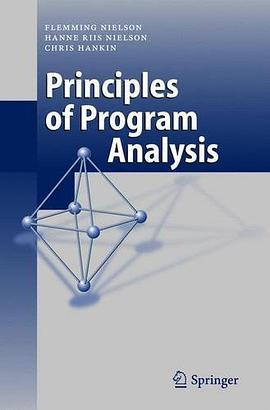
Program analysis utilizes static techniques for computing reliable information about the dynamic behavior of programs. Applications include compilers (for code improvement), software validation (for detecting errors) and transformations between data representation (for solving problems such as Y2K). This book is unique in providing an overview of the four major approaches to program analysis: data flow analysis, constraint-based analysis, abstract interpretation, and type and effect systems. The presentation illustrates the extensive similarities between the approaches, helping readers to choose the best one to utilize.
作者简介
目录信息
1 Introduction 1
1.1 The Nature of Program Analysis 1
1.2 Setting the Scene o o 3
1.3 Data Flow Analysis o 5
1.301 The Equational Approach 5
1.302 The Constraint Based Approach 8
1.4 Constraint Based Analysis o 10
1.5 Abstract Interpretation 13
1.6 Type and Effect Systems o 17
1.601 Annotated Type Systems 18
1.602 Effect Systems 22
1.7 Algorithms o o o 25
1.8 Transformations 27
Concluding Remarks 29
Mini Projects 29
Exercises o o 31
2 Data Flow Analysis 35
201 Intraprocedural Analysis o o o ••••• 35
201.1 A vailable Expressions Analysis 39
201.2 Reaching Definitions Analysis o 43
201.3 Very Busy Expressions Analysis 46
201.4 Live Variables Analysis ••• o • 49
201.5 Derived Data Flow Information o 52
XII Contents
2.2 Theoretical Properties . . . . . . . . . . . 54
2.2.1 Structural Operational Semantics . 54
2.2.2 Correctness of Live Variables Analysis 60
2.3 Monotone Frameworks . 65
2.3.1 Basic Definitions 67
2.3.2 The Examples Revisited . 70
2.3.3 A Non-distributive Example. 72
2.4 Equation Solving . . . . . 74
2.4.1 The MFP Solution 74
2.4.2 The MOP Solution . 78
2.5 Interprocedural Analysis .. 82
2.5.1 Structural Operational Semantics . 85
2.5.2 Intraprocedural versus Interprocedural Analysis . 88
2.5.3 Making Context Explicit . 90
2.5.4 Call Strings as Context 95
2.5.5 Assumption Sets as Context . 99
2.5.6 Flow-Sensitivity versus Flow-Insensitivity 101
2.6 Shape Analysis •••••••••••••• o 104
2.6.1 Structural Operational Semantics . 105
2.6.2 Shape Graphs . 109
2.6.3 The Analysis 115
Concluding Remarks 128
Mini Projects 132
Exercises .. 135
3 Constraint Based Analysis 141
3.1 Abstract 0-CFA Analysis 141
3.1.1 The Analysis ... 143
3.1.2 Well-definedness of the Analysis 150
3.2 Theoretical Properties . . . . . . . . . . 153
3.2.1 Structural Operational Semantics . 153
3.2.2 Semantic Correctness 158
3.2.3 Existence of Solutions 162
Contents XIII
3.2.4 Coinduction versus Induction 165
3.3 Syntax Directed 0-CFA Analysis .. 168
3.3.1 Syntax Directed Specification 169
3.3.2 Preservation of Solutions 171
3.4 Constraint Based 0-CFA Analysis . 173
3.4.1 Preservation of Solutions 175
3.4.2 Solving the Constraints 176
3.5 Adding Data Flow Analysis . . 182
3.5.1 Abstract Values as Powersets 182
3.5.2 Abstract Values as Complete Lattices 185
3.6 Adding Context Information . . . 189
3.6.1 Uniform k-CFA Analysis. 191
3.6.2 The Cartesian Product Algorithm 196
Concluding Remarks 198
Mini Projects 202
Exercises .. 205
4 Abstract Interpretation 211
4.1 A Mundane Approach to Correctness. 211
4.1.1 Correctness Relations .. 214
4.1.2 Representation Functions 216
4.1.3 A Modest Generalisation 219
4.2 Approximation of Fixed Points 221
4.2.1 Widening Operators 224
4.2.2 N arrowing Opera tors . 230
4.3 Galois Connections . . . . . . 233
4.3.1 Properties of Galois Connections 239
4.3.2 Galois Insertions ......... 242
4.4 Systematic Design of Galois Connections . 246
4.4.1 Component-wise Combinations 249
4.4.2 Other Combinations 253
4.5 Induced Operations . . . . . 258
4.5.1 Inducing along the Abstraction Function . 258
XIV
4.5.2 Application to Data Flow Analysis . . . . .
4.5.3 Inducing along the Concretisation Function
Concluding Remarks
Mini Projects
Exercises ..
5 Type and Effect Systems
5.1 Control Flow Analysis ....... .
5.1.1 The Underlying Type System
5.1.2 The Analysis ...
5.2 Theoretical Properties ..
5.2.1 Natural Semantics
5.2.2 Semantic Correctness
5.2.3 Existence of Solutions 297
5.3 Inference Algorithms . . . . . 300
5.3.1 An Algorithm for the Underlying Type System 300
5.3.2 An Algorithm for Control Flow Analysis . 306
5.3.3 Syntactic Soundness and Completeness 312
5.3.4 Existence of Solutions 317
5.4 Effects . . . . . . . . . . . . 319
5.4.1 Side Effect Analysis
5.4.2 Exception Analysis .
5.4.3 Region Inference ..
5.5 Behaviours . . . . . . . . .
5.5.1 Communication Analysis
Concluding Remarks
Mini Projects
Exercises ..
6 Algorithms
6.1 Worklist Algorithms . . . . . . . . . . . . . .
6.1.1 The Structure of Worklist Algorithms
6.1.2 Iterating in LIFO and FIFO.
6.2 Iterating in Reverse Postorder ....
6.2.1 The Round Robin Algorithm .
6.3 Iterating Through Strong Components
Concluding Remarks
Mini Projects
Exercises ..
Partially Ordered Sets
A.1 Basic Definitions . . •••• o •••
A.2 Construction of Complete Lattices
A.3 Chains ....
A.4 Fixed Points
Concluding Remarks
Induction and Coinduction
B.1 Proof by Induction . . . .
B.2 Introducing Coinduction .
B.3 Proof by Coinduction
Concluding Remarks . . . .
Graphs and Regular Expressions
C.1 Graphs and Forests .
C.2 Reverse Postorder .
C.3 Regular Expressions
Concluding Remarks
Index of N otation
Index
Bibliography
· · · · · · (收起)
读后感
对 static analysis 祛魅的书。所有的分析都建立在 monotone framework 的结构上,通过显而易见的partial order 和finite powerset 这两个属性来证明算法一定会收敛。然后通过简单到naïve的worklist 或者round robin 的特化算法来对所有 statements 做 simulation ,以找到 ...
对 static analysis 祛魅的书。所有的分析都建立在 monotone framework 的结构上,通过显而易见的partial order 和finite powerset 这两个属性来证明算法一定会收敛。然后通过简单到naïve的worklist 或者round robin 的特化算法来对所有 statements 做 simulation ,以找到 ...
对 static analysis 祛魅的书。所有的分析都建立在 monotone framework 的结构上,通过显而易见的partial order 和finite powerset 这两个属性来证明算法一定会收敛。然后通过简单到naïve的worklist 或者round robin 的特化算法来对所有 statements 做 simulation ,以找到 ...
对 static analysis 祛魅的书。所有的分析都建立在 monotone framework 的结构上,通过显而易见的partial order 和finite powerset 这两个属性来证明算法一定会收敛。然后通过简单到naïve的worklist 或者round robin 的特化算法来对所有 statements 做 simulation ,以找到 ...
对 static analysis 祛魅的书。所有的分析都建立在 monotone framework 的结构上,通过显而易见的partial order 和finite powerset 这两个属性来证明算法一定会收敛。然后通过简单到naïve的worklist 或者round robin 的特化算法来对所有 statements 做 simulation ,以找到 ...
用户评价
我必须承认,这本书的阅读体验绝对是“高强度”的。它不是那种可以放松地窝在沙发里随意翻阅的读物。它需要你全神贯注,甚至可能需要你准备好笔和纸来标记和推导。但这种“挑战性”恰恰是它最宝贵的地方。它拒绝提供现成的答案,而是将思考的工具和框架交给你,让你自己去构造答案。书中对于理论模型的阐述,严密到几乎让你产生一种错觉:仿佛数学和逻辑本身就在以最纯粹的形式向你低语。它探讨的视角非常宏大,几乎触及了计算机科学中关于“可理解性”和“可证明性”的终极命题。对于那些已经厌倦了仅仅停留在框架API层面,渴望理解软件系统“灵魂”的资深开发者来说,这本书提供的思想深度,是市场上其他同类书籍难以企及的“硬通货”。
天哪,我刚看完的那本关于软件开发的“巨著”,简直是一场智力上的探险!这本书的叙述方式简直是教科书级别的严谨,每一个概念的引入都像是精心设计的棋局,每一步都带着深思熟虑的布局。它没有那种浮夸的、为了吸引眼球而堆砌的“秘籍”式口吻,而是以一种近乎哲学的深度,剖析了软件构建背后的核心原理。我尤其欣赏作者对于抽象层面的把握能力,他们似乎能轻易地从无数的代码实例中提炼出最本质的逻辑骨架。阅读过程中,我几次停下来,不是因为内容太难,而是因为某个论证的精妙让我忍不住要回味再三。它迫使你停止浮光掠影的浏览,转而深入思考“为什么是这样”,而不是仅仅满足于“能用就行”。这本书对那些真正想在技术栈上打下坚实地基的工程师来说,简直是无价之宝。它教会你的不是如何快速修复一个Bug,而是如何从根本上避免这些Bug的产生。那种被知识体系的严密逻辑所包裹的感觉,非常令人满足。
这本书的整体氛围是极其严肃且充满学究气的,但这种严肃性却带来了一种极强的信赖感。它引用的参考文献和案例都经过了严格的筛选和论证,没有一丝多余的“花架子”。我特别欣赏作者在论证过程中展现的批判性思维,他们不仅展示了“做什么”,更重要的是揭示了“为什么不能这样做”以及“在什么情况下必须采用另一种路径”。这种对局限性的坦诚,让整本书的论断显得无比坚实可靠。它就像一位德高望重的导师,以极其耐心的态度引导学生探索知识的深水区,而不是在岸边泛泛而谈。读完之后,我感觉自己对整个领域产生了一种更具责任感的认知,仿佛被赋予了一套新的、更强大的“世界观”过滤器,用来审视和评估一切新出现的编程范式和工具。
这本书的结构安排简直是艺术品级别的流畅。它不像有些技术书籍那样,东一榔头西一棒子地罗列知识点,让读者感觉像是在一个巨大的、没有地图的图书馆里迷失方向。相反,作者构建了一个极其清晰的知识导览系统。从最基础的定义出发,稳步攀升到复杂的应用场景,每当我觉得即将触及知识的边界时,总有一个巧妙的过渡将我引向下一个更加开阔的视野。我喜欢它那种“循序渐进,但绝不简单化”的态度。它尊重读者的智力,同时也体贴地为初学者铺设了足够的垫脚石。读完后,我感觉自己像是完成了一次高难度的攀岩,虽然过程充满挑战,但最终站在顶峰俯瞰全局的成就感是无可替代的。对于那些追求系统化、非碎片化知识体系的人来说,这本书提供的知识路径规划,比任何市场上的“速成”指南都要可靠得多。
这本书的作者显然拥有将复杂性“驯服”的超凡能力。他们处理那些通常让人望而生畏的主题时,采用了一种近乎诗意的简洁。我发现自己不再需要反复查阅外部资料来理解那些晦涩的术语,因为作者的解释本身就带着一种内在的清晰度。这种清晰并非源于简化了问题,而是源于对问题核心的深刻洞察,能够用最少的词汇表达最丰富的内容。特别是书中对于不同分析方法的对比部分,处理得极其高明。它没有简单地罗列优缺点,而是深入探讨了每种方法的适用边界和内在的权衡取舍。这让我对工具的选择不再是盲从,而是基于一种深思熟虑的策略。这本书的文字有一种独特的节奏感,读起来不拖沓,信息密度极高,但又不会让人感到窒息,仿佛每一句话都精准地落在了它该在的位置上,不多不少。
a little bit old. Collection of PA papers before 2000.
a little bit old. Collection of PA papers before 2000.
a little bit old. Collection of PA papers before 2000.
a little bit old. Collection of PA papers before 2000.
a little bit old. Collection of PA papers before 2000.