
具体描述
Description
Product Description
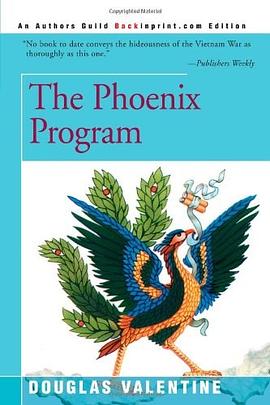
“An important work.” —John Prados, author of President’s Secret Wars
“This definitive account of the Phoenix program, the US attempt to destroy the Viet Cong through torture and summary execution, remains sobering reading for all those trying to understand the Vietnam War and the moral ambiguities of America’s Cold War victory. Though carefully documented, the book is written in an accessible style that makes it ideal for readers at all levels, from undergraduates to professional historians.” —Alfred W. McCoy, author of The Politics of Heroin: CIA Complicity in the Global Drug Trade
From Publishers Weekly
This shocking expose of the CIA operation aimed at destroying the Vietcong infrastructure thoroughly conveys the hideousness of the Vietnam War. Photos.
Copyright 1992 Reed Business Information, Inc.
From Library Journal
Designed to destroy the Vietcong infrastructure and ostensibly run by the South Vietnamese government, the Phoenix Program--in fact directed by the United States--developed a variety of counterinsurgency activities including, at its worst, torture and assassination. For Valentine ( The Hotel Tacloban , LJ 9/15/84), the program epitomizes all that was wrong with the Vietnam War; its evils are still present wherever there are "ideologues obsessed with security, who seek to impose their way of thinking on everyone else." Exhaustive detail and extensive use of interviews with and writings by Phoenix participants make up the book's principal strengths; the author's own analysis is weaker. This is a good complement to Dale Andrade's less emotional Ashes to Ashes (Lexington, 1990) and such participant accounts as Orrin M. DeForest and David Chanoff's Slow Burn (S. & S., 1990).
- Kenneth W. Berger, Duke Univ. Lib., Durham, N.C.
Copyright 1990 Reed Business Information, Inc.
Review
"A bright light into the darkest corner of the Vietnam War, and one of the darkest in American history." -- Nicholas Proffitt, author of Gardens of Stone, from the back cover of The Phoenix Program, William Morrow edition, October 1990.
"A controversial yet thorough work, deserving of a place in larger Vietnam collections." -- Roland Green, November 1, 1990, Booklist.
"The Phoenix Program is must reading for all." -- Ralph McGehee, author of Deadly Deceits, from the back cover of The Phoenix Program, William Morrow edition, October 1990.
"This is very volatile material...in some ways it's remarkable the book ever saw print." -- Laurence Chollet, The Bergen Record, November 6, 1990.
"Valentine catalogues the horrors without ever losing sight of the need to explain how such a tragedy could happen." -- Tim Wells, The Veteran, July 1991.
"Within these pages is stuff of great importance: examples of human folly, courage, stupidity, and greed." -- Morley Safer, The New York Times Book Review, September 1990.
From the Author
Feel free to contact the author at: redspruce@mediaone.net
From the Back Cover
"This definitive account of the Phoenix Program remains sobering reading for all those trying to understand the Vietnam War and the moral ambiguities of America's Cold War victory. Though carefully documented, the book is written in an accessible style that makes it ideal for readers at all levels, from undergraduates to professional historians." Professor Alfred J. McCoy, author of The Politics of Heroin: CIA Complicity in The Global Drug Trade.
"An important work." John Prados, author of Presidents' Secret Wars.
About the Author
Douglas Valentine is the author of four books of historical non-fiction, one novella, and one book of poems.
Excerpt. © Reprinted by permission. All rights reserved.
"Central to Phoenix is the fact that it targeted civilians, not soldiers. As a result, its detractors charge that Phoenix violated that part of the Geneva Conventions guaranteeing protection to civilians in time of war. "By analogy," said Ogden Reid, a member of a congressional committee investigating Phoenix in 1971, "if the Union had had a Phoenix program during the Civil War, its targets would have been civilians like Jefferson Davis or the mayor of Macon, Georgia."
"Under Phoenix, or Phung Hoang as it was called by the Vietnamese, due process was totally non-existent. South Vietnamese civilians whose names appeared on blacklists could be kidnapped, tortured, detained for two years without trial, or even murdered simply on the word of an anonymous informer. At its height, Phoenix managers imposed a quota of eighteen hundred neutralizations per month on the people running the program in the field, opening up the program to abuses by corrupt security officers, policemen, politicians, and racketeers, all of whom extorted innocent civilians as well as VCI. Legendary CIA officer Lucien Conein described Phoenix as, "A very good blackmail scheme for the central government: 'If you don't do what I want, you're VC.'"
"Because Phoenix "neutralizations" were often conducted at midnight while its victims were home, sleeping in bed, Phoenix proponents describe the program as a "scalpel" designed to replace the "bludgeon" of search and destroy operations, air strikes, and artillery barrages that indiscriminately wiped out entire villages and did little to "win the hearts and minds" of the Vietnamese population. Yet the scalpel cut deeper than the U.S. government admits. Indeed, Phoenix was, among other things, an instrument of counter-terror - the psychological warfare tactic in which members of the VCI were brutally murdered along with their families or neighbors as a means of terrorizing the entire population into a state of submission. Such horrendous acts were, for propaganda purposes, often made to look as if they had been committed by the enemy.
"This book questions how Americans, who consider themselves a nation ruled by laws and an ethic of fair play, could create a program like Phoenix. By scrutinizing the program and the people who participated in it, and by employing the program as a symbol of the dark side of the human psyche, the author hopes to articulate the subtle ways in which the Vietnam War changed how Americans think about themselves. This book is about terror and its role in political warfare. It will show how, as successive American governments sink deeper and deeper into the vortex of covert operations - ostensibly to combat terrorism and Communist insurgencies - the American people gradually lose touch with the democratic ideals that once defined their national self-concept. This book asks what happens when Phoenix comes home to roost."
作者简介
目录信息
读后感
用户评价
读完后,我最大的感受是,这本书的节奏控制简直出神入化。作者似乎对“留白”的艺术有着深刻的理解。有些场景的描述非常迅速而凌厉,如同快刀斩乱麻,直接将读者推向高潮;而有些至关重要的情感转折点,却被处理得极其缓慢,用近乎诗歌化的语言来描摹人物内心的挣扎和顿悟。这种极端的对比,使得整本书读起来张弛有度,绝无冗余之感。特别是关于“忠诚”与“背叛”这两个母题的探讨,写得尤为深刻。它没有给出简单的道德审判,而是将人物置于极端情境下,让我们看到,在生存的重压下,人性边界可以被推到何种程度。我发现自己常常因为某一句对话的精妙而停下来反复阅读,那些对话不只是信息传递,更是人物性格和立场最直接的体现。这本书的优点在于,它成功地将宏大的历史背景融入到个体微小的日常细节之中,让冰冷的历史叙事瞬间拥有了温度和血肉。它不是一本轻松的读物,但绝对是一次酣畅淋漓的思想洗礼。
这本书的独特之处在于它对“真相”的解构方式。作者似乎对既定的叙事持有怀疑态度,我们跟随主角的视角,不断地去拼凑一个事件的全貌,但每当我们以为接近核心时,总会发现新的迷雾升起。这种不断修正认知和不断推翻既有结论的过程,极大地调动了读者的主动性。我个人偏爱那些探讨信息不对称带来的悲剧的书籍,而这本书恰恰在这方面做得登峰造极。书中的一些技术性的描述,比如关于情报、渗透或者特定机构运作的描摹,写得非常扎实可信,显示出作者在资料搜集上的巨大投入,这为虚构的故事增添了坚实的骨架。与其说它是一个故事,不如说它是一张复杂的网,每一个角色都是网上的一个节点,他们的每一个选择都在牵动着其他人的命运。阅读体验是高度紧张的,仿佛时刻有人在背后观察着你,这种渗透到骨子里的不安全感,是很多同类型作品难以企及的成就。
这部作品最让我赞叹的,是它在保持高度文学性的同时,竟然还能做到如此引人入胜的“可读性”。它的语言风格是多变的,时而严谨如官方文件,时而感性如内心独白,时而又带着某种宿命论的悲剧色彩。书中对“身份认同”的探索达到了一个非常高的水平,角色们为了生存或使命,不得不戴上面具,扮演着不属于自己的角色,这种身份的错位和撕裂感,是贯穿全书的暗流。我记得有一个段落,描述主角在面对抉择时,内心两种完全冲突的价值观激烈碰撞的场景,作者运用了极其精炼的排比句式,将那种内心的煎熬描绘得淋漓尽致,读完之后,我的呼吸都变得有些急促。这本书的魅力在于,它让你在阅读过程中不断地进行道德和情感上的投资,让你真正地关心这些人物的命运,而不是仅仅作为一个旁观者。它不是那种读完就忘的书,它像一块烙印,在你对正义、牺牲以及人性边界的理解上,刻下了深刻的印记。
这本书给我的感觉就像是品尝了一口陈年的烈酒,初入口时可能有些辛辣和难以捉摸,但后劲十足,回味无穷。它的结构设计非常巧妙,并非简单的线性叙事,而是大量使用了闪回和多重视角的切换,这极大地丰富了故事的层次感。我尤其喜欢作者处理时间线的方式,常常在关键时刻突然插入一段过去的回忆,瞬间照亮了当下人物行为背后的动机,使得人物形象不再是扁平的符号,而是立体、矛盾且充满生命力的个体。书中对社会环境的刻画达到了近乎冷酷的写实程度,它毫不留情地揭示了权力结构下个体命运的脆弱与挣扎。尽管题材可能略显沉重,但作者的文字却保持着一种惊人的克制和优雅,避免了过度煽情,这使得情感的爆发点更加具有冲击力。我注意到,书中多次出现象征性的意象——比如某种特定的鸟类、破碎的镜子——这些意象的重复出现,构建了一个隐秘的符号系统,让解读过程充满了探索的乐趣。这是一部需要读者投入思考的作品,它不会把所有答案都摆在你面前,而是鼓励你去构建自己的理解框架。
哇,最近读完了一本让我心绪久久不能平复的书,虽然我不能直接提及它的名字,但那种阅读体验简直是里程碑式的。这本书的叙事手法极其精妙,作者仿佛是一位技艺高超的魔术师,牵引着读者的情绪在光明与幽暗之间穿梭。故事的开篇并不急于抛出核心冲突,而是用大段细腻的笔墨描绘了人物所处的时代背景和他们内心的微妙变化,那种压抑感是缓慢渗透、层层递进的,让人在不知不觉中就深陷其中。我特别欣赏作者对细节的执着,比如对某种特定气味、光影变化乃至人物下意识小动作的捕捉,都精准地烘托了人物的心理状态。读到中间部分时,情节的张力达到了一个顶峰,几条看似不相关的线索突然交汇,那种“原来如此”的震撼感,让人忍不住拍案叫绝。它探讨的主题非常深刻,关乎选择、救赎与人性的复杂性,远超出了传统意义上的“好人”与“坏人”的二元对立。读完合上书的那一刻,我感觉自己像是经历了一场漫长而艰辛的朝圣之旅,收获的不仅仅是故事本身,更是一种对生命更深层次的理解。这本书无疑是那种值得反复品味,每次都能从中挖掘出新意的作品,它的文字力量是沉默而强大的。