具体描述
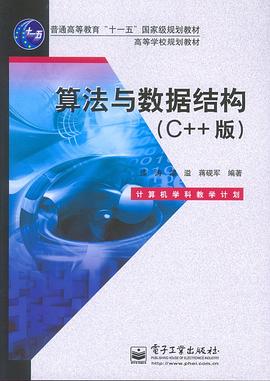
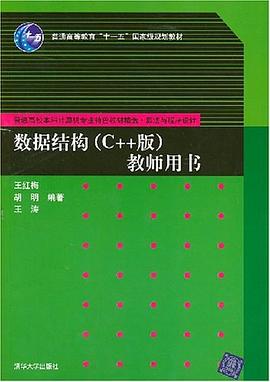
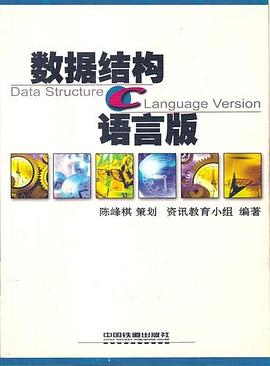
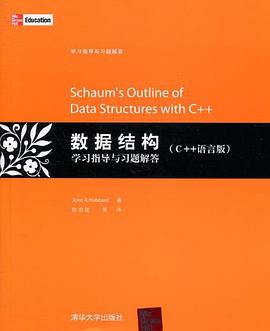
本书用C++语言描述和学习数据结构。
全书分为12章,基本覆盖了数据结构的各方面的知识,包括查找、排序、链表、堆栈、队列、递归、树以及图等。书中提供了相应的算法和程序实现,还有许多针对性很强的练习题。附录部分给出了常用的C++语言的知识,对读者进一步实现和应用本书知识提供帮助。全书的最后是部分习题的解答和术语表。
本书适合作为各高等院校计算机专业师生学习数据结构的教材,也可作为专业程序员学习数据结构的参考书籍。
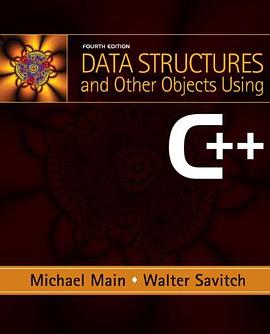
A detailed and comprehensive guide in C++ style presents data structures as practical tools for organizing, managing, and accessing information efficiently. This book explores fundamental constructs from scratch, emphasizing implementation clarity, algorithmic efficiency, and real-world applicability. Starting with arrays, the text delves into static linear collections that store homogeneous elements in contiguous memory—offering direct access via index but limited flexibility. Pointers are introduced early not as magic tools but as essential mechanisms for dynamic control over memory allocation and structure modification. Linked structures follow naturally: singly and doubly linked lists provide dynamic size capabilities, enabling insertions and deletions at arbitrary positions without costly shifts, though at the cost of sequential access. The book develops these with iterators and node classes that encapsulate both data and links, revealing how abstraction supports maintainability and reuse. Structs and simple classes form the foundation of object-oriented data modeling. Rather than abstracting away implementation, readers learn to craft custom types that bundle values with meaningful semantics—critical for domain-specific clarity. Operator overloading is introduced not as a syntactic trick but as a means to make code expressive and intuitive, bridging high-level intent with low-level execution. Trees emerge as hierarchical models central to sorting, searching, and divide-and-conquer strategies. Binary search trees enforce ordered relationships, allowing logarithmic time complexity for insertion and lookup under balanced conditions. Balanced variants like AVL or Red-Black trees automatically maintain structure, ensuring performance guarantees. The text presents tree operations—traversals, splits, merges—with emphasis on invariants that sustain correctness across modifications. Hashing is explored as a cornerstone of fast data retrieval. Through open addressing and chaining, readers implement collision resolution techniques while analyzing load factors and rehashing costs. Performance trade-offs between memory usage and access speed are discussed in depth, illustrating how hash tables underpin dictionaries, caches, and index structures across software systems. Advanced topics include graphs—modeled via adjacency lists or matrices—and their traversal algorithms: depth-first search reveals connectivity and pathfinding potential, while breadth-first search excels in shortest-path calculations on unweighted networks. Heaps are presented as efficient priority queues, supporting dynamic order maintenance with logarithmic insertions and extractions—vital for scheduling and simulation systems. Memory management is treated rigorously: manual control via raw pointers is balanced with smart pointers and RAII principles to prevent leaks, aligning with modern C++ best practices. Templates enable generic data structures that adapt across types without sacrificing performance or safety. Extemplates and move semantics further refine efficiency by minimizing unnecessary copies during construction and destruction. Each chapter builds on prior concepts through carefully designed exercises embedded directly in code, reinforcing theory with hands-on implementation. Algorithms for sorting—quicksort’s partition logic, merge sort’s recursive divide-and-conquer, and heapsort’s priority-based extraction—are presented not as isolated routines but as interwoven components of a broader computational strategy. The narrative stresses correctness through invariants: loop conditions, pointer stability, and resource ownership are scrutinized to prevent subtle bugs that undermine reliability. Performance analysis includes Big-O notation applied in context, helping readers predict scalability across data volumes. Throughout, examples use familiar data—integers, strings, pointers—to ground abstract ideas, while progressive complexity introduces concurrency basics: mutexes for thread-safe access, atomic operations where needed—preparing learners for real-world parallel systems. By focusing on implementation detail and practical utility rather than theory alone, this book serves as both a reference and a companion for engineers seeking to master data structures in C++. It bridges academic rigor with engineering pragmatism, ensuring that readers emerge not just with knowledge, but with the craftsmanship to build robust, efficient software systems from structured data foundations.