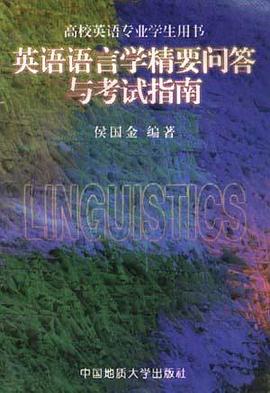

具体描述
作者简介
目录信息
I Key Points of Linguistics: Questions and Answers
1.1 What is language?
1.2 What are design features of language?
1.3 What is arbitrariness?
1.4 What is duality?
1.5 What is productivity?
1.6 What is displacement?
1.7 What is cultural transmission?
1.8 What is interchangeability?
1.9 Why do linguists say language is human specific?
1.10 What functions does language have?
1.11 What is the phatic function?
1.12 What is the directive function?
1.13 What is the informative function?
1.14 What is the interrogative function?
l.15 What is the expressive function?
l.16 What is the evocative function?
l.17 What is the performative function?
l.18 What is linguistics?
l.19 What makes linguistics a science?
l.20 What are the major branches of Hnguistics?
l.21 What are synchronic and diachronic studies?
l.22 What is speech and what is writing?
l.23 What are the differences between the descrip-
tive and the prescriptive approaches?
l.24 What is the difference between langue and
parole?
l.25 Whal is the difference between competence and
performance?
l.26 What is linguistic potential? What is actual lin-
guistic behaviour?
l.27 In what way do langue ,competence and linguis-
tic potential agree? In what way do they differ?
And their counterparts?
l.28 What is phonetics?
l.29 How are the vocal organs formed?
l.30 What is place of articulation?
l.31 What is the manner of articulation?
l.32 How do phoneticians classify vowels?
l.33 What is IPA ? When did it come into being?
l.34 What is narrow transcription and what is broad
transcription?
l.35 What is phonology? What is the difference
between phonetics and phooology?
l.36 What is a phone? What is a phoneme? What is
an allophone?
l.37 What are minimal pairs?
l.38 What is free variation?
l.39 What is complementary distribution? 什么是互补公布?
l.40 What is the assimilation rule? What is the deletion
rule?
l.41 What is suprasegmental phonology? What are
suprasegmental features?
l.42 What is morphotogy?
l.43 What is inflection/inflexion?
l.44 What is a morpheme? What is an allomorph?
l.45 What is a free morpheme? What is a bound mor-
p-heme?
l.46 What is a root? What is a stem? What is an
affix?
l.47 What are open classes? What are closed classes?
l.48 What is lexicon? What is word? What is lexeme?
What is vocabulary?
l.49 What is collocation?
l.50 What is syntax?
l.51 What is a sentence?
l.52 What are syntactic relations?
l.53 What is lC Analysis? What are immediate con-
stituents(and ultimate constituents)? 什么是
l.54 What are endocentric and exocentric construc-
tions?
l.55 What is a subject? A predicate? An object? 什么
l.56 What is category?
l.57 What is number? What is gender? What is case?
l.58 What is concord? What is government?
l.59 What is a phrase? What is a clause?
l.60 What is conjoining? What is embedding? What is
recursiveness?
l.61 What is hypotactic relation? What is paratactic
relation?
l.62 What is semantics?
l.63 What is meaning?
l.64 What is the difference between meaning,concept,
connotation, sense, implication, denotation,
notation,reference,implicature and signification?
l.65 What is the Semantic/Semiotic Triangle?
l.66 What is contextualism?
l.67 How many kinds of meaning did linguists find
l.68 What is synonymy?
l.69 What is antonymy? How many kinds of antonyms
are there?
l.70 What is hyponymy? What is a hyponym? What
is a superordinate?
l.71 What is polysemy? What is homonymy?
l.72 What is entailment?
l.73 Whal is presupposition?
l.74 What is componential analysis?
l.75 What is predication analysis? What-is a oneplace
predicate? What is a two-place predicate? What
is a no-place predicate? What are down-graded
predications?
l.76 What is a logical operator?
l.77 Why is writing important? Why is speech
considered prior to writing?
l.78. What is a pictogram? What is an ideogram?
l.79 What is word writing? What is sound writing?
What is syllabic writing?
l.80 What is an alphabet? What is a syllabary?
l.81 What is a grapheme? What is orthography?什么
l.82 What is refererice?
l.83 What is affixation, conversion and compounding?
l.84 What is blending, abbreviation and back formation?
l.85 What is analogical creation? What is borrowing?
l.86.What is assimilation,dissimilation and metathesis?
l.87 What is sociolinguistics?
l.88 What is a dialect? A regional dialect? A temporal
dialect? A sbciolect? An idiolect? A standarddialect?
l.89 What is register?
l.90 What is the field of discourse, the mode of dis-
course and the tenor of discourse?
l.91 What is a variety? What is a speech community?
l.92 What is a discourse?
l.93 What is vernacular? Pidgin? Creole?
l.94 What is bilingualism and diglossia?
l.95 What is Grimm's Law?
l.96 What is comparative-historical linguistics?
l.97 What is a language family? What is a family tree?
l.98 What is linguistic typology?
l.99 What is an isolating language? What is an
agglutinative language? What is a fusional
language?
l.100 What is correspondence?
l.101 What is a starred letter?
l.102 What is internal reconstruction?
l.103 What is the wave theory?
l.104 What is functional classification?
l.105 What is the difference between standard lan-
guage,national language and official language?
l.106 What is internal and external authority?
l.107 What is a prestige language?
l.108 What is language planning? What is institu-
tional linguistics?
l.109 What is language maintenance?
l.110 What is roleidomainiand reputation?
l.111 What is code-switching?
l.112 What is the Sapir-Whorf Hypothesis? (What is
linguistic determinism and linguistic relativity?)
l.113 What are cultural and linguistic universals and
peculiarities?
l.114 What is the use of grammar and dictionary?
l.115 What is pragmatics? Why pragmatics since there
is semantics?
l.116 What is the speech act theory? What is a con-
stative and performative? What is a locution,
s" illocution and a perlpcution?
l.117 What is an indirect speech act?
l.118 What is a linguistic context and a situational
context?
l.119 What is the difference between assertive,direc-
tive commissive, expressive and declaration?
l.120 What is a speech event?
l.121 What are adjacency pairs? What are preferred
second parts?
l.122 What is the co-operative prin ipleVCP?
l.123 What is the conversational implicature?
l.124 What is communicative competence?
l.125 What is language acquisition? How does a child
acquire his mother tongue?
l.126. How does a child acquire the phonological and
grammatical systems?
l.127 What is over-extension? What is over-generali-
TEST FlVE
TEST SlX
TEST SEVEN
TEST ElGHT
TEST NlNE
KEY to TESTS
附录1 现代语言学自学考试大纲
附录2 语言学主要术语汉英对照表
附录3 语言学主要术语英汉对照表
主要参考文献
· · · · · · (收起)
读后感
用户评价
这本书的排版真是让人眼前一亮,色彩搭配得恰到好处,既不会过于花哨,又充满了学习的活力。拿到手的时候,我就被它厚实的质感和精美的封面吸引了,这绝对是一本值得珍藏的学习资料。在内容上,我发现它在梳理复杂的语言学概念时,用了很多清晰的图表和结构化的解释,这对于我这种初学者来说简直是救命稻草。那些晦涩难懂的理论,经过作者的妙笔生花,变得清晰易懂,逻辑链条也异常顺畅。特别是对于那些需要快速掌握核心知识点的读者,这本书的“精要”二字名副其实,它没有冗余的叙述,每一页都充满了干货。我特别喜欢它在章节末尾设置的“自测小结”,让我可以随时检验自己的学习效果,及时查漏补缺,这种循序渐进的学习方式极大地提升了我的学习效率和自信心。总之,这本书在视觉呈现和内容组织上都达到了一个非常高的水准,让我对即将到来的考试充满了期待。
阅读这本书的体验,对我来说更像是一场结构严谨的学术对话,作者的文字功底极其深厚,行文如流水,但字里行间又蕴含着深邃的洞察力。它不像许多教科书那样死板说教,而是通过一系列巧妙的“问答”设计,引导读者主动思考,主动去探究语言现象背后的深层原理。我发现自己常常会在看完一个问答后,忍不住停下来,结合自己的语言经验去印证书中的论点,这种互动性是我在其他学习材料中很少遇到的。更值得称赞的是,这本书对不同流派观点的平衡处理,没有偏袒任何一方,而是客观地呈现了各种理论的优势与局限,这为我们构建一个全面、辩证的语言学认知体系打下了坚实的基础。对于想要深入理解语言学核心脉络的读者,这本书无疑提供了一个非常高级且优雅的视角。它不是简单地告诉你“是什么”,而是教你“为什么是这样”,这种教学理念的体现,让这本书的价值远超出了普通的考试用书范畴。
这本书给我的整体感受是非常“实用导向”的,特别是对于那些将语言学作为专业工具来使用的学习者,它的价值体现得淋漓尽致。与其说这是一本“指南”,不如说它是一个经过精心打磨的“工具箱”。作者似乎非常清楚不同学习阶段、不同考试侧重点的需求,所以书中的内容组织极具策略性。我注意到,凡是容易混淆的概念,都会被放在一起进行对比辨析,这种“针锋相对”的讲解方式,瞬间打消了我长期以来的困惑。此外,书中对于如何运用语言学知识去分析真实语料的示范,做得尤为精彩。它不是空泛地谈论理论,而是将抽象的规则落实到具体的语言现象中去检验,这种“学以致用”的示范,极大地增强了学习的代入感和成就感。对于希望将理论知识转化为实际分析能力的读者,这本书提供了一条清晰且高效的路径。
这本书的装帧质量和纸张选择给我留下了极佳的印象,它耐用且易于翻阅,即便是高强度的学习和反复查阅,也不会有损坏的担忧。更重要的是,字体和行间距的设计体现了对阅读者体验的深切关怀,长时间阅读下来,眼睛的疲劳感明显减轻了许多。在内容的组织上,我尤其欣赏作者在构建知识体系时所展现出的宏观视野。全书的逻辑结构如同一个精心构建的知识金字塔,从最基础的语音学、音位学层层递进,直到高阶的语义学和语用学,每一层级之间的过渡都衔接得异常自然,几乎没有生硬的转折。这种结构上的严谨性,使得学习者在构建知识框架时,不会感到碎片化,而是能清晰地看到整个语言学领域的全貌。这种对结构美学的追求,使得这本书不仅仅是一本学习资料,更是一件具有高度可读性的知识载体,让人爱不释手。
我必须说,这本书在处理知识点的广度和深度之间的平衡上做得非常出色。它既保证了对核心概念的覆盖率,确保你在面对任何标准的考试或评估时都能游刃有余,又没有牺牲掉对前沿研究的关注。比如,在涉及到某些新兴的认知语言学或社会语言学分支时,作者并没有草草带过,而是提供了相当深入的解析和案例分析,这让我感觉自己跟随作者的脚步,踏入了一个充满活力的研究前沿。尤其是书中对一些经典语言学实验的复述和解析,简直是神来之笔,它不仅仅是罗列事实,更深入地剖析了实验设计中的精妙之处以及结论对后续研究的影响。这种对学术脉络的清晰梳理,极大地帮助我理解了语言学学科的发展轨迹。对于那些渴望从“知道知识”跃升到“理解学科”的学习者来说,这本书提供的知识深度是令人印象深刻的,它培养的不仅仅是应试能力,更是学术思维。